Covering China’s National People’s Congress and its Standing Committee
Changhao Wei
Changhao Wei is the founder, manager, and editor of NPC Observer. He is a Fellow at the Paul Tsai China Center of Yale Law School, where he focuses on China’s legislative process and constitutional enforcement mechanisms. He holds a Juris Doctor degree from Harvard Law School, and a bachelor’s degree in Molecular, Cell, and Developmental Biology from the University of California, Los Angeles.
The NPC Standing Committee is seeking public comment on the following bills through November 26:
Part on Pollution Prevention and Control and Part on Legal Liability and Supplementary Provisions of the draft Ecological and Environmental Code [生态环境法典];
China’s national legislature, the Standing Committee of the National People’s Congress (NPCSC), is soliciting public comment on the following four bills through November 26, 2025.
English translations will be provided if available. All explanatory documents are in Chinese and compiled in a single PDF; the links above will take you to the corresponding pages in the PDF only if you use a desktop browser—this does not work on a phone or a tablet.
To submit comment online, please refer to this guide. Comments can also be mailed to the NPCSC Legislative Affairs Commission [全国人大常委会法制工作委员会] at the following address:
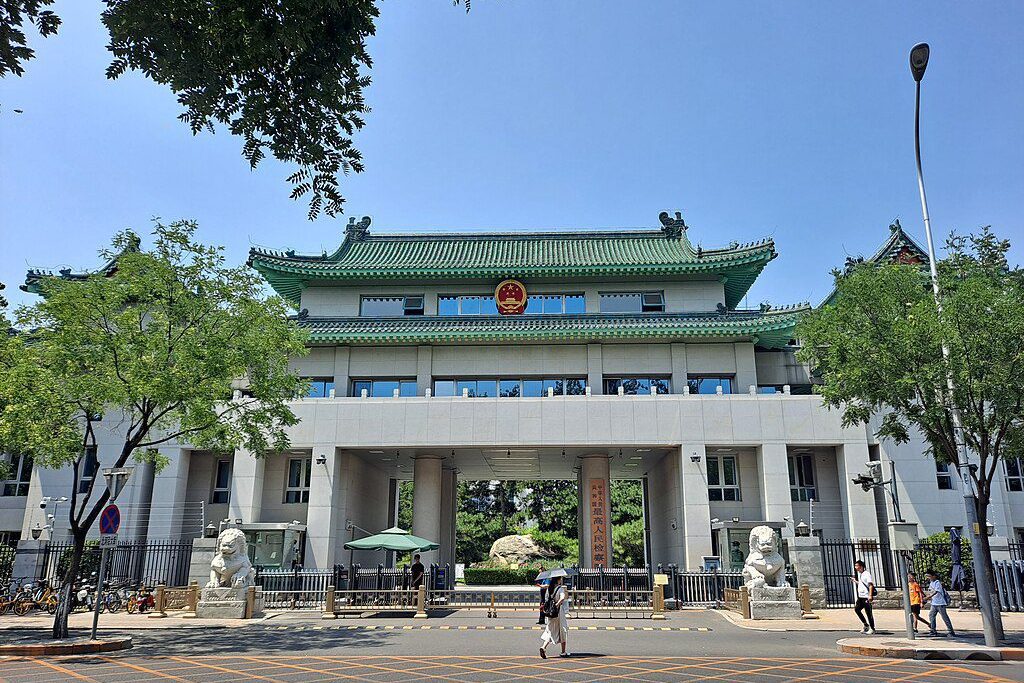
Supreme People’s Procuratorate. Photo by EditQ (Wikimedia Commons). CC BY-SA 4.0.
China’s top legislature, the 14th NPC Standing Committee (NPCSC), will convene for its eighteenth session from October 24 to 28, immediately after the Communist Party’s upcoming Fourth Plenum concludes on October 23, the Council of Chairpersons decided on Wednesday, October 15. According to the Council’s proposed agenda, the session will consider 9 legislative bills and hear 7 oversight reports, among other business. As usual, we preview the session’s legislative agenda in detail below.
The Communist Party’s 20th Central Committee will convene for its Fourth Plenum from October 20 to 23. The Plenum is expected to approve the Central Committee’s Recommendations for Formulating the 15th Five-Year Plan for National Economic and Social Development [关于制定国民经济和社会发展第十五个五年规划的建议].
The 14th NPCSC is expected to convene for its eighteenth session in late October. The Council of Chairpersons is expected to meet in mid-October to decide on the agenda and dates of the session.
Lastly, the session may review the draft amendment to the Cybersecurity Law, one or more parts of the draft Ecological and Environmental Code, as well as one or more additional bills scheduled for initial review in 2025.
Homepage of the Database on September 21, 2025 showing the popup note explaining the upgrades.
After a decade of development, the National People’s Congress (NPC), China’s national legislature, launched the National Database of Laws and Regulations (Database) [国家法律法规数据库] on February 24, 2021. Initially approved for development in 2011, the Database was deployed for testing in November 2018. By January 202, all data had been uploaded, and the following month it was opened for trial use by select institutions. While recognizing its scale, ambition, and laudable goal, we nonetheless thought the Database’s initial version—which we will call “Phase I”—missed the mark. Due to glaring gaps in coverage and a broken search function, it was “good for reading the documents you are able to locate, but not much more,” we wrote.
Four and a half years later, the NPC quietly rolled out major upgrades to the Database on August 20, 2025. While this new version—or “Phase II”—has the same coverage (with a caveat, as we will note below), there have been significant improvements on all other fronts: it has a more modern look, upgraded core functionalities, and useful new features. In short, we believe Phase II will prove to be much more valuable for the average citizen, if not for legal professionals as well.
In this guide and review, we introduce the Database’s current collection, redesigned homepage, browsing and search experience, and individual document pages. Its WeChat Mini App has received similar upgrades, but we decided not to review it this time.
China’s national legislature, the Standing Committee of the National People’s Congress (NPCSC), is soliciting public comment on the following twelve bills through October 11, 2025.
English translations will be provided if available. All explanatory documents are in Chinese and compiled in a single PDF; the links above will take you to the corresponding pages in the PDF only if you use a desktop browser—this does not work on a phone or a tablet.
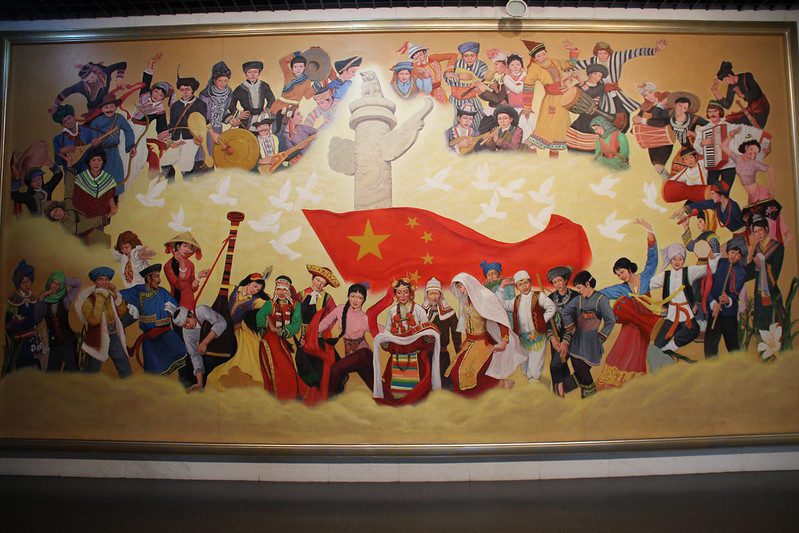
Mural of China’s ethnic minorities on display at the National Museum of Chinese Writing in Anyang, Henan Province. Photo by Gary Todd. CC 0 1.0.
China’s national legislature, the 14th NPC Standing Committee (NPCSC) is holding its seventeenth session from today to Friday, September 12. As we have previewed, it is considering a whopping 16 draft laws, in addition to other agenda items. Today’s official readout of the session’s opening meeting reveals that the NPCSC is reviewing two other bills as well: a draft Law on Promoting Ethnic Unity and Progress [民族团结进步促进法] and a draft revision to the Foreign Trade Law [对外贸易法]. We will take a quick look at these bills below, based on latest state-media reporting. The caveat is that such reports are essentially condensed versions of the bill’s official explanation, which in turn presents a selective summary of the draft itself. Those interested should consult the original texts (of the drafts and their accompanying explanations) when they are released on Friday. Below, we will also provide an update on the other bills under review.
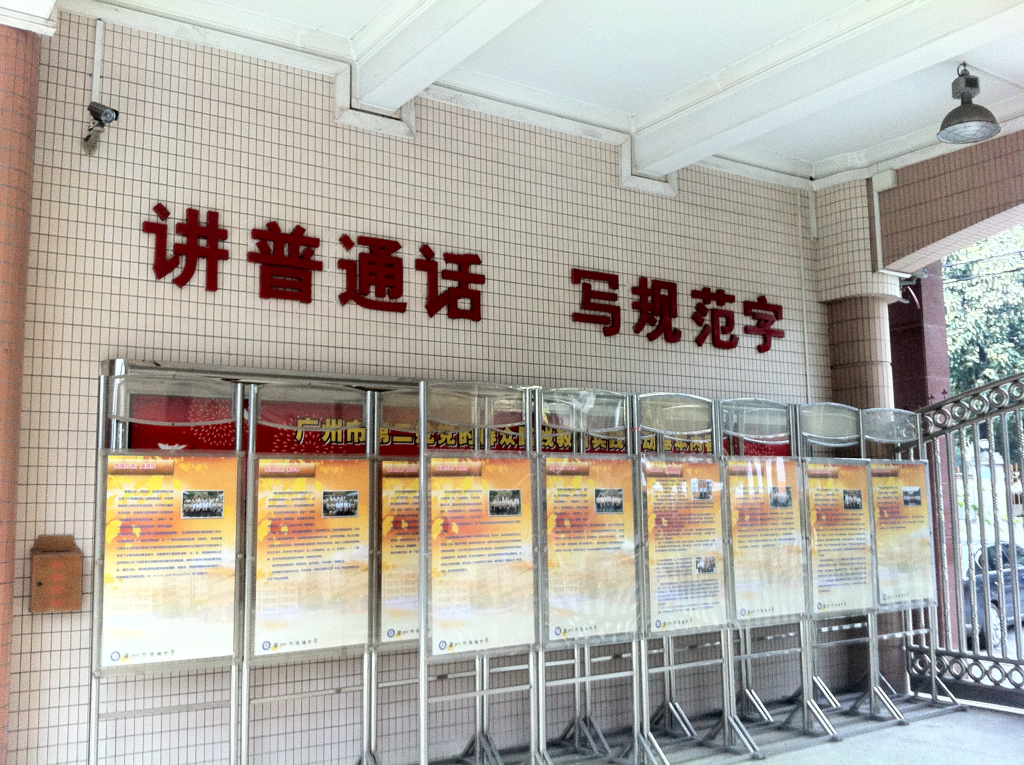
A slogan reading “Speak Putonghua, Write Standard Characters” in a Guangzhou secondary school. Photo by Gzdavidwong (Wikimedia Commons). CC BY-SA 3.0.
China’s top legislature, the 14th NPC Standing Committee (NPCSC), will convene for its seventeenth session from September 8 to 12, the Council of Chairpersons decided on Tuesday, August 26. According to the Council’s proposed agenda, the session will consider 16 legislative bills—the most so far during this five-year term—and hear 8 oversight reports, among other business. As usual, we preview the session’s legislative agenda in detail below.
This post is the second and final part of our coverage of China’s revised Public Security Administration Punishments Law (PSAPL) [治安管理处罚法], approved by the Standing Committee of the National People’s Congress (NPCSC) on June 27 and set to go into effect on New Year’s Day. As introduced in Part 1 in more detail, the PSAPL authorizes the police to punish what are deemed minor offenses against the public order through administrative processes outside the criminal justice system. Part 1 focuses on several broader issues that arose during the revision process: the use of administrative detention, the availability of detention hearings, and the vagueness of certain offenses. This part will more comprehensively survey the changes in the revision, though it is still not intended to be exhaustive.
The PSAPL can be roughly divided into three parts: general rules on liability and punishment; offenses and penalties; and procedures for investigating and penalizing public security violations. This post will proceed in the same order. We will draw on Jeremy Daum’s overview of the revision’s first draft as well as a recent explainer by the NPCSC Legislative Affairs Commission (LAC).1 For additional information on the revised PSAPL, please see this English translation by China Law Translate or this Chinese-language comparison chart we have prepared. Inline page citations are to the LAC article, while inline statutory references are to the revised PSAPL unless context indicates otherwise.