
NPCSC Session Watch: Environmental Code, Private Sector Promotion, Arbitration, Enforcement of Prison Sentences & National Development Planning

UPDATE (Apr. 30, 2025): On April 30, the NPCSC approved the Private Economy Promotion Law (effective May 20, 2025); revised the Law on the Prevention and Control of Infectious Diseases (effective Sept. 1, 2025); and adopted a decision authorizing the State Council to temporarily modify a provision of the Seed Law in the Xinjiang Pilot Free Trade Zone (effective May 1, 2025).

Tourists riding bamboo rafts on the Li River in Yangshuo, Guangxi. Photo by Changhao Wei. All rights reserved.

China’s top legislature, the 14th NPC Standing Committee (NPCSC), will convene for its fifteenth session from April 27 to 30, the Council of Chairpersons decided on Friday, April 18. According to the Council’s proposed agenda, the session will consider eight legislative bills, which we preview below. The Council also approved the NPCSC’s 2025 work priorities as well as 2025 plans for legislative, oversight, delegates-related, and foreign-affairs work. We expect all but the foreign-affairs work plan to be released after the upcoming session, likely in early May.

Continue reading “NPCSC Session Watch: Environmental Code, Private Sector Promotion, Arbitration, Enforcement of Prison Sentences & National Development Planning”
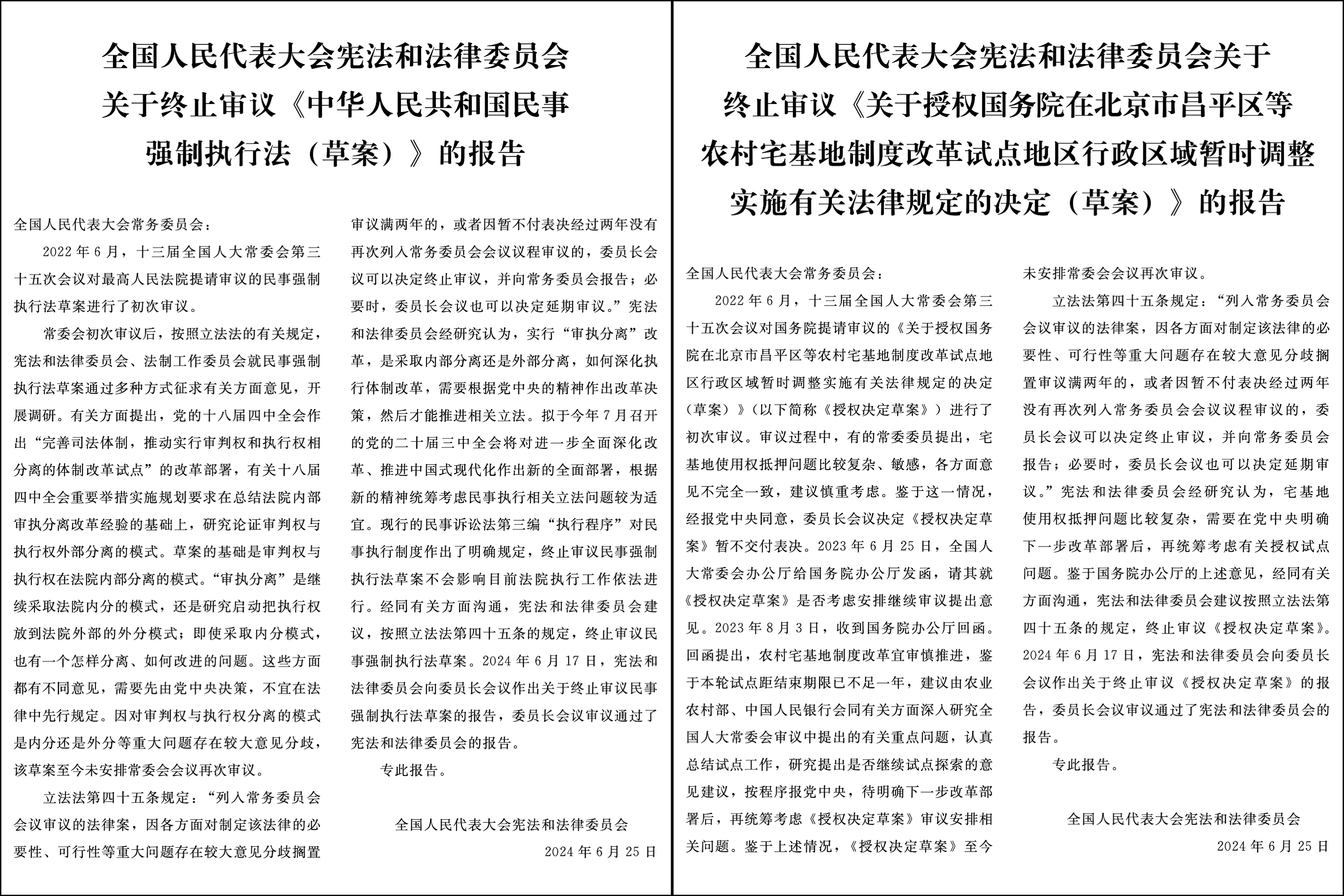

In Rare Move, Chinese Legislature Shelves Two Bills

The two reports of the NPC Constitution and Law Committee recommending shelving the two bills discussed in this post, as published in the NPCSC Gazette.

It is rare for a bill to “die” in the Chinese legislature. It is rarer for two bills introduced at the same time to later meet that fate together. Recently, the NPC Standing Committee (NPCSC) disclosed in its official publication, the NPCSC Gazette, that it decided to “terminate deliberations” [终止审议] on two bills that it reviewed in June 2022: a draft Compulsory Civil Enforcement Law [民事强制执行法] and a draft decision authorizing to the State Council to pilot certain reforms of rural residential land. In other words, the two bills in their current form have been shelved indefinitely. This post recounts the history of the deliberation-termination procedure and discusses the two bills at issue.

Continue reading “In Rare Move, Chinese Legislature Shelves Two Bills”

NPCSC Session Watch: Public Security Offenses, Border Health, Financial Stability, Mineral Resources & Report on Promoting Development of Private Economy

UPDATE (June 29, 2024): On June 28, the NPC Standing Committee (NPCSC) revised the Emergency Response Law (effective Nov. 1, 2024) and the Border Health and Quarantine Law (effective Jan. 1, 2025); passed the Rural Collective Economic Organizations Law (effective May 1, 2025) and an amendment to the Accounting Law (effective July 1, 2024); and approved a decision authorizing the State Council to suspend certain provisions of the Food Safety Law in the Hainan Free Trade Port (effective Oct. 1, 2024).

Close-up on the belt of a Chinese police officer in Beijing displaying the coat of arms of China.
Photo by Gwengoat. iStock.com standard license.

China’s top legislature, the 14th NPC Standing Committee (NPCSC), will convene for its tenth session from June 25 to 28, the Council of Chairpersons decided on Monday, June 17. The Council proposed an agenda with ten legislative bills, all of which are pending bills that return for further review. The agenda also includes a report by the State Council that might be of wider interest. We briefly discuss these items below.

Continue reading “NPCSC Session Watch: Public Security Offenses, Border Health, Financial Stability, Mineral Resources & Report on Promoting Development of Private Economy”

NPCSC Session Watch: National Defense Education, (Atomic) Energy, Anti–Money Laundering & Official Statistics

UPDATE (Apr. 26, 2024): On April 26, 2024, the NPCSC approved the Academic Degrees Law (effective Jan. 1, 2025) and the Tariff Law (effective Dec. 1, 2024). It also adopted the amendments to the Agricultural Technology Popularization Law, Minors Protection Law, and Biosecurity Law. For reasons unknown, the State Council’s request for an authorization to pilot reforms of the Food Safety Law in the Hainan Free Trade Port was not put to a vote.

Wind farm in Shanxi. Photo by Hahaheditor12667 (cropped). CC BY-SA 4.0.

China’s top legislature, the 14th NPC Standing Committee (NPCSC), will convene for its ninth session from April 23 to 26, the Council of Chairpersons decided on Tuesday, April 16. The Council proposed an agenda with ten legislative bills, which we preview below. It also approved the NPCSC’s 2024 work priorities as well as 2024 plans for legislative, oversight, and delegates-related work, which we expect will be released after the upcoming session.

Continue reading “NPCSC Session Watch: National Defense Education, (Atomic) Energy, Anti–Money Laundering & Official Statistics”

NPCSC Adopts New Laws on Family Education and Land Borders, Amends Audit Law & Authorizes New Regulatory and Military Reforms

The 13th NPC Standing Committee (NPCSC) concluded its 31st session on Saturday, October 23, with the approval of six bills. We already wrote about and translated the decision authorizing the State Council to carry out pilot projects on a property tax in selected regions. Below, we will briefly summarize the other five bills.

Continue reading “NPCSC Adopts New Laws on Family Education and Land Borders, Amends Audit Law & Authorizes New Regulatory and Military Reforms”

NPCSC Passes Legislation to Support Rural Revitalization Campaign, Curb Food Waste & Combat Identity Thefts in School Admissions

Photo by Pixabay from Pexels.

The 13th NPC Standing Committee (NPCSC) concluded its 28th session on Thursday, April 29. It approved the Rural Revitalization Promotion Law [乡村振兴促进法] and the Anti–Food Waste Law [反食品浪费法], revised the Maritime Traffic Safety Law [海上交通安全法] and a quasi-legislative decision on budget oversight, amended another ten laws, and authorized a set of regulatory pilot programs in China’s free trade zones. Below we take a closer look at some of these bills.

Continue reading “NPCSC Passes Legislation to Support Rural Revitalization Campaign, Curb Food Waste & Combat Identity Thefts in School Admissions”

NPCSC Session Watch: COVID-19 Responses, Copyright, Armed Police Reform & Silence on 2020 NPC (Updated)

UPDATE (Apr. 28, 2020): The NPCSC decided on April 29 that the NPC’s 2020 session will start on May 22. We do not know how long the session will be at this point. They ordinarily last around ten days, but several outlets reported that this year’s would be shortened to only a week. The official schedule is expected to be released the day before the session starts, on May 21.

The NPCSC also approved the revision to the Law on the Prevention and Control of Environmental Pollution by Solid Waste, effective September 1, 2020, and the decision to authorize the suspension of certain statutory provisions in the Hainan Free Trade Zone, to expire on December 31, 2024.

UPDATE (Apr. 26, 2020): According to the official readout of the first plenary meeting of the NPCSC’s session this week, the Council of Chairpersons has indeed submitted a draft decision on the new dates for NPC’s 2020 session. We expect the NPCSC to adopt the draft decision and announce the new dates this Wednesday. Bloomberg reported last week that the NPC might meet from May 23 to 30.

The Council of Chairpersons decided on Friday, April 17 to convene the 17th session of the 13th NPC Standing Committee (NPCSC) from April 26 to 29. Contrary to what we have expected, this upcoming session seems to be a regular bi-monthly session, where the NPCSC will review seven legislative bills. Below, we will briefly review the session’s agenda before turning to the question on everyone’s mind (well, ours at least): when will the NPC meet this year?

Continue reading “NPCSC Session Watch: COVID-19 Responses, Copyright, Armed Police Reform & Silence on 2020 NPC (Updated)”

NPCSC to End 2017 with Blockbuster December Session (UPDATED)

UPDATE (Dec. 23, 2017): The NPCSC has released the finalized agenda and daily schedule of the ongoing session. This agenda, unlike the agendas of past December sessions since the early 1990s, does not include a draft decision to convene the NPC session of the following year (which would be the 1st Session of the 13th NPC). This is highly unusual. But the significance (if any) of the absence of that decision is not clear at this point. Elsewhere, in a report on the draft Supervision Law (as reported by state media), the NPC Law Committee seemed to be deliberately avoiding referring explicitly to the 1st Session of the 13th NPC: It recommended that the NPCSC submit the draft Supervision Law to “a session of the NPC” [全国人民代表大会会议] for deliberation, short of identifying the specific NPC session (unlike what it had done before). Through this update we merely wish to point out these irregularities. It is still premature to speculate whether the 2018 NPC session will convene as usual on March 5 because the Council of Chairmen could always add a convening decision to the agenda (though it doesn’t explain why it hasn’t done so already). In any event, we will find out on December 27 when the ongoing NPCSC session closes.

As predicted, the Council of Chairmen met on Thursday (December 14) to set the dates and propose an agenda for the second last session of the 12th NPC Standing Committee (NPCSC). According Xinhua’s report of the Council’s meeting, an astonishing 12 legislative bills (among others) were submitted to the upcoming six-day NPCSC session (December 22–27) for deliberation, the most ever since the start of the 12th NPC. Most of these bills are worth paying close attention to because of their subject matters, as we will discuss below.

Continue reading “NPCSC to End 2017 with Blockbuster December Session (UPDATED)”

Reviewing the Supreme People’s Court Report on the People’s Assessor System Reform: Pt. 1

In April 2015, the NPC Standing Committee (NPCSC) passed a decision authorizing the Supreme People’s Court (SPC) to conduct pilot programs to reform the people’s assessor system in 50 courts—at both basic and intermediate level—in ten listed provinces. The pilots formally began on April 28, 2015 to run for a period of two years, in accordance with the NPCSC’s authorization. In June 2016, months before we started this Blog, the SPC submitted to the NPCSC a midterm report on the status of the pilot programs, as required by the authorization. As the authorization is set to expire later this month, we think it fitting at this moment to review what the SPC has written about the reform efforts in its 2016 report.

Continue reading “Reviewing the Supreme People’s Court Report on the People’s Assessor System Reform: Pt. 1”