
Commentary & Translation: China’s Plan to Raise Statutory Retirement Ages

Editor’s Note: In April 2025, we published in the Made in China Journal a longer commentary on the Decision that digs deeper into the history of retirement-age legislation and demographic changes in China, the national legislature’s post–Cultural Revolution lawmaking reforms, as well as its procedural failings in adopting the Decision.

On Friday, September 13, China’s national legislature, the Standing Committee of the National People’s Congress (NPCSC) approved the Decision on Gradually Raising the Statutory Retirement Ages (Decision) [关于实施渐进式延迟法定退休年龄的决定]. Upon taking effect next year, the Decision will finally implement a reform that has been on the Chinese government’s agenda since at least 2013.

The Decision has three visually distinct components. It begins with a short main text with five articles covering only the essentials of the reform. What follows is a set of measures, attributed to the State Council, that describe the specific steps to implement the reform. The Decision ends with four charts (technically, annexes to the State Council’s measures) that allow citizens to easily look up their new retirement ages and see how much longer they may need to contribute to the pension fund to qualify for pension payments. As a legislative official made clear, all three are integral parts of the Decision and thus have statutory force.

News outlets worldwide have extensively covered the demographic challenges driving the reform, the initial public reaction to the plan, and its details. We won’t belabor the same points here. Nor will we delve into the Decision’s substance, a task we leave to subject matter experts.

Instead, we will provide a translation of the Decision (sans the charts) and discuss three issues related to the Decision: the NPCSC’s involvement in this major policy decision; the swift and secretive way in which the Decision was adopted; and the Decision’s unusual makeup—i.e., its inclusion of the State Council’s measures.

Continue reading “Commentary & Translation: China’s Plan to Raise Statutory Retirement Ages”
NPC 2024: Annotated Translation of the Revised State Council Organic Law

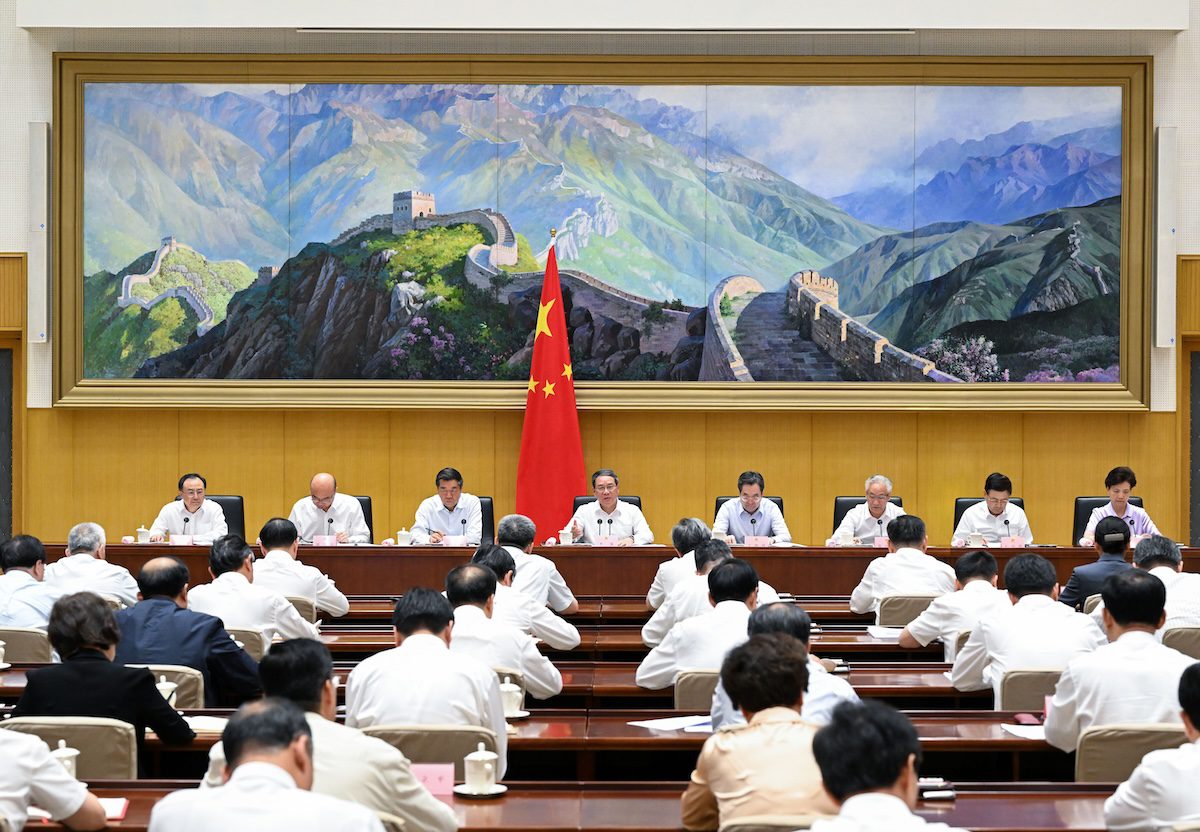
Li Qiang presides over the second plenary meeting of the State Council on August 16, 2023.

On March 11, 2024, China’s top legislature, the National People’s Congress, voted 2883 to 8, with 9 abstentions, to revise the State Council Organic Law [国务院组织法]—the first update of the statute since its enactment in December 1982. As part of a Communist Party-directed effort to “improve the organic laws of state institutions,” the revision seeks to modernize the governing statute of China’s central government. It memorializes some of the core principles and practices concerning State Council operation that have developed since 1982 and harmonizes the statute with later-enacted laws. For instance, the revision specifies the State Council’s constitutional status, guiding ideologies, and relationship with other state organs; clarifies the functions of different State Council meetings; and incorporates existing policy measures to develop a “law-based government” [法治政府]. The practical significance of these changes is thus minimal. But they nonetheless hold great symbolic value (e.g., by codifying the State Council’s duty to uphold the Party’s leadership) or can serve an important signaling purpose (e.g., by writing into law the principle of “adhering to transparency in government affairs”).

That does not change the fact, however, that the Law remains minimalist. With only 20 articles (increased from 11), it is not only the shortest state-organ organic law but also one of the shortest national laws overall. More detailed rules on the State Council’s operation are (still) found in lower-level authorities like the latest State Council Work Rules [国务院工作规则]. For this reason, instead of providing an even shorter summary, we are posting a full translation of the revised Law below, with comments on selected provisions. 🆕 marks newly added articles, whereas 🔄 marks those without substantive changes. The remaining articles were all amended to some extent, though we won’t comment on every one of them. For details, please refer to this comparison chart (in Chinese).

Continue reading “NPC 2024: Annotated Translation of the Revised State Council Organic Law”

Translation: Five-Year Legislative Plan of China’s National People’s Congress for 2023–2028

On Thursday, September 7, 2023, China’s national legislature, the Standing Committee of the National People’s Congress (NPCSC), released the five-year legislative plan for its current term ending in 2028. Since 1993, each NPCSC has adopted such a plan to outline and prioritize the legislative tasks during its five-year term. Those plans are important documents that require the approval of the Communist Party’s central leadership.

Continue reading “Translation: Five-Year Legislative Plan of China’s National People’s Congress for 2023–2028”

Translations: New Legislation on Chengdu-Chongqing Financial Court & Military Ranks for PLA Soldiers

The 13th NPC Standing Committee (NPCSC) concluded its 33rd session on Monday, February 28 adopted two short decisions that, respectively, established a Chengdu-Chongqing Financial Court and codified a system of ranks for the active-duty soldiers of the Chinese People’s Liberation Army (PLA). Below we translated the decisions and offered some brief explanations.

Continue reading “Translations: New Legislation on Chengdu-Chongqing Financial Court & Military Ranks for PLA Soldiers”

Translation: Readout of October 2021 Central Conference on Work Related to the People’s Congresses

Two months ago, on October 13–14, the Communist Party held the first-ever “Central Conference on Work Related to the People’s Congresses” [中央人大工作会议]. In the lead-up to the Conference and in the months since, the concept of “whole-process people’s democracy” [全过程人民民主] has permeated official discourse and was recently further expounded on in a government white paper titled China: Democracy That Works (the Chinese title, “中国的民主” (China’s Democracy), is blander). That concept requires further study and assessment, and the Conference could prove significant in additional ways, especially for the people’s congress system. We thus translated the readout of the Conference (via Xinhua) below, while we await, hopefully, the release of the full text of Xi Jinping’s speech at the Conference on which the readout is largely based.

Continue reading “Translation: Readout of October 2021 Central Conference on Work Related to the People’s Congresses”

NPC Standing Committee Authorizes Property Tax Pilots (with Translation of the Authorization)

On Saturday, October 23, China took an important, albeit small, step toward enacting a nationwide “real estate tax” [房地产税], commonly called “property tax” (we will use these terms interchangeably below). The NPC Standing Committee (NPCSC) adopted a decision authorizing the State Council to carry out property tax pilots in selected, as yet unspecified, regions, for at least five years. Reflecting the ongoing intense debates within the party-state, the decision lacks essential details about the proposed new tax and the pilots, and instead grants the State Council broad authority to design them.

Continue reading “NPC Standing Committee Authorizes Property Tax Pilots (with Translation of the Authorization)”

Communist Party Releases New Set of NPC-Related Reform Goals in First Five-Year Plan on Building Rule of Law in China

On Sunday, January 10, 2021, the Communist Party releases China’s first Plan on Building the Rule of Law in China [法治中国建设规划], for the years 2020 to 2025. According to an unnamed Party official interviewed by Xinhua, the Plan was approved by two top Party institutions: the Central Commission for Overall Law-Based Governance and the Politburo Standing Committee. The Plan is a comprehensive document addressing all aspects of China’s legal reform. Not only does it restate and refine reform objectives laid down since the 18th Party Congress in 2012, it also includes new reform goals. Below, we will focus on four subsections of the Plan that set forth new reform goals relating to the NPC. We will translate the relevant parts of those subsections and supplement with our comments.

Continue reading “Communist Party Releases New Set of NPC-Related Reform Goals in First Five-Year Plan on Building Rule of Law in China”

Translation: NPCSC’s New Public Health Legislative Plan in Response to COVID-19

Editor’s Note (Oct. 2, 2020): This page is not being updated. For the latest status of each project in this legislative plan, please see the Legislation page or the projects’ individual bill pages.

On Wednesday, April 29, the NPC Standing Committee (NPCSC) released a special legislative plan in response to the COVID-19 pandemic that is devoted to improving China’s public health legislation. According to an NPCSC spokesperson, the pandemic has exposed the “gaps” in and the “weaknesses” of the current legal scheme. Because to fix those problems many laws need to be enacted or updated, the authorities thought it appropriate to formulate a legislative plan to proceed in a coordinated manner. The spokesperson also said that the legislature would approach different laws in different ways: some would need complete overhauls, while some (like newer ones) would need only “targeted” changes. Finally, as expected, the NPCSC will focus on public health legislation in the near future, and other legislative projects would be deprioritized as a result.

Continue reading “Translation: NPCSC’s New Public Health Legislative Plan in Response to COVID-19”

Translation: 13th NPC Standing Committee Five-Year Legislative Plan

On Friday, the 13th NPC Standing Committee (NPCSC) held a Legislative Work Conference and released its five-year legislative plan, which we translated in full below. We will start first with a brief introduction to the NPCSC’s five-year legislative plans in general and an overview of the newest plan.

Continue reading “Translation: 13th NPC Standing Committee Five-Year Legislative Plan”

NPCSC Solicits Public Comments on Draft Amendment to Criminal Procedure Law (Trial in Absentia Procedures Translated) (UPDATED)

UPDATE (May 11, 2018): The link to an English translation of the draft amendment is added below.

The NPC Standing Committee (NPCSC) is soliciting public comments on a new draft amendment to the Criminal Procedure Law [刑事诉讼法] that it just considered at its session last month. The comments period ends on June 7, 2018. We expect the amendment to pass by late August at the latest.

The original Chinese (PDF) version is available here. An English translation is available on China Law Translate. Its accompanying explanation can be read here.

Continue reading “NPCSC Solicits Public Comments on Draft Amendment to Criminal Procedure Law (Trial in Absentia Procedures Translated) (UPDATED)”