The Content and Context of Chinese Military’s New Authority to Change “Wartime” Court-Martial Rules

On February 24, 2023, China’s national legislature, the Standing Committee of the National People’s Congress (NPCSC), adopted a decision authorizing the Central Military Commission (CMC), China’s highest military authority, to “adjust” the way in which the Chinese military applies the Criminal Procedure Law [刑事诉讼法] during “wartime” (the Decision). That is admittedly (three-month-)old “news.” We did not write about it then because the Decision’s timing was not self-evident and the scope of its authorization unclear. Its accompanying explanation, we had hoped, would shed light on those questions, but it was not immediately released.

Continue reading “The Content and Context of Chinese Military’s New Authority to Change “Wartime” Court-Martial Rules”

Term Review: How Long Did It Take the 13th NPC to Pass a Law?

The five-year term of the 13th National People’s Congress (NPC) recently ended. At the risk of overpromising, we plan to write a few end-of-term reviews on different aspects of the 13th NPC’s lawmaking over the next several months. In this first installment, we will try to answer the question “how long does it take the (last) NPC to pass a bill?”—as well as subsidiary questions like “when is [insert bill of your choice] up for its next reading?” and “how many reviews will the bill go through?”

Continue reading “Term Review: How Long Did It Take the 13th NPC to Pass a Law?”

NPCSC Seeks Public Comment on Draft Barrier-Free Environments Law

The NPC Standing Committee (NPCSC) is seeking public comments on the second deliberation draft of the Barrier-Free Environments Development Law [无障碍环境建设法] through May 25, 2023. The draft is available in PDF here and an explanatory document (in Chinese) here. An English translation will be provided if and when available.

To submit comments online, please refer to this guide. Comments can also be mailed to the NPCSC Legislative Affairs Commission [全国人大常委会法制工作委员会] at the following address:

北京市西城区前门西大街1号 邮编: 100805
No. 1 West Qianmen Avenue, Xicheng District, Beijing 100805

Please clearly write “无障碍环境建设法草案二次审议稿征求意见” on the envelope.

NPCSC Session Watch: Counterespionage, Accessible Environments & Tibetan Plateau Conservation

A man in suit holding a yellow folder marked with "top secret" in red.

The 14th NPC Standing Committee (NPCSC) will convene for its second session from April 24 to 26, the Council of Chairpersons decided on Friday. Before providing our customary rundown of the session’s legislative agenda, we’d like to first discuss our approach to covering the NPCSC’s sessions during its new five-year term—what will change and what won’t.

Continue reading “NPCSC Session Watch: Counterespionage, Accessible Environments & Tibetan Plateau Conservation”

NPC to Establish New Agency to Support Delegates

UPDATE (June 28, 2023): The NPCSC established the NPCSC Deputies Affairs Commission on June 28, 2023. It also appointed the Commission’s director and two deputy directors.

Former NPCSC Chairman Li Zhanshu participating in a discussion session with delegates invited to attend the NPCSC’s August 2022 session in a nonvoting capacity. Photo by Xinhua.

The number of agencies under the National People’s Congress (NPC) is about to grow by one. In the Party-state restructuring plan released on March 16, the Communist Party has decided to set up a new Delegates Affairs Commission1 [代表工作委员会] under the NPC Standing Committee (NPCSC) to take charge of “delegates work” [代表工作],2 an often overlooked part of the NPCSC’s duties. “Delegates work,” in sum, refers to a range of activities carried out by the NPCSC, NPC special committees, as well as their members and staff to facilitate (and, to a lesser extent, supervise) ordinary NPC delegates’ discharge of their duties. The last NPCSC (2018–23), led by Chairman Li Zhanshu, markedly elevated the importance of delegates work to the same level as lawmaking and oversight. The new Commission could thus be seen as an epilogue to the previous NPCSC’s reforms and an embodiment of its legacy.

Continue reading “NPC to Establish New Agency to Support Delegates”

A Guide to China’s 2023 State Council Restructuring

UPDATE #2 (Mar. 23, 2023): Chinese authorities released the full Party and State Institutional Reform Plan on March 16, and the new State Council announced its organizational structure on March 20. We have accordingly updated our bilingual State Council organizational chart and this guide. Click here to jump to the update.

UPDATE #1 (Mar. 10, 2023): The NPC approved the State Council Institutional Reform Plan on March 10 and has released its full text, which is identical to the version discussed in this post.

On Tuesday, March 7, China unveiled details of its 2023 State Council Institutional Reform Plan (Plan) [国务院机构改革方案]. The National People’s Congress (NPC) is set to approve the Plan on March 9, ahead of its votes to appoint a new slate of State Council officials on March 10–11. This would be the ninth round of State Council reorganization since the Reform Era began. Previous rounds took place in 1982, 1988, and every five years thereafter.

Continue reading “A Guide to China’s 2023 State Council Restructuring”

NPC 2023: Amendments to China’s “Statutory Constitution” of Lawmaking

Editor’s Note (Mar. 16, 2023): We have updated this post in accordance with the final text of the amendments adopted on March 13. The original version of this post is archived here.

For the ninth year in a row, China’s National People’s Congress (NPC) considered and adopted legislation at its annual session earlier this month. This year’s bill was amendments to the Legislation Law [立法法] (Bill), previously reviewed in October and December 2022. The Legislation Law is an important statute with semi-constitutional status. It serves three principal purposes: it demarcates the legislative authority of various state institutions; regulates (to varying extents) their legislative procedures; and prescribes a hierarchy of legal norms, along with the attendant mechanism to enforce that hierarchy, called “recording and review” [备案审查].

The Bill has made an array of amendments to provisions in all three areas. In this post, we will offer a relatively thorough discussion of the Bill, proceeding in the order of legislative authority, procedure, and hierarchy. In each section below, we will discuss more important amendments in the order they appear in the Bill, and briefly summarize minor ones at the end of the section. We will not mention amendments that simply repeat the provisions of other laws. All in-line citations are to the Legislation Law as amended by the Bill.

Continue reading “NPC 2023: Amendments to China’s “Statutory Constitution” of Lawmaking”

(Still) Mostly Han Men: Demographics of the 14th NPC

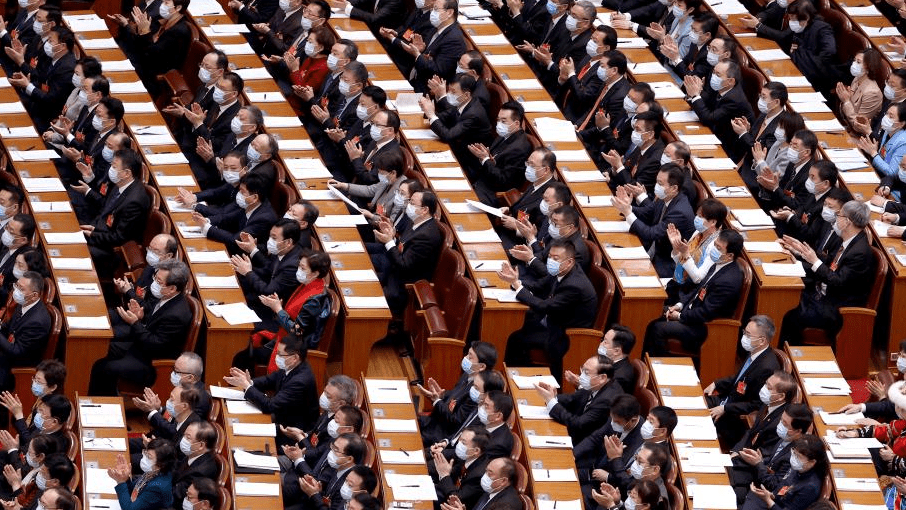
Delegates clapping at the 2022 NPC session. Photo by CGTN.

On Friday, February 24, the 13th NPC Standing Committee (NPCSC) concluded its final session, thus effectively bringing the 13th NPC’s five-year term to a close. As one of its last official acts, the outgoing NPCSC certified the elections of 2,977 delegates to the 14th NPC, which will first convene on March 5. In a rare move, the NPCSC Delegate Credentials Committee disqualified three delegates-elect (from Hebei, Guangdong, and Chongqing, respectively)[*] because they “lack the basic statutory requirements” for being a delegate, without further elaborating.

Continue reading “(Still) Mostly Han Men: Demographics of the 14th NPC”

2022 Legal Inquiry Response: Localities Lack Legislative Authority over Personal Bankruptcy—Except Shenzhen?

On January 28, 2023, the Legislative Affairs Commission (LAC) of the NPC Standing Committee (NPCSC) released one of the “legal inquiry responses” [法律询问答复] it had issued during the past year. As discussed in depth here, such responses clarify the applicable law in real-world scenarios at the request of central governmental bodies or provincial legislatures. They are not universally binding, but are considered highly persuasive—hence a form of “soft law”—because of the LAC’s pivotal role in lawmaking.

The sole response released on Saturday concerns the division of legislative powers between central and local authorities. In May 2022, an unnamed provincial legislature1 wrote to the LAC that the minors protection legislation it was reviewing would touch on (1) guardianship of minors, and that it was also mulling legislation on (2) intellectual property protections for porcelain and (3) personal bankruptcy. May it legislate on those matters, it asked, or are they within the national legislature’s exclusive purview?

Continue reading “2022 Legal Inquiry Response: Localities Lack Legislative Authority over Personal Bankruptcy—Except Shenzhen?”

Year in Review: The NPC and the Observer in 2022

As we bid farewell to 2022, we look back at the National People’s Congress’s and our work in the past year.

Continue reading “Year in Review: The NPC and the Observer in 2022”