Covering China’s National People’s Congress and its Standing Committee
Changhao Wei
Changhao Wei is the founder, manager, and editor of NPC Observer. He is a Fellow at the Paul Tsai China Center of Yale Law School, where he focuses on China’s legislative process and constitutional enforcement mechanisms. He holds a Juris Doctor degree from Harvard Law School, and a bachelor’s degree in Molecular, Cell, and Developmental Biology from the University of California, Los Angeles.
The 14th NPC Standing Committee (NPCSC) will convene for its 22nd session in late April. The Council of Chairpersons is expected to meet in mid-April to decide on the agenda and the dates of the session.
The Council is also expected to approve the NPCSC’s 2026 work priorities as well as plans for legislative, oversight, and delegates-related work. These documents will be released after the upcoming NPCSC session (likely in early May).
The session is expected to review the recently submitted draft revision to the Bid Invitation and Bidding Law [招标投标法] and draft revision to the Water Law [水法].
The session is also likely to review one or more of the following bills:
On March 12, 2026, shortly after China’s National People’s Congress (NPC) adopted the Ecological and Environmental Code (Code) [生态环境法典], the legislature separately announced that it had also upgraded “ecological and environmental law” [生态环境法] to an official “branch of [Chinese] law” [法律部门], joining the existing seven, including civil and commercial law and criminal law.
The 9th NPC (1998–2003) was the first to divide Chinese law into official branches. In fall 1997, the Communist Party announced at its 15th Congress the goal of establishing “a socialist system of laws with Chinese characteristics” [中国特色社会主义法律体系] by 2010. This task primarily fell to the national legislature, which decided that, to achieve that goal, it must (among other criteria) enact enough legislation to cover all branches of law, which in turn raised the question of how those branches should be defined.
As we previewed, on March 12, 2026, China’s National People’s Congress (NPC), approved a decision declaring that 35 instruments it adopted between 1982 and 2018 had lapsed, while confirming the continued validity of past actions taken under them.
The oldest among them, adopted together with China’s current Constitution on December 4, 1982, provided that certain provisions of the 1978 Constitution would continue to apply until the next NPC elected a new president, vice president, and NPC Standing Committee (NPCSC), which took place in June 1983. The newest instrument, adopted on March 17, 2018, prescribed voting rules for the 2018 state leadership transition at the first session of the 13th NPC.
UPDATE (Mar. 12, 2026): We have updated this post in accordance with the Code’s final text. The original version is archived here.
Editor’s Note: This post is a collaboration between NPC Observer and a group of Chinese environmental law scholars led by Feng Ge, currently a visiting scholar at the U.S.-Asia Law Institute of NYU School of Law. The other members are Jiaying Deng, Xinyu Jia, Jingxian Zhang, and Gaachi Liang. This post was written by Changhao Wei and draws on materials prepared by those scholars.
Zhangjiajie National Forest Park in Hunan Province. Photo by aphotostory (stock.adobe.com).
On March 12, 2026, China’s National People’s Congress (NPC) adopted the Ecological and Environmental Code (Code) [生态环境法典] to partially codify, with updates, China’s existing environmental laws and regulations. It is China’s second formal legal code, after the 2020 Civil Code [民法典]. The Communist Party views the latter’s enactment as a success. In 2021, Xi Jinping praised it as a “model” for codification and called for codifying other areas of law where “conditions are ripe.”
In fall 2023, the Code was chosen as the next codification project, likely due to its strong political and legal foundations. Environmental protection has been a top priority for the Party under Xi Jinping, whose “Thought on Ecological Civilization” was coined in 2018 as a component of his overarching political thought. China’s environmental law is also fairly well developed. Today, the country boasts over 30 environmental statutes, more than 100 State Council–issued administrative regulations, and many more ministerial rules and policy documents.
UPDATE (Mar. 12, 2026): We updated this post in accordance with the Law’s final text. The original version is archived here.
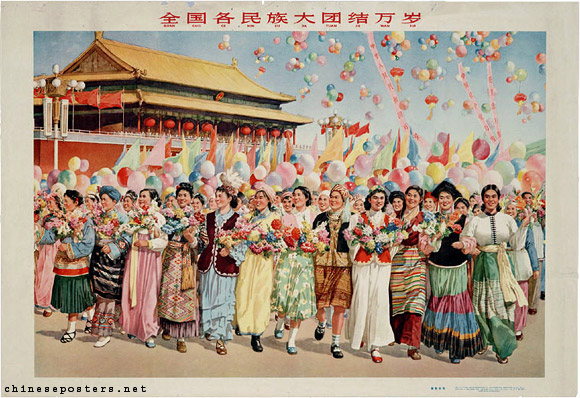
1957 propaganda poster depicting representatives of different ethnic minorities participating in a National Day parade on Tiananmen Square. The caption reads, “Long Live the Great Unity of Chinese People of All Ethnic Groups.” Original poster by Yang Junsheng. Photo via chineseposters.net. 🅮 Public domain.
On March 12, 2026, China’s National People’s Congress (NPC) adopted the Law on Promoting Ethnic Unity and Progress (Law) [民族团结进步促进法]—designed to codify General Secretary Xi Jinping’s new orthodoxy for governing China’s ethnic minorities. That doctrine, known as the “Important Thinking on Improving and Strengthening Ethnic Work,” reflects the “Second-Generation Ethnic Policies” promoted by several prominent scholars. In a nutshell, this new “assimilationist” approach aims “not just to strengthen citizens’ sense of belonging to a larger, unified Chinese nation under the Party but also to mute expression of other—in the Party’s view, competing—identities.”
China’s National People’s Congress (NPC) has released its 2026 session’s agenda and daily schedule of meetings, as well as a preliminary schedule of press events during the session. This year’s session will open on the morning of March 5 and close on the afternoon of March 12, lasting eight full days. As the NPC spokesperson announced in 2024, Premier Li Qiang will not hold a press conference after this session (or during the remainder of this NPC term “absent special circumstances”).
All times below are in China Standard Time (UTC +8:00). For a primer on the NPC and its annual sessions, check out this FAQ.
China’s 14th National People’s Congress (NPC) will convene for its fourth session on Thursday, March 5. The session’s agenda is expected to include the following items:
Deliberate the Government Work Report;
Deliberate work reports by the NPC Standing Committee (NPCSC), the Supreme People’s Court, and the Supreme People’s Procuratorate;
Review a report on the implementation of the 2025 Plan for National Economic and Social Development and on the draft 2026 Plan for National Economic and Social Development; and review the draft 2026 Plan for National Economic and Social Development;
Review a report on the execution of the 2025 Central and Local Budgets and on the draft 2026 Central and Local Budgets; and review the draft 2026 Central and Local Budgets;
Review a draft Outline of the 15th Five-Year Plan for National Economic and Social Development;
Deliberate the NPCSC’s Report on Efforts to Clean Up Laws and Opinions on Handling Relevant Laws and Decisions [关于法律清理工作情况和有关法律和决定处理意见的报告].
On March 4, the NPC session will convene for a preparatory meeting to select members of the Presidium (an ad hoc body of around 180 members that will preside over the session) and to finalize the session’s agenda. The Presidium will then immediately meet to decide on the session’s daily schedule and designate a spokesperson. Shortly thereafter the session is expected to hold its first press conference.
The NPC’s 2026 session will likely close on March 11, based on a recent notice from the Beijing police on ensuring airspace safety during the event. All documents submitted for review are expected to be approved.
China’s national legislature, the Standing Committee of the National People’s Congress (NPCSC), is soliciting public comment on the following three bills through March 28, 2026.
English translations will be provided if available. All explanatory documents are in Chinese and compiled in a single PDF; the links above will take you to the corresponding pages in the PDF.
Last December, China’s national legislature, the NPC Standing Committee (NPCSC), heard its Legislative Affairs Commission’s report on efforts to “clean up” [清理] China’s national laws—that is, a systematic review of existing legislation to identify outdated or inconsistent provisions. This was the NPCSC’s third comprehensive cleanup of laws since 1978.1 The first took place at the outset of the Reform Era, leading to a declaration that 148 instruments enacted or approved by the NPCSC had de facto expired. The second round occurred in 2008–09, ahead of the official declaration in 2010 that China had established “a socialist system of laws with Chinese characteristics.” It resulted in not only the repeal of eight laws, but also minor amendments to 141 provisions in 59 laws.
On December 27, 2025, the NPCSC adopted a decision approving the Commission’s report. In this “Cleanup Decision,” it also declared that 104 instruments it enacted between 1955 and 2021 had lapsed and were no longer in force, while confirming the continued validity of past actions taken under those instruments.
Neither the Commission’s report nor any legislative record associated with the Cleanup Decision has been published in the latest issue of the NPCSC Gazette, so we do not yet know the Commission’s full findings and reasoning. That said, according to the Cleanup Decision, the Commission also identified another 35 obsolete instruments enacted by the full NPC, which will address them at its 2026 session.
Below, we first provide an overview of those 104 instruments, then focus on several repeals with substantive effects, and finally discuss what may happen at NPC 2026 and beyond.
UPDATE (Mar. 12, 2026): We updated this post in accordance with the Law’s final text. The original version is archived here.
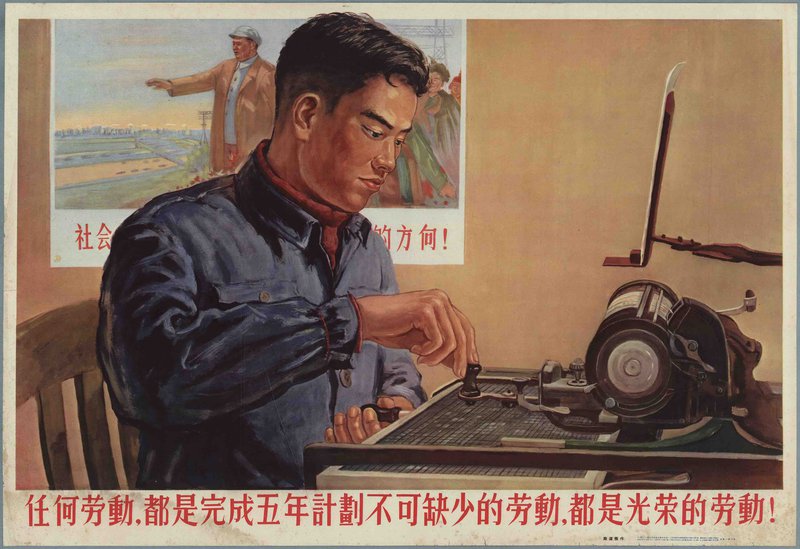
1956 propaganda poster featuring a Chinese typist and the caption “All labor contributes indispensably to the fulfillment of the [First] Five-Year Plan and is glorious work!” Original poster by Zhou Daowu. Photo via The Mao Era in Objects. 🅮 Public domain.
On March 12, 2026, China’s top legislature, the National People’s Congress (NPC), approved the 15th Five-Year Plan (FYP), a roadmap for the nation’s socioeconomic development through 2030. Alongside it, the NPC also adopted the Law on National Development Plans (Law) [国家发展规划法]—the first statute to formalize the procedures for drafting, approving, and implementing FYPs.
Developed over seven decades, the planning process now operates under a mix of written authorities and long-standing customs. In 2018, the Communist Party and the State Council issued a joint opinion imposing a range of procedural and substantive requirements for drafting and implementing FYPs. In 2021, the NPC Standing Committee (NPCSC) overhauled its Decision on Strengthening the Oversight of Economic Work (Oversight Decision) [关于加强经济工作监督的决定]—which governs, among other things, legislative oversight of the planning process. Meanwhile, other features of the process, such as the Party’s quinquennial recommendations for formulating the next FYP, continue as a matter of practice.
The Law codifies that existing regime and regulates the entire lifecycle of an FYP: from drafting (Ch. II) to legislative review and approval (Ch. III), to implementation (Ch. IV) and related oversight activities (Ch. V). Most notably, the Law spells out the Party’s role throughout the planning process. While, unsurprisingly, it contains the now-standard language that national development planning must uphold the Party’s leadership (arts. 3, 5), the Law is the first Chinese statute to assign detailed roles to Party documents and institutions.
UPDATE (Mar. 3, 2026): In a new essay for the Brookings Institution’s John L. Thornton China Center, we further elaborated and commented on the Law’s Party provisions.