
UPDATE (Dec. 22, 2025): The NPCSC has revealed that it will indeed submit the first three bills discussed below to the 2026 NPC session for approval and will pass the draft revisions to the Law on the Standard Spoken and Written Chinese Language and to the Foreign Trade Law on December 27.

China’s top legislature, the 14th NPC Standing Committee (NPCSC), will convene for its nineteenth session, its final meeting of the year, from December 22 to 27, the Council of Chairpersons decided on Monday, December 15. It will be the longest legislative session—lasting six days—since December 2019, with a suitably packed agenda. The NPCSC will review 14 legislative bills and hear almost two dozen reports, in addition to other business. As usual, we preview the session’s legislative agenda in detail below, while highlighting a few notable reports.
Returning Bills
Eight bills have been scheduled for further review.
First, the draft Ecological and Environmental Code [生态环境法典], draft Law on Promoting Ethnic Unity and Progress [民族团结进步促进法], and draft Law on National Development Plans [国家发展规划法] return for additional review—and it seems all three are heading to the NPC’s plenary session next spring.
- The NPCSC first reviewed the draft Ecological and Environmental Code as a whole in April 2025, before discussing each of its five parts again in two batches in September and October. Reassembling the parts into a complete Code signals that it will pass at next year’s NPC session.
- The draft Law on National Development Plans will undergo its third review next week. Ordinarily, we would predict that it will be adopted then, but the NPCSC disclosed back in early 2024 that the bill would eventually be adopted by the full NPC. The law would govern, among other things, the procedures whereby the NPC approves China’s Five-Year Plans, so it makes sense to require its approval.
- The draft Law on Promoting Ethnic Unity and Progress returns for its second review. Officials have not revealed their plan for this bill, and we surmise it will be referred to the NPC only because it is listed between the previous two bills on the draft agenda. But this fate would not be surprising: the Communist Party leadership has attached great importance to the bill and took the rare step of discussing it at a Politburo meeting. The last bill that enjoyed such treatment was also enacted by the full NPC.
Second, the draft revision to the Fisheries Law [渔业法], draft Hazardous Chemicals Safety Law [危险化学品安全法], and draft revision to the Civil Aviation Law [民用航空法] return for their third—and most likely final—review.
Third, the draft revision to the Law on the Standard Spoken and Written Chinese Language [国家通用语言文字法] and draft revision to the Foreign Trade Law [对外贸易法] return for their second review. While an additional round of deliberations likely awaits both, we would not rule out the possibility that they would pass next week.
New Bills
Six new bills have been submitted for review.
First, the Council of Chairpersons submitted a draft State-Owned Assets Law [国有资产法]. China divides state-owned assets into four categories: state-owned assets of non-financial enterprises; state-owned assets of financial enterprises; state-owned assets of administrative organs and public-service institutions; and state-owned natural resources. The first category is governed by a 2008 statute, and the third category by a State Council regulation issued in 2021. In recent years, the NPCSC has strengthened oversight over the management of state-owned assets and began studying a comprehensive statute to govern all types of assets as early as 2018. Such a law was later included in the 14th NPCSC’s five-year legislative plan as a top-priority project. We expect it to pass after three reviews.
Second, the NPC Education, Science, and Public Health Committee submitted a Childcare Service Law [托育服务法]. As expected for a bill drafted by an NPC special committee, details are scarce at the moment. In an April 2024 report to the NPCSC on efforts to promote childcare service, the State Council acknowledged various problems and challenges, including inadequate and uneven supply, low affordability, insufficient policy support, and lax regulation. The Law is therefore likely to address these issues. We expect it to pass after three reviews.
Third, the NPC Environmental Protection and Resource Conservation Committee submitted an Antarctic Activities and Environmental Protection Law [南极活动与环境保护法]. Under the 2015 National Security Law [国家安全法], China considers “strengthening its capacity for safe passage, scientific investigation, development and exploitation [in polar regions], strengthening international cooperation, and preserving the security of [China’s] activities, assets, and other interests in . . . polar regions” to be part of the mission to safeguard national security. In addition, an NPC official disclosed in 2019 that the Law would adopt “the principles of the Antarctic Treaty System” as domestic legislation. We expect it to pass after two or three reviews.
Fourth, the State Council submitted a draft revision to the Banking Supervision and Administration Law [银行业监督管理法]. This Law was initially enacted in 2003 and has yet to be meaningfully updated. In late 2022, the now-defunct China Banking and Insurance Regulatory Commission (succeeded by the National Financial Regulatory Administration) sought public comment on an earlier draft, which proposed to, among other changes, expand the Law’s scope to regulate the major shareholders and actual controllers of banking institutions; improve risk-management mechanisms; and broaden oversight and increase penalties. We expect the draft revision to pass after three reviews.
Fifth, the State Council also submitted a draft revision to the Trademark Law [商标法]. The NPCSC last amended this Law in 2019 to crack down on “trademark squatting” (bad-faith registration of a mark without intent to use it) and toughen punishments for infringement. According to a draft released by the China National Intellectual Property Administration in early 2023, this round of updates will further restrict and penalize trademark squatting, streamline registration and dispute-resolution procedures, emphasize the obligation to use registered marks, bolster protections against infringement and dilution, and strengthen administrative law enforcement. We expect the bill to pass after three reviews.
Lastly, the Council of Chairpersons submitted a bill to interpret as-yet unspecified provisions of the Criminal Procedure Law [刑事诉讼法]. The NPCSC has the authority to “interpret” a law (1) when the “specific meaning” of a statutory provision needs further clarification; or (2) when it is necessary to clarify the “applicable statutory basis” in new circumstances arising after a statute’s enactment. In practice, such “legislative interpretations” amount to de facto statutory amendments. It was in 2014 that the NPCSC last exercised this interpretive authority regarding statutes unrelated to Hong Kong, including three provisions of the Criminal Procedure Law. It is likely that it will again interpret multiple provisions of the Law.
Reports
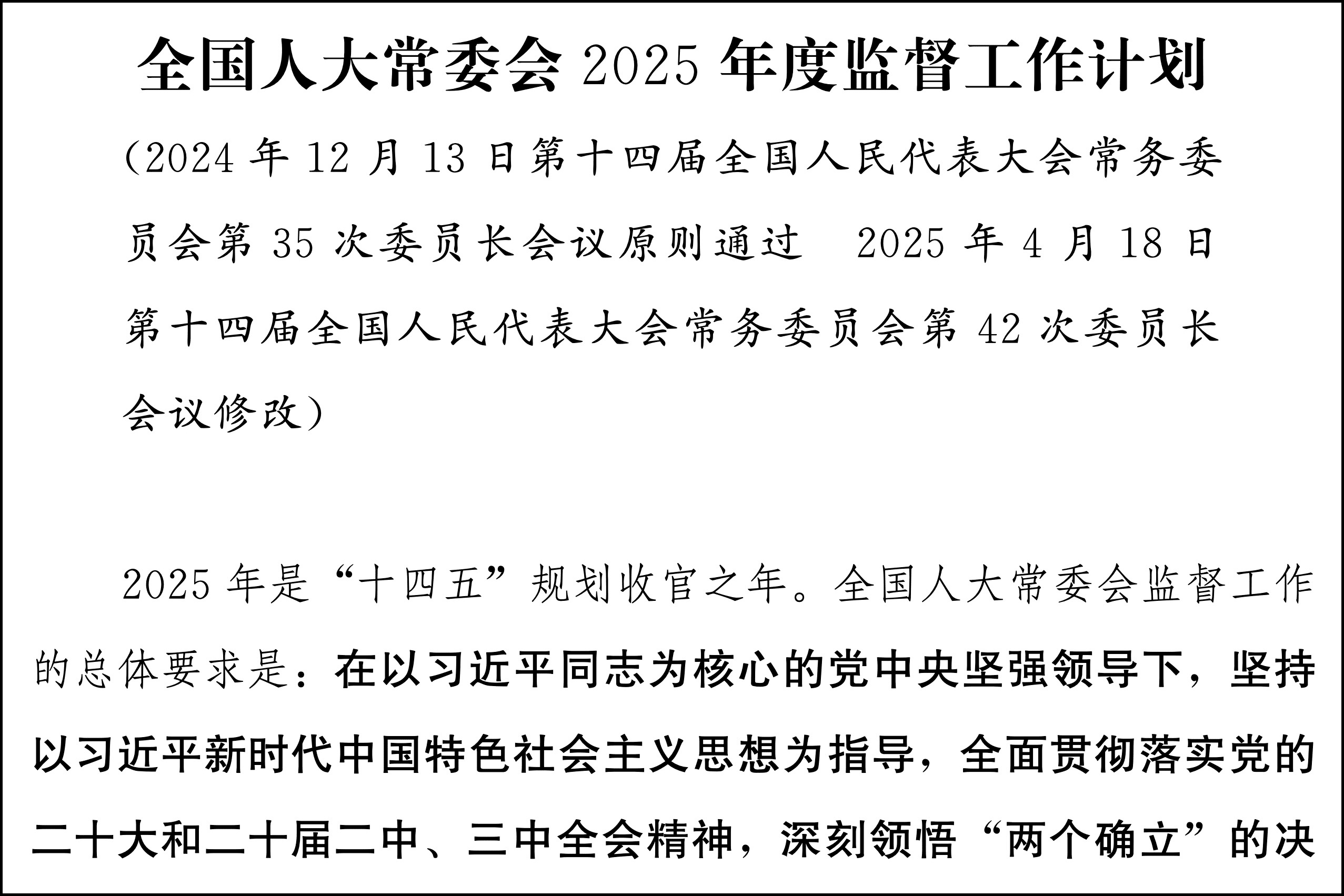
Next week, the NPCSC will hear seven oversight reports, including the State Council’s report on protecting the rights and interests of gig workers. Check out our coverage of the NPCSC’s 2025 oversight plan for details:
The NPCSC will also hear two other noteworthy reports from its Legislative Affairs Commission:
- an annual report on “recording and review” [备案审查], which will disclose new cases in which the Commission has ruled legislation unconstitutional, unlawful, or against major national policy; and
- a report on the Commission’s recent efforts to “clean up” laws and its recommended next steps. As we have explained, a “legislation clean-up” [法律清理] is a comprehensive review of existing legislation to identify provisions that are grossly outdated or contradict each other. The report will likely list the provisions that must be repealed or amended, and we expect that legislative proposals to implement the recommendations will follow in the coming months.