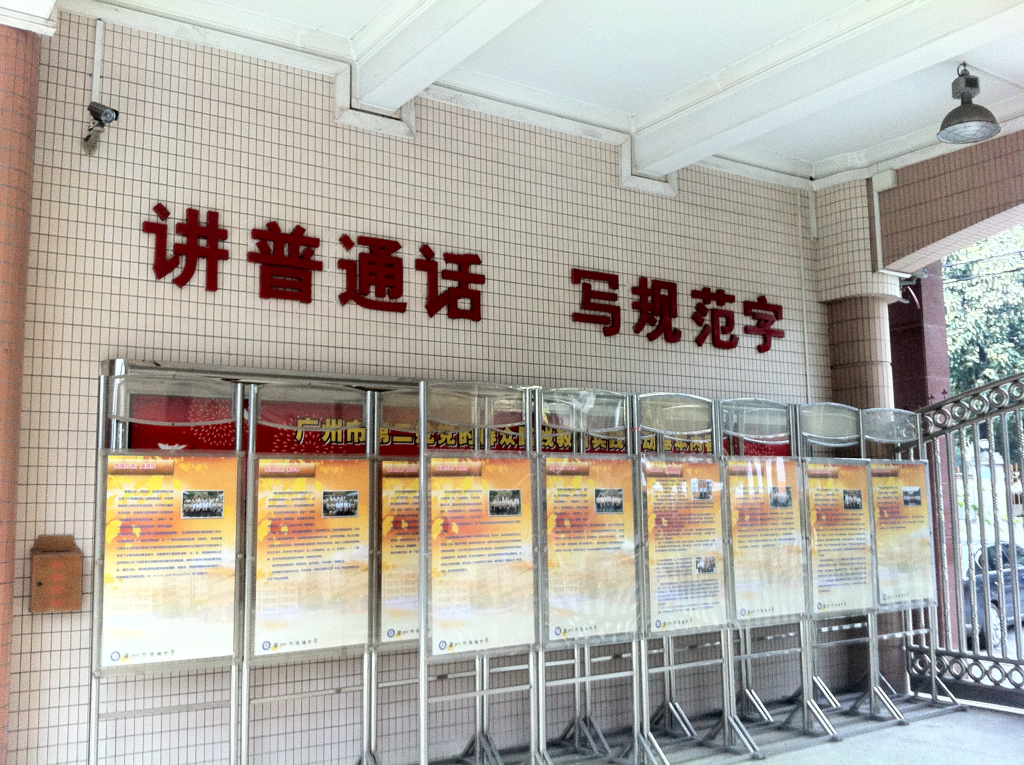
A slogan reading “Speak Putonghua, Write Standard Characters” in a Guangzhou secondary school. Photo by Gzdavidwong (Wikimedia Commons). CC BY-SA 3.0.
China’s top legislature, the 14th NPC Standing Committee (NPCSC), will convene for its seventeenth session from September 8 to 12, the Council of Chairpersons decided on Tuesday, August 26. According to the Council’s proposed agenda, the session will consider 16 legislative bills—the most so far during this five-year term—and hear 8 oversight reports, among other business. As usual, we preview the session’s legislative agenda in detail below.
This post is the second and final part of our coverage of China’s revised Public Security Administration Punishments Law (PSAPL) [治安管理处罚法], approved by the Standing Committee of the National People’s Congress (NPCSC) on June 27 and set to go into effect on New Year’s Day. As introduced in Part 1 in more detail, the PSAPL authorizes the police to punish what are deemed minor offenses against the public order through administrative processes outside the criminal justice system. Part 1 focuses on several broader issues that arose during the revision process: the use of administrative detention, the availability of detention hearings, and the vagueness of certain offenses. This part will more comprehensively survey the changes in the revision, though it is still not intended to be exhaustive.
The PSAPL can be roughly divided into three parts: general rules on liability and punishment; offenses and penalties; and procedures for investigating and penalizing public security violations. This post will proceed in the same order. We will draw on Jeremy Daum’s overview of the revision’s first draft as well as a recent explainer by the NPCSC Legislative Affairs Commission (LAC).1 For additional information on the revised PSAPL, please see this English translation by China Law Translate or this Chinese-language comparison chart we have prepared. Inline page citations are to the LAC article, while inline statutory references are to the revised PSAPL unless context indicates otherwise.
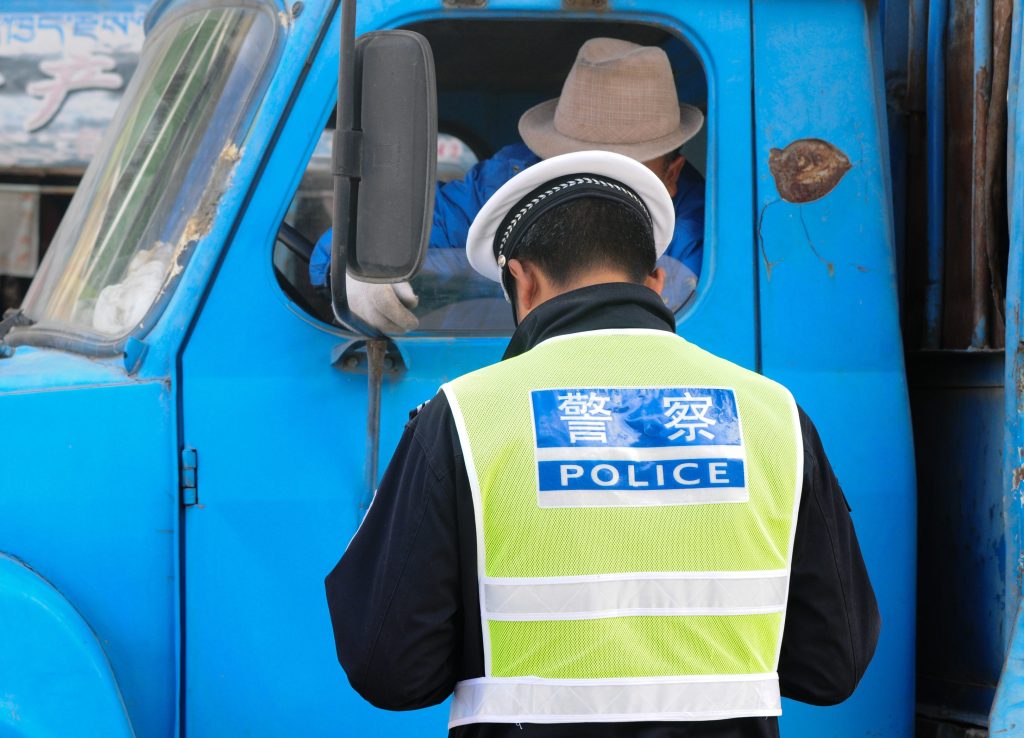
Chinese traffic police officer stands on duty on the street in Beijing. Photo by Phuong (stock.adobe.com).
On June 27, 2025, China’s national legislature, the Standing Committee of the National People’s Congress (NPCSC), approved an overhaul of the 2005 Public Security Administration Punishments Law (PSAPL) [治安管理处罚法], bringing a 12-year legislative marathon to a close. The revised PSAPL will enter into force on January 1, 2026.
The PSAPL sits at the intersection of Chinese criminal law and administrative law. On the one hand, it is a penal statute that defines “violations of public security administration”: relatively minor public order offenses that generally correspond to more serious “crimes” in the Criminal Law [刑法]. These violations are punishable with warnings, fines, license revocations, and even detention of up to 15 days (or up to 20 days for multiple offenses). The PSAPL also lays down the procedures for investigating and punishing the violations, so it is like the Criminal Law and the Criminal Procedure Law [刑事诉讼法] rolled into one. On the other hand, the PSAPL skirts the normal criminal justice process, authorizing the police to penalize public security violations by themselves through nominally administrative proceedings. It incorporates most of the procedures under the Administrative Punishments Law [行政处罚法] and the Administrative Coercion Law [行政强制法]—which regulate, respectively, administrative punishments (e.g., fines and detention) and coercive administrative measures (e.g., investigative restraints on physical liberty and property seizures)—while adapting them to the public security context.
As the first meaningful update of the PSAPL in 20 years, the revision has introduced too many changes to recount individually. To summarize, it has tweaked the general rules of liability and punishments; added around 30 new offenses to the original 152 and modified about 20 others; increased fines across the board; and refined investigatory and decisionmaking procedures.
We will cover the revision in two parts. In this first part, we will delve into a few major changes (or sets of changes), drawing on a recent explainer by Zhang Yijian, a division head in the Office for Criminal Law within the NPCSC Legislative Affairs Commission (LAC).1 Though necessarily biased and self-congratulatory—the article portrays a legislature that tempered the more aggressive draft prepared by the Ministry of Public Security (MPS)—it explains in detail why certain changes were or weren’t made, offers glimpses of behind-the-scenes debates, and candidly acknowledges some flaws in the PSAPL regime. In the next part, we will take a more comprehensive look at the changes but without detailed analysis.