

Publication History (last major update: July 31, 2025)
Minor edits and formatting changes are not noted
June 25, 2018: First published; written by Shuhao Fan and edited by Changhao Wei and Xiaoyuan Zhang
June 21, 2021: Revised by Changhao Wei and Taige Hu to update all factual information and citation style, rewrite the section on legal inquiry responses, and add a new part on the LAC’s duties throughout lawmaking (focusing on its roles in constitutional enforcement and public communications), in addition to miscellaneous minor changes throughout
July 31, 2025: Revised by Changhao Wei and Taige Hu to update all factual information and substantially update the sections on the LAC’s legal status as well as its roles in ex ante constitutional review of draft laws and public communications, in addition to miscellaneous minor changes throughout
The Legislative Affairs Commission (LAC) [法制工作委员会] under China’s national legislature, the National People’s Congress (NPC) and its Standing Committee (NPCSC), is such a unique institution that one can hardly find an equivalent in another jurisdiction. Staffed primarily by unelected and unidentified members, the LAC works mostly behind closed doors, although recently it has become much more visible in the public eye. The LAC’s employees outnumber NPCSC members, and unlike the latter, they all work full-time and include more legal experts than the staff of any other NPC body.1 Their decisions play significant roles throughout the legislative process, from the agenda-setting stage to deliberations—and even after laws are enacted. One Chinese scholar thus aptly dubs the LAC staff “invisible legislators” [隐性立法者].2 Some worry that they may have usurped the powers of elected members of the legislature, thus becoming de facto legislators.3 Below, we provide an overview of the LAC—an essential yet peculiar institution under the Chinese legislature—and its roles in the legislative process.
I. The LAC’s Past and Present
A. Establishment
In February 1979, the NPCSC established under itself a “legal affairs commission” [法制委员会]—the LAC’s predecessor—to assist in rebuilding China’s legal system in the aftermath of the Cultural Revolution. This new commission was a “large and high-level” institution headed by Peng Zhen [彭真], widely regarded as one of the chief architects of China’s modern legal system. (He was succeeded by Xi Zhongxun [习仲勋], Xi Jinping’s father, in 1981. Peng later served as the inaugural secretary of the Central Political and Legal Affairs Commission (1980–83) and as Chairman of the 6th NPCSC (1983–88).) The 1979 commission was staffed by 80 highly regarded legal talents, many of whom would later become state leaders and leading scholars.4 It was also given by the Communist Party leadership broad discretion to draft laws without having to ask for the Party’s instructions.5 It thus was able to achieve the “miracle” of drafting seven bills in merely three months.6
In 1982, the NPC enacted the NPC Organic Law [全国人民代表大会组织法], authorizing the NPCSC to “establish working commissions [工作委员会] when necessary” (art. 28). Exercising that authority, the NPCSC in September 1983 decided to rename the commission “Legislative Affairs Commission,” which is still in use today. (Although the word “工作” in the LAC’s name literally means “work” or “working,” the official translation uses “affairs.”) In the 2021 amendment to the NPC Organic Law, the NPC listed the LAC as an example of a working commission under the NPCSC, thereby giving it a more enduring status.
B. Structure
At first, the proto-LAC had only three subdivisions: a Law Office [法律室], a Policy Research Office [政策研究室], and an Administrative Office [办公室]. In 1983, the LAC officially began with five, with separate units for criminal law, civil/state law, and economic law. Over the following decades, its offices have continued to diversify and specialize.7 In 2007, for example, the LAC established a Legislative Planning Office [立法规划室] to fulfill its then-newly acquired responsibility to draft legislative plans (see infra Section III.A). And in late 2018, it formed an Office for Constitution [宪法室] to assist the NPC’s new Constitution and Law Committee [宪法和法律委员会] (renamed from “Law Committee” [法律委员会] earlier that year) in performing constitution-related tasks (see infra Section III.B.3).
As of July 2025, the LAC has the following eleven offices, with the first seven focusing on particular areas of law and last four on specific tasks:
| # | Name | Year Established |
| 1 | Office for Criminal Law 刑法室 | 1983 |
| 2 | Office for Civil Law 民法室 | 1987 |
| 3 | Office for Economic Law 经济法室 | 1983 |
| 4 | Office for State Law 国家法室 | 2004 |
| 5 | Office for Administrative Law 行政法室 | 2004 |
| 6 | Office for Social Law 社会法室 | 2011 |
| 7 | Administrative Office 办公室 | 1983 |
| 8 | Office for Constitution 宪法室 | 2018 |
| 9 | Legislative Planning Office 立法规划室 | 2007 |
| 10 | Office for Recording and Reviewing Regulations 法规备案审查室 | 2004 |
| 11 | Research Office 研究室 | 1983 |
C. Personnel
Like its institutional structure, the LAC’s workforce has also been steadily expanding. While there is no official tally, a 2008 report put its staff size at around 170, which would make the LAC the largest agency under the NPCSC.8 Our interviews with three LAC staff members in 2014 and 20209 confirmed that the LAC was employing more than 200 people.
The current LAC leadership (as of July 2025) includes one director and four deputy directors. The director holds a ministerial-level position and tends to concurrently serve as an NPCSC member and a vice-chair of the NPC Constitution and Law Committee, as does the current director Shen Chunyao [沈春耀] (2017–). Apart from the director and (as of July 2025) two deputy directors (who also sit on the NPCSC and the Constitution and Law Committee), the rest of the LAC staff are unelected civil servants.
Most LAC staffers are believed to have received rigorous legal training and developed professional expertise. Again, while no official data are available on their educational backgrounds, a 2013 study of the LAC’s provincial counterparts found that most of their staff members were “well-trained in the law,”10 suggesting that the same is likely true of the LAC’s own employees. Recent NPCSC hiring practice provides further support: LAC positions generally require candidates with law degrees—and often at the graduate level.11 With its stable and highly professional staff, the LAC is therefore well equipped to handle the onerous day-to-day legislative work, compensating for two of the NPCSC’s institutional deficiencies: its members mostly serve part-time, and it typically meets only once every two months.12
II. The LAC’s Legal Status
The LAC is a ministerial-level body under the NPCSC.13 It is commonly characterized as a “working body” [工作机构] of the NPCSC. (The other working bodies are the NPCSC’s Budgetary Affairs Commission, Deputy Affairs Commission, as well as Hong Kong and Macao SAR Basic Law Committees). The late Professor Cai Dingjian [蔡定剑], a leading authority on the NPC, explains:
A working body can be considered a type of semi-functional body [半职能机构]: it can exercise certain statutory authorities, but cannot, in its own name, issue enforceable [执行性的] documents, directives, or orders; its role is to provide services to functional bodies [职能机构] [such as the legislature itself]. Thus, in essence, it is also a kind of service body.14
In other words, the LAC is traditionally considered a professional bureaucracy under the NPCSC with only support functions. It has no independent legislative authority and, as Chinese scholars argue,15 its actions should not have any external legal effect.
But recent developments in the system of “recording and review” (R&R) [备案审查] have begun to challenge that traditional view. R&R, in short, is a process whereby the LAC reviews (on the NPCSC’s behalf) the legislation of other state organs—including the State Council and local legislatures—for inconsistency with the Constitution, national law, or central policy (see infra Section III.C.1). Since 2015, the Legislation Law [立法法] has authorized it to issue “research opinions” [研究意见] to the relevant organs, urging them to correct problems in their legislation. (In 2023, these opinions were upgraded to the more authoritative-sounding “review opinions” [审查意见].) No one disputes that such opinions do not bind other state organs as a matter of law: If an organ refuses to amend or repeal a problematic document, the LAC by itself cannot order it to do so, but will have to request the NPCSC to annul the document. In practice, however, the LAC’s written opinions have invariably been the final word.16 Enacting organs have generally chosen to follow them (albeit after some delay in certain cases), whether due to political considerations or the threat of NPCSC action.17 The effects of the opinions have even “spilled over” beyond specific cases to influence “the exercise of legislative, administrative, and judicial powers” more broadly.18 For example, a recent empirical study found that, in multiple contract disputes, courts relied on a 2017 LAC opinion rejecting local legislation that had conditioned the final settlement of government-funded construction projects on official audit results.
That said, aside from that (important) aspect of the LAC’s work, the traditional view nonetheless holds today: As we will discuss below, the LAC’s influence on lawmaking is still channeled through the NPC’s internal mechanisms and externalized only via the Council of Chairpersons, the NPC special committees, or the legislature itself.
III. The LAC’s Roles
The Legislation Law is the primary home of the LAC’s statutory duties. It makes about two dozen references to the relevant “NPCSC working body”—which, in the legislative context, means the LAC. Two other laws—the Law on Oversight by the Standing Committees of People’s Congress (Oversight Law) [各级人民代表大会常务委员会监督法] and the NPCSC’s 2023 Decision on Improving and Strengthening the System of Recording and Review (R&R Decision) [关于完善和加强备案审查制度的决定]—also govern the LAC’s role in R&R. The agency also performs a few other functions that have not been codified but are helpfully listed in its official profile on the NPC website (Official Profile). Based on these sources, we have divided the LAC’s roles into four categories. The first three correspond to stages of lawmaking: agenda-setting; drafting through enactment; and post-enactment activities. The last category encompasses responsibilities not tied to any particular phase of the legislative process. Below, we will highlight particular roles in each category that we find noteworthy.
A. Legislative Planning
- Drafting the NPCSC’s five-year, annual, and special legislative plans, subject to the approval of the relevant Party entity and the Council of Chairpersons (Legislation Law art. 56); and
- Overseeing the implementation of those legislative plans as directed by the NPCSC (id.).
Under its internal guidelines, the LAC follows a three-step process when drafting five-year legislative plans: consultation, analysis, and prioritization.19 It starts by gathering legislative proposals from a variety of sources, including central Party and state organs, provincial people’s congresses, quasi-governmental bodies (such as the China Law Society), as well as NPC delegates, experts and scholars, and (through its “grassroots legislative outreach offices” [基层立法联系点]) the public. The party proposing a legislative project must justify, at a minimum, the project’s “necessity” and “feasibility.” Institutional (but not individual) sponsors must additionally explain the law’s main contents, its relationship with other laws, the entities responsible for drafting and introducing the bill, and the drafting schedule. The LAC also collects additional proposals by combing through important political and policy documents as well as NPC delegates’ submissions. Next, it moves on to evaluating the gathered proposals. When there is a broad consensus among the stakeholders, a proposal may be included in the plan or rejected outright. For an important project over which there is substantial disagreement, however, the LAC’s guidelines require it to conduct additional “assessment” [论证] with the relevant parties before making a decision. Lastly, the LAC prioritizes selected projects by dividing them into three categories based on urgency and ripeness. The agency follows an analogous but shorter process in drafting the NPCSC’s annual legislative plans.
The LAC’s central role in setting the legislative agenda has made it a powerful “allocator and guardian of legislative resources.”20 Since these resources are extremely limited—as the NPCSC typically convenes only once every two months—some legislative projects must be shelved or even outright rejected. The LAC thus becomes a key actor that decides the winners and losers in this legislative “battle,”21 subject, of course, to the Party and legislative leaderships’ priorities. These decisions “in large part” depend on the LAC staff members’ “individual and collective motives, values, and mentalities.”22 But the LAC is still heavily influenced both by strong players—“banks,” for instance, a former LAC deputy director told us—and by external events—China’s accession to the World Trade Organization, for instance, required prioritization of intellectual property laws. As that deputy director put it, the drafting of legislative plans is essentially an “iterative” process of “balancing [competing] interests.”
Under the NPCSC Party Group’s rules, five-year legislative plans must be greenlit by the Party leadership, and other legislative plans by the NPCSC Party Group itself, before they are submitted to the Council of Chairpersons for final approval.
B. From Drafting to Enactment
- Participating in other entities’ drafting process in advance and draft laws as entrusted by the Council of Chairpersons—in particular, important laws that “are comprehensive in nature, affect the overall picture, or are fundamental” (Legislation Law art. 57; Official Profile #1);
- Soliciting opinions on draft laws from various parties, including NPC delegates, local legislatures, government agencies, and relevant organizations and experts via methods such as seminars [座谈会], expert assessment sessions [论证会], and hearings [听证会] (Legislation Law art. 39);
- Collecting and organizing solicited opinions and NPCSC members’ comments during deliberations; and distributing these materials to the NPC Constitution and Law Committee and other relevant special committees and, when necessary, to NPCSC sessions (id. art. 41);
- Proposing amendments to draft laws based on gathered opinions (Official Profile #4);
- Reviewing the constitutionality of draft laws and producing research opinions (see Legislation Law arts. 23, 36; Official Profile #2);
- Conducting pre-enactment evaluations of draft laws, including the feasibility of major statutory schemes, timing of promulgation, as well as expected social impacts and potential problems (Legislation Law art. 42); and
- Standardizing the language used in laws and making cosmetic changes to draft laws before passage (Official Profile #4).
1. Drafting legislation. As a professional body with many legal talents, it is not surprising that the LAC is authorized to draft bills. (It cannot, however, directly submit bills to the NPCSC and must go through the Council of Chairpersons.) In practice, the LAC drafts almost all the bills submitted by the Council. Its drafting mandate is not clearly defined, but appears to mainly encompass two types of projects based on recent practice. First, it drafts (or coordinates the drafting of) laws that qualify as “basic laws” under the PRC Constitution(such as the Civil Code [民法典], a basic civil law), as well as their subsequent updates. Second, it often participates in drafting when a Communist Party body acts as the primary drafter or a co-lead, as in the case of the Patriotic Education Law [爱国主义教育法] (which it co-drafted with the Central Propaganda Department).23
2. Proposing amendments to pending legislation. What is more interesting is how the LAC, a mere information collector based on the text of the Legislation Law (see list items b and c), is able to act as an information processor that proposes amendments (see list item d)—a role not found in that law. One crucial factor that makes this transformation possible is the so-called “unified deliberations” [统一审议] process. Under the Legislation Law, only the NPC Constitution and Law Committee (formerly the Law Committee) can conduct “unified deliberations” on a pending bill by considering the views of all relevant parties and then submit a revised version of the bill to the legislature, along with a report explaining the main changes made (arts. 23, 36). Put differently, no other body or individual formally has the power to submit amendments to pending bills for discussion or a vote. Only during group discussions can NPCSC members express their opinions,24 which are recorded and summarized by the LAC.
Yet the Constitution and Law Committee alone cannot shoulder that responsibility. The incumbent Committee of the 14th NPC (2023–), for example, has only nineteen members—with (by our count) only eleven serving full-time (as of July 2025). And unlike other special committees, the Committee has no support staff of its own.25 It therefore has delegated much of its burdensome daily work to the LAC, which now in practice not only collects opinions from different parties and summarizes them, but also recommends to the Committee amendments to pending bills based on those opinions. During this process, it is almost inevitable that the LAC needs to interpret, evaluate, and synthesize the opinions received. Some scholars have found that, as the one controlling the information flow, the LAC is able to “filter out views with which NPCSC leadership disagrees,” thereby “imposing the will of the NPCSC’s or LAC’s leaders” on other legislators.26
The LAC’s central role in information processing has also made it “increasingly the target of lobbying efforts.”27 Those that lost in the earlier stages of lawmaking hope to influence the LAC in the later stages of deliberation and revision. The LAC in fact encourages their inputs and was the first central government organ to “openly acknowledge the value of pluralist political dynamics.”28 According to our 2014 interviews with LAC staffers, the LAC has indeed devoted substantial resources to soliciting views from different sides, in particular through the public consultation process.
Since April 2008, the NPCSC has released the first draft of almost every single bill for public comment. Then, in 2013, it extended this soft consultation requirement to any additional non-final draft of a bill as well. After each round of consultation, the LAC prepares an internal brief29 summarizing and categorizing the submitted comments, which it then considers in drafting proposed amendments to the bills. The LAC will distribute the briefs, but not the original comments, to the Constitution and Law Committee and NPCSC members. Because only the LAC has the personnel to sift through the submitted comments, it conceivably can filter them the same way as it filters rank-and-file legislators’ opinions.
3. Researching and reviewing the constitutionality of draft laws. As part of 2018’s far-reaching state institutional reforms, the former NPC Law Committee was rechristened the Constitution and Law Committee (CLC) and assumed new responsibilities over implementing the Constitution, including constitutional interpretation and constitutional review. To help the CLC discharge those duties, the LAC established its newest subdivision—the Office for Constitution—in October 2018. It is now understood that the CLC and the Office for Constitution review the constitutionality of statutes ex ante—that is, before they are enacted—whereas the LAC’s Office for Recording and Reviewing Regulations, as part of R&R, conducts ex post constitutional review of legal instruments other than statutes (see infra Section III.C.1). (Enacted statutes are not formally subject to constitutional review.)
One of the earliest examples of its ex ante constitutional review concerned the 2019 Foreign Investment Law [外商投资法]. This statute regulates investments by foreign “natural persons, enterprises, or other organizations,” whereas Article 18 of the 1982 Constitution permits only “foreign enterprises and other economic organizations or individuals” to invest in China (our emphasis). In an article published after the Law’s passage, the Office for Constitution endorsed its broader scope. (LAC officials would later describe the article as an “interpretive research opinion” [解释性研究意见], the first publicly available document of this kind.) As it explains, Article 18’s terminology “reflected the social realities and understanding of the time” (i.e., before China’s market-oriented economic reforms), but its underlying “spirit” was clear—that China pursues a policy of opening to the outside world. Indeed, as China embraces foreign investments, the article continues, the meaning of that constitutional provision has “evolved gradually and become more expansive.” Hence, it was “inadvisable” to require the statutory language to match the constitutional text in this case, and the Foreign Investment Law’s “updated” terminology was consistent with the provisions and spirit of the Constitution.
The LAC took another historic step in ex ante review two years later. In July 2021, the State Council proposed amendments to the Population and Family Planning Law [人口与计划生育法] to codify the Party’s earlier decision to adopt a three-child policy and accompanying measures to boost childbirths. Some questioned, however, whether the Law so amended would still comply with China’s constitutional policy of “promoting family planning [计划生育] so that population growth is consistent with economic and social development plans” (PRC Const. art. 25)—for “family planning” undoubtedly referred to the one-child policy in 1982.30 The LAC defended the proposal’s constitutionality in a research opinion—also subsequently characterized as a “report on constitutional review and research” [合宪性审查研究报告]—that was distributed to lawmakers during deliberations—apparently a first in NPCSC history.31 After reviewing China’s evolving family planning policy, the opinion concludes that the constitutional provisions on “family planning” are “inclusive and adaptable” enough to encompass the birth policies implemented at different periods . The proposed three-child policy and accompanying reforms, too, would “conform to the provisions and spirit of the Constitution.” (Identical language made it into the CLC’s legislative report on the amendments.)
Officials claim to have reviewed the constitutionality of every legislative bill since the start of the 13th NPC in March 2018.32 In March 2023, the NPC amended the Legislation Law to formalize this process, requiring the CLC to explain “the issues of constitutionality involved” in legislative bills in its reports to the legislature. Later, the Office for Constitution, in its 2023 report on constitutional enforcement, disclosed the following workflow for ex ante constitutional review:
- When an LAC executive meeting discusses a draft law, it will hear the Office for Constitution’s “research opinion” on the constitutionality of the draft.
- When the CLC meets to conduct unified deliberations on a draft law, it will also hear the LAC’s report on “research opinion on constitutional and Constitution-related issues” in the draft and then explain the relevant issues in the appropriate legislative document.
- When the NPC or NPCSC discusses a draft law, some “constitutional review opinions” may be distributed to lawmakers as references.
As of July 2025, the LAC has released twelve research opinions on constitutional and Constitution-related issues—three from 2022 and seven from 2023, in addition to the two just discussed—likely a fraction of what it has produced internally. And unlike the last two, most of the other opinions did not address discernible, specific constitutional disputes.33 Rather, they tend to “engage in routine examination of the entire draft law’s constitutionality” by explaining how the law specifically implements relevant constitutional provisions and (in some cases) how the Constitution “regulates” or “guides” the particular legislative endeavor.34
Those observations echo the following three asymmetries that Professor Huang Mingtao [黄明涛] recently articulated to encapsulate the current state of the LAC’s routine ex ante constitutional review, now seven years in.35 Mere citations to the Constitution have outnumbered determinations of the constitutionality of specific provisions. Formal assessments of constitutionality (focusing on textual consistency) have been more common than substantive ones (looking beyond the text). And ex ante review has more often facilitated the legislative process than obstructed it (if at all). While Huang did not benefit from the LAC’s 2022 and 2023 research opinions—they were published only in the expensive and hard-to-obtain NPC Yearbooks and did not become widely available until December 202436—those documents, in our view, further corroborate his findings.
C. Post-Enactment Activities
- Drafting legislative interpretations [法律解释] (Legislation Law art. 50);
- Organizing post-enactment evaluations of laws or specific statutory provisions and reporting the results to the NPCSC (id. art. 67);
- Responding to “legal inquiries regarding specific questions” [有关具体问题的法律询问] and filing the responses with the NPCSC (id. art. 69); and
- Reviewing the validity of sub-statutory normative documents—including their constitutionality—and ordering rectifications when a document fails review (id. arts. 110–113; Oversight Law arts. 41–43; R&R Decision arts. 3–14; see also Official Profile #2).
1. Recording and review. As mentioned earlier, R&R is the NPCSC’s mechanism for resolving legislative conflicts that undermine China’s legislative hierarchy, including the supremacy of the Constitution. The LAC conducts review on the NPCSC’s behalf and acts as the de facto final arbiter, as the NPCSC has yet to step in to either annul a piece of legislation itself or rebuke an LAC decision.
The following table lists the six broad categories of legislation that must be filed with the NPCSC for review (R&R Decision arts. 2, 21).
| # | Category | Enacting Organ(s) | |
|---|---|---|---|
| 1 | administrative regulations 行政法规 | State Council (together with Central Military Commission, if regulations concern national defense) | |
| 2 | supervision regulations 监察法规 | State Supervision Commission | |
| 3 | judicial interpretations 司法解释 | Supreme People’s Court and Supreme People’s Procuratorate | |
| 4 | local regulations 地方性法规 | provincial-level and municipal-level people’s congresses and their standing committees | |
| 5 | special local legislation | autonomous and separate regulations 自治条例、单行条例 | people’s congresses of autonomous counties and autonomous prefectures |
| special economic zone regulations 经济特区法规 | people’s congresses of (1) the cities of Xiamen, Shantou, Shenzhen, and Zhuhai, and (2) Hainan Province; and their standing committees | ||
| Pudong New Area regulations 浦东新区法规 | municipal people’s congress of Shanghai and its standing committee | ||
| Hainan Free Trade Port regulations 海南自由贸易港法规 | provincial people’s congress of Hainan and its standing committee | ||
| 6 | laws enacted by the legislatures of Hong Kong and Macao Special Administrative Regions | ||
Among other criteria, the LAC may review whether a document conforms to the Constitution, complies with national laws or policies, or observes the enacting organ’s legislative authority or procedures (R&R Decision art. 11). Its review of Hong Kong and Macao’s local legislation, though, is governed by the special criteria and procedures laid out in their basic laws.37 It may also review other generally binding, non-legislative official documents for constitutional infirmities (id. art. 5).
The LAC may review specific legislation at the request of a private or state entity. It may also conduct review proactively, including “targeted reviews” [专项审查] that focus on a particular area of existing law. Recently, the LAC has often supplemented targeted reviews by directing the relevant enacting organs to “clean up” [清理] their legislation—that is, to amend or repeal documents that are no longer in keeping with the latest national laws, Party policies, or the times (R&R Decision art. 12). It is specifically authorized to order clean-ups after the national legislature enacts or amends important laws (id.).
For more information, please visit our Recording & Review portal, which collects all our writings on R&R (including more detailed discussions of the process and specific cases), R&R’s governing rules, and the LAC’s annual reports on R&R.
2. Legal inquiry responses. Among the LAC’s more obscure and less visible post-lawmaking functions is its authority to respond to “legal inquiries”: requests to clarify the applicable law in real-world scenarios submitted by provincial legislatures or central governmental bodies, such as State Council departments.
The LAC has been responding to legal inquiries since at least the 1980s, long before the Legislation Law codified this practice in 2000.38 By 2014, it had issued over 2,000 such responses in total, according to an LAC staffer.39 Yet only a fraction has been made public. In 2006 and 2017, the LAC published two volumes of selected responses, totaling 224. It had also posted about 200 (partially overlapping) responses online by 2007, followed by a thirteen-year hiatus.40 From fall 2020 to spring 2024, it briefly resumed online publication, releasing four new batches of responses (17 in total, covering 2018–2022), plus a standalone response issued in March 2024 concerning Hong Kong’s national security legislation.
There is some evidence that the LAC’s original mandate was to respond only to inquiries on the “specific application of laws” that concern the operation of the people’s congresses (e.g., election law).41 But the Legislation Law does not contain this textual limitation. And empirically, its responses have touched on diverse areas of law, including constitutional law.42 Consider, for instance, a 2003 administrative lawsuit from Hunan. A dispute there was whether the court may invoke its statutory evidence-gathering power to force a local China Mobile branch to hand over a party’s call log. China Mobile refused, citing Article 40 of the PRC Constitution, which guarantees the “freedom and privacy of correspondence.” Under that Article, only the police and the procuratorates may examine a citizen’s correspondence, and only for purposes of criminal investigation or national security. In response to an inquiry from Hunan authorities in the 2003 case, the LAC concluded that the court may not access the party’s call log because the log was constitutionally protected correspondence and the court’s demand did not fall within Article 40’s narrow exception.
Scholars observe that many of the LAC’s legal inquiry responses function like the NPCSC’s legislative or constitutional interpretations.43 The NPCSC uses legislative interpretations to clarify the “specific meaning” of statutory provisions or to identify the “applicable statutory basis” when new circumstances arise after a statute’s enactment (Legislation Law art. 48); it has yet to issue a formal constitutional interpretation. As the NPCSC has not made adequate use of its exclusive interpretive power for a variety of reasons (e.g., limited time in session), scholars generally recognize the practical need for the LAC’s gap-filling role, especially when an inquiry is urgent and requires a prompt response.44 Still, some criticize the LAC for encroaching on the NPCSC’s exclusive authority.45
Despite the functional overlap between the NPCSC’s legislative interpretations and the LAC’s legal inquiry responses, the scholarly consensus is that the responses, unlike the former, do not have the force of law.46 The LAC itself agrees, but emphasizes that its responses are still “authoritative” because it is intimately involved in lawmaking, thus uniquely qualified to ascertain legislative intent.47 Empirical research shows that the inquiring governmental bodies themselves tend to follow the responses.48 But there also exist many cases in which both inquiring and non-inquiring bodies ignored the LAC’s responses—and there is no adverse legal consequence for doing so.49 Chinese courts, for instance, have repeatedly used their evidence-gathering power to gain access to parties’ call logs and even text messages, despite the LAC’s response in the 2003 Hunan case. Hence its responses can be considered a form of “soft law”: they are highly persuasive but non-binding.50
D. Throughout Lawmaking
- Preparing technical specifications for legislative drafting (Legislation Law art. 65);
- Operating “local legislative outreach offices” [基层立法联系点] to solicit comments from grassroots communities on legislative work (id. art. 70)
- Carrying out specific tasks relating to Constitution-related publicity (Official Profile #2);
- Addressing the proposals of NPC delegates and members of the Chinese People’s Political Consultative Conference that concern legislative affairs (id. #6);
- Conducting research on legal theories, legal history, and comparative law relating to the work of the people’s congresses (id. #8);
- Performing the daily duties of the LAC spokespersons’ office, publicizing legislative work, and conducting research on Chinese-style “human rights theory”51 (id. #9);
- Carrying out work related to the compilation, translation, and editorial review of legal literature (id. #10); and
- Developing, maintaining, and managing legal information and data (id. #11).
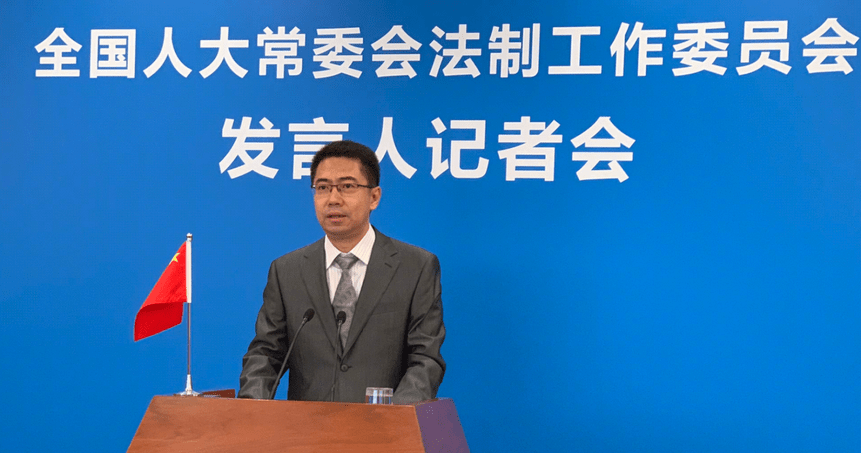
Public communications. In mid-2019, with the Central Propaganda Department’s blessing, the LAC established a new office of the spokespersons within its Research Office to “strengthen ties with the news media and better inform the public about legislative work.” The heads of the Research Office and the Legislative Planning Office have been serving as co-spokespersons. Their office can be reached at +86-10 6309-8334.
Under its current practice, the LAC generally holds a press conference a few days before each regular NPCSC session. The press conferences follow a largely fixed format. A spokesperson first previews the upcoming session, providing short summaries of selected bills on the agenda. He then gives updates on recent public consultations on draft laws, in fulfillment of the legislature’s statutory duty to disclose such information (see Legislation Law art. 40). The spokesperson typically reveals how many people have commented on a draft (online and offline) and the total number of comments received, in addition to offering terse—if not perfunctory—summaries of the comments. Since December 2022, the spokesperson has also made a point of naming specific citizens, NPC delegates, or grassroots legislative outreach offices that have provided valuable input. Finally, the spokesperson answers questions from the media—mostly pre-arranged, it appears—that allow him to discuss the relevant bills in greater detail, especially those that concern hot-button social issues.52 (Overseas media outlets have not asked a question since October 2019; it is unclear if they still have access.)
These events offer the public their only opportunity to learn about the comments submitted on draft legislation and, occasionally, about authorities’ responses as well. In 2019, for example, the spokespersons twice acknowledged public comments in support of marriage equality. Although they ruled out the possibility of legalizing same-sex marriage in China in the near future—indeed, the 2020 Civil Code [民法典] did not do so—they were among the very few (if not the only) high-level Chinese officials who have publicly addressed the issue.
Compared to the prior practice of revealing a draft’s contents only during or after a legislative session, the LAC’s pressers have brought the disclosure forward by several days. This shift, one scholar argues, has given the public “the time and opportunity” to follow and influence legislative deliberations.53 On the flip slide, however, the LAC’s pressers have, for the most part, supplanted the NPCSC General Office’s traditional post-session press conferences, where the legislature would routinely disclose vote tallies on newly enacted laws and invite senior officials to discuss them in depth. In their present format, the LAC’s press conferences cannot perform this important function.
Beyond regular pressers, the spokespersons’ office has employed other forms of media engagements to provide updates on enacted legislation, discuss the legislature’s recent work in specific areas, and explain the legal issues raised by current events—all part of its broader effort to “popularize the law.”54 For instance, after the NPC adopted Hong Kong–related decisions in May 2020 and March 2021, a spokesperson issued separate statements explaining their significance and briefly previewing next steps. On National Security Education Day in 2021, another spokesperson introduced recent national security legislation in an interview with the People’s Daily. And perhaps the best-known media appearances by the spokespersons came in spring 2020, when they gave multiple press interviews to answer legal questions arising from efforts to contain COVID-19. In one interview, a spokesperson emphasized that local governments must employ measures that “maximally” protect the rights and interests of citizens and other private entities and must not “exceed the necessary limits”—a statement that citizens later recirculated online to protest the “hard isolation” imposed during Shanghai’s spring 2022 lockdown.
The spokespersons have also issued ad hoc statements to convey the legislature’s stance on issues of public concern. They most notably did so in November 2019, during the Hong Kong anti–extradition bill protests. After a Hong Kong court struck down part of a local statute that the government had invoked to ban masks during the protests, a spokesperson issued a stern statement criticizing the ruling. He warned that the ruling had intruded on the NPCSC’s exclusive authority to interpret the Hong Kong Basic Law and threatened NPCSC intervention. (None materialized, however, likely because the statute was upheld on appeal.) More recently, on September 11, 2023, the office issued a public statement responding to strong backlash against a proposed change to the Public Security Administration Punishments Law [治安管理处罚法] that would have punished clothing or speech deemed “detrimental to the spirit of the Chinese people or hurtful to the feelings of the Chinese people.” The statement said the LAC “sincerely welcomed” public input on the bill—which, by the end of the monthlong consultation on September 30, had received almost 126,000 comments—and pledged to “carefully sort out and study” the comments and suggest improvements. The controversial language was dropped from subsequent drafts of the bill.
Conclusion
In 1885, Woodrow Wilson (then a doctoral student) famously wrote that “Congress in its committee-rooms is Congress at work.” In the NPCSC’s case, the “committee” may well refer to the LAC. It exerts significant influence throughout the legislative process, yet all its decisionmaking takes place behind closed doors. Often, elected NPCSC members are merely rubber-stamping the legislative products of LAC bureaucrats. To some scholars studying the LAC, this is what they find the most troubling. Unlike U.S. congressional committee members who are elected legislators, few on the LAC staff are even known to the public. The LAC’s bureaucratic nature raises the concern whether it will attempt to expand its own power, just like any other bureaucracy.55 Such worry complicates the reform of having the legislature take a leading role in the legislative process: In the end, who will gain more control, NPCSC members or the LAC’s “invisible legislators”?
- See 卢群星 [Lu Qunxing ], 隐性立法者——中国立法工作者的作用及其正当性难题 [Invisible Legislators: The Function and the Legitimacy Problem of Chinese Legislative Workers], 浙江大学学报(人文社会科学版) [J. Zhejiang U. (Human. & Soc. Sci.)], no. 2, 2013, at 74, 80. ↩︎
- Id. at 76. ↩︎
- See 褚宸舸 [Chu Chenge], 全国人大常委会法工委职能之商榷 [Debating the Functions of the NPCSC Legislative Affairs Commission], 民德公法网 [calaw.cn] (Jan. 17, 2017). An abridged version of this article (with the same title) was published in the China Law Review’s first issue of 2017 (at pages 191–98). ↩︎
- See id. ↩︎
- 王理万 [Wang Liwan], 立法官僚化:理解中国立法过程的新视角 [Bureaucratization of Lawmaking: New Perspective for Understanding China’s Legislative Process], 中国法律评论 [China L. Rev.], no. 2, 2016, at 114, 129. ↩︎
- See Lu, supra note 1, at 80. The seven bills were the Criminal Law [刑法], Criminal Procedure Law [刑事诉讼法], People’s Courts Organic Law [人民法院组织法], People’s Procuratorates Organic Law [人民检察院组织法], Organic Law of Local People’s Governments and Local People’s Congresses[地方各级人民代表大会和地方各级人民政府组织法], Law on Elections for the National People’s Congress and Local People’s Congresses[全国人民代表大会和地方各级人民代表大会选举法], and Chinese-Foreign Equity Joint Ventures Law [中外合资经营企业法]. For more on the LAC’s beginnings, see Lu, supra note 1, at 79–80; Wang, supra note 5, at 129–130. ↩︎
- For a detailed account of the LAC’s institutional changes through 2011, see Chu, supra note 3. ↩︎
- See Lu, supra note 1, at 80. ↩︎
- The two 2014 interviewees were working in the Office for State Law and the Office for Administrative Law, respectively; and the 2020 interviewee in the Office for Economic Law. ↩︎
- Lu, supra note 1, at 79. ↩︎
- In 2023, for example, the Office for Recording and Reviewing Regulations required applicants to hold at a minimum a master’s law degree. The Offices for Social Law and Civil Law were hiring only candidates with a master’s degree in the relevant areas of law. And, in 2025, the Office for Civil Law again required a master’s degree in civil/commercial law or civil procedure. ↩︎
- See Chu, supra note 3. ↩︎
- 蔡定剑 [Cai Dingjian], 中国人民代表大会制度 [China’s System of People’s Congresses] 492 (4th ed. 2003). ↩︎
- Id. at 476. ↩︎
- See, e.g.,于文豪 [Yu Wenhao], 宪法和法律委员会合宪性审查职责的展开 [Developing the Constitution and Law Committee’s Constitutional Review Function], 中国法学 [China Legal Sci.], no. 6, 2018, at 43, 52. ↩︎
- See, e.g., 梁洪霞 [Liang Hongxia], 备案审查柔性处理阶段的救济程序构建 [Designing Remedial Procedures for the Soft Correction Phase of R&R], 四川师范大学学报(社会科学版) [J. Sichuan Normal U. (Soc. Scis. Ed.)], no. 4, 2022, at 71, 72. ↩︎
- See 温泽彬 [Wen Zebin] & 李昱辰 [Li Yuchen], 论备案审查意见的督促纠错功能 [On the Supervisory and Error-Correcting Functions of R&R Opinions], 西南政法大学学报 [J. Sw. U. Pol. Sci. & L.], no. 1, 2024, at 14, 21–22. ↩︎
- Id. at 24; see also 赵计义 [Zhao Jiyi], 全国人大常委会法工委备案审查意见的司法功能及其限度 [The Judicial Function of the NPCSC Legislative Affairs Commission’s R&R Opinions and Its Limits], 苏州大学学报(法学版) [J. Soochow U. (L. Ed.)], no. 4, 2023, at 1, 3–6. ↩︎
- Cf. Lu, supra note 1, at 82–83 (describing similar procedures used by the LAC’s local counterparts). ↩︎
- Id. at 83. ↩︎
- Id. (quoting former Deputy Director of the LAC and Chairwoman of the 14th NPC Constitution and Law Committee Xin Chunying). ↩︎
- Id. ↩︎
- In a practice that has emerged over the last decade, the LAC is also responsible for processing the drafts prepared by Party entities and turning them into bills submitted by the Council of Chairpersons. Examples include the 2018 revision to the Civil Servants Law [公务员法] (drafted by the Central Organization Department); 2021 Foreign Relations Law [对外关系法] (drafted by the Office of the Central Foreign Affairs Commission); and 2024 revision to the National Defense Education Law [国防教育法] (drafted by the Central Propaganda Department). ↩︎
- Another feature of the NPCSC’s deliberative process is that all members are divided into small groups to discuss bills and can express their views only within the group. Professor Cai suggested that these small-group discussions allow the LAC to easily take control of the amendment power and to “arbitrarily” pick and choose elected lawmakers’ opinions. See 蔡定剑 [Cai Dingjian], 论人民代表大会制度的改革和完善 [On the Reform and Improvement of the People’s Congress System], 政法论坛 [Trib. Pol. Sci. & L.], no. 6, 2004, at 8, 17. ↩︎
- Cai, supra note 13, at 490 & n.1. ↩︎
- Chu, supra note 3; see also Cai, supra note 24, at 17–18. ↩︎
- Michael W. Dowdle, The Constitutional Development and Operations of the National People’s Congress, 11 Colum. J. Asian L. 1, 43 (1997). ↩︎
- Id. ↩︎
- Few of these internal briefs are publicly available. The LAC once released several of them within the first few years after the NPCSC began soliciting public comment online. The 2015 amendment to the Legislation Law does require the NPCSC to provide feedback to the public on the comments it has received. To comply with that requirement, the LAC has been providing oral summaries of solicited comments—much shorter than its internal briefs—at press conferences since August 2019 (see infra Section III.D). ↩︎
- See, e.g., 许安标 [Xu Anbiao] & 刘松山 [Liu Songshan], 中华人民共和国宪法通释 [General Comments on the PRC Constitution] 78–80 (2003). ↩︎
- Vague official statements have made it difficult to tell which was a first: the LAC’s issuance of such a report or its distribution to the legislature (or perhaps both). Either way, it was billed as a significant development. ↩︎
- See, e.g., 黄明涛 [Huang Mingtao], 法律案合宪性审议的实践图景、概念迁移与制度完善 [Deliberation on the Constitutionality of Legislative Bills: Practical Landscape, Conceptual Shifts, and Institutional Improvements], 比较法研究 [J. Comp. L.], no. 2, 2025, at 206, 211 (quoting 13th NPC Constitution and Law Committee Chairman Li Fei). ↩︎
- See 秦前红 [Qin Qianhong] & 罗世龙 [Luo Shilong], 论法律草案合宪性研究意见的功能与结构 [On the Functions and Structures of Research Opinions on the Constitutionality of Draft Laws], 江淮论坛 [Jianghuai Trib.], no. 3, 2025, at 21, 26 tbl.3. ↩︎
- See id. at 25–27. ↩︎
- See Huang, supra note 32, at 210–12. ↩︎
- We obtained copies of the 2022 opinions from the Kyoto branch of Japan’s National Diet Library through a Xiaohongshu-based service, and bought the 2023 Yearbook ourselves. We then shared the texts with a professor at the Southwest University of Political Science and Law, whose WeChat public account first published the documents online in early December 2024. Coincidentally, the WeChat account of the Peking University Center for Constitution and Administrative Law Studies also posted those documents a week later, though it likely obtained them directly from the publisher. ↩︎
- The NPCSC may review only whether a local law of Hong Kong or Macao is “in conformity with the provisions of [the city’s basic law] regarding affairs within the responsibility of the Central Authorities or regarding the relationship between the Central Authorities and the [city].” It may “immediately” invalidate a law that fails review by “returning” it—something it has yet to do. ↩︎
- See 梁洪霞 [Liang Hongxia], 论法律询问答复的效力 [On the Force of Legal Inquiry Responses], 重庆理工大学学报(社会科学) [J. Chongqing U. Tech. (Soc. Sci.)], no. 4, 2010, at66, 67. ↩︎
- See 褚宸舸 [Chu Chen’ge], 论答复法律询问的效力——兼论全国人大常委会法工委的机构属性 [On the Force of Responses to Legal Inquiries—and on the Institutional Nature of the NPCSC Legislative Affairs Commission], 政治与法律 [Pol. Sci. & L.], no. 4, 2014, at 87, 90. ↩︎
- The 2006 book disclosed 164 responses issued between July 1, 2000 (when the Legislation Law took effect) and the end of 2005, incorporating the ones already published in two earlier compilations from 2001 and 2002. The 2017 book published 60 responses concerning local legislative authority issued by the end of 2016 (dating as far back as 1989). ↩︎
- Liang, supra note 38, at 67. ↩︎
- See 林彦 [Lin Yan], 法律询问答复制度的去留 [On Abolishing or Retaining the System of Legal Inquiry Responses], 华东政法大学学报 [J. E. China U. Pol. Sci & L.], no. 1, 2015, at 54; 周伟 [Zhou Wei], 宪法解释案例实证问题研究 [Research on the Empirical Questions of Constitutional Interpretation Cases], 中国法学 [China Legal Sci.], no. 2, 2002, at 72, 72–79. ↩︎
- See Lin, supra note 42, at 57–58; Zhou, supra note 42, at 79. ↩︎
- See Liang, supra note 38, at 66; Chu, supra note 39, at 92; Zhou, supra note 42, at 72. ↩︎
- See Liang, supra note 38, at 69; Zhou, supra note 42, at 79. ↩︎
- See Chu, supra note 39, at 90. ↩︎
- 全国人民代表大会法制工作委员会国家法室 [Off. for State L., Legis. Affs. Comm’n, NPC Standing Comm.], 中华人民共和国立法法释义 [Annotations of the PRC Legislation Law] 197 (2015). ↩︎
- See Lin, supra note 42, at 59. Sometimes, the inquiring bodies—for instance, a State Council department—have also given the LAC’s responses universally binding effect through their own rulemaking processes. See id.; Chu, supra note 39, at 89. ↩︎
- See Liang, supra note 38, at 66 & nn.①–②, 69–70. ↩︎
- The force of the LAC’s legal inquiry responses could become relevant in future litigation under the Hong Kong Basic Law or the Hong Kong National Security Law, as explained in detail here. In its lone published response from 2024—issued at the Hong Kong government’s request—the LAC suggested a definition for “Central Authorities” and “the body of central power” that the city later incorporated into the Safeguarding National Security Ordinance. Those terms also appear in the two laws mentioned earlier. Though the LAC did not purport to interpret those laws, future litigants could nonetheless cite its suggested definition, thereby bringing the legal status of its 2024 response—and of its legal inquiry responses more broadly—into play. ↩︎
- See generally Jackson Neagli, Bend, Don’t Break: China’s Approach to the International Human Rights Order, 64 Harv. Int’l L.J. 489, 497–509 (2023); 莫纪宏 [Mo Jihong], 论中国特色社会主义人权发展道路的历史逻辑、 理论基础及基本特征 [On the Historical Logic, Theoretical Basis, and Basic Characteristics of the Socialist Path of Human Rights Development with Chinese Characteristics ], 山西师大学报(社会科学版) [J. Shanxi Normal U. (Soc. Sci. Ed.)], no. 3, 2022, at 1; 陈佑武 [Chen Youwu], 中国特色社会主义人权理论的基本范畴 [The Basic Categories of the Socialist Human Rights Theory with Chinese Characteristics], 人权 [Hum. Rts.], no. 1, 2015, at 48. ↩︎
- See 张梦奇 [Zhang Mengqi], “隐性立法者”走向台前——法工委发言人机制运作的实证考察和规范分析 [The “Invisible Legislators” Step Forward to the Stage: An Empirical Study and Normative Analysis of the Operation of the LAC’s Spokesperson Mechanism], 人大研究 [People’s Cong. Stud.], no. 8, 2022, at 22, 25. ↩︎
- Id. ↩︎
- See id. at 25. ↩︎
- See Chu, supra note 3 (arguing that the LAC arrogated to itself additional power by controlling the legislative process of the 2015 Legislation Law amendment). ↩︎
Regarding unelected and unidentified nature of committee’s member, could it be that the LAC functions like Law Office, for counselling, drafting, and lawyer speaking on behalf of the representatives?