As we previewed, on March 12, 2026, China’s National People’s Congress (NPC), approved a decision declaring that 35 instruments it adopted between 1982 and 2018 had lapsed, while confirming the continued validity of past actions taken under them.
The oldest among them, adopted together with China’s current Constitution on December 4, 1982, provided that certain provisions of the 1978 Constitution would continue to apply until the next NPC elected a new president, vice president, and NPC Standing Committee (NPCSC), which took place in June 1983. The newest instrument, adopted on March 17, 2018, prescribed voting rules for the 2018 state leadership transition at the first session of the 13th NPC.
UPDATE (Mar. 12, 2026): We have updated this post in accordance with the Code’s final text. The original version is archived here.
Editor’s Note: This post is a collaboration between NPC Observer and a group of Chinese environmental law scholars led by Feng Ge, currently a visiting scholar at the U.S.-Asia Law Institute of NYU School of Law. The other members are Jiaying Deng, Xinyu Jia, Jingxian Zhang, and Gaachi Liang. This post was written by Changhao Wei and draws on materials prepared by those scholars.
Zhangjiajie National Forest Park in Hunan Province. Photo by aphotostory (stock.adobe.com).
On March 12, 2026, China’s National People’s Congress (NPC) adopted the Ecological and Environmental Code (Code) [生态环境法典] to partially codify, with updates, China’s existing environmental laws and regulations. It is China’s second formal legal code, after the 2020 Civil Code [民法典]. The Communist Party views the latter’s enactment as a success. In 2021, Xi Jinping praised it as a “model” for codification and called for codifying other areas of law where “conditions are ripe.”
In fall 2023, the Code was chosen as the next codification project, likely due to its strong political and legal foundations. Environmental protection has been a top priority for the Party under Xi Jinping, whose “Thought on Ecological Civilization” was coined in 2018 as a component of his overarching political thought. China’s environmental law is also fairly well developed. Today, the country boasts over 30 environmental statutes, more than 100 State Council–issued administrative regulations, and many more ministerial rules and policy documents.
UPDATE (Mar. 12, 2026): We updated this post in accordance with the Law’s final text. The original version is archived here.
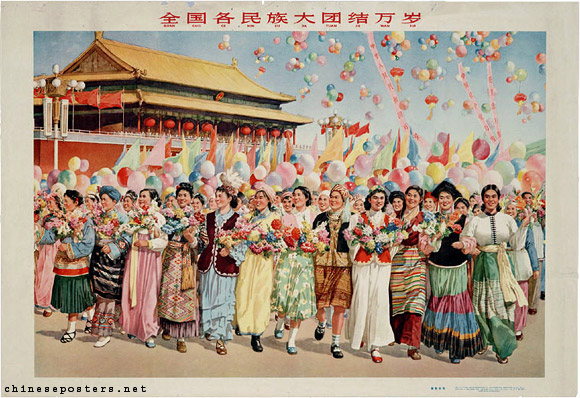
1957 propaganda poster depicting representatives of different ethnic minorities participating in a National Day parade on Tiananmen Square. The caption reads, “Long Live the Great Unity of Chinese People of All Ethnic Groups.” Original poster by Yang Junsheng. Photo via chineseposters.net. 🅮 Public domain.
On March 12, 2026, China’s National People’s Congress (NPC) adopted the Law on Promoting Ethnic Unity and Progress (Law) [民族团结进步促进法]—designed to codify General Secretary Xi Jinping’s new orthodoxy for governing China’s ethnic minorities. That doctrine, known as the “Important Thinking on Improving and Strengthening Ethnic Work,” reflects the “Second-Generation Ethnic Policies” promoted by several prominent scholars. In a nutshell, this new “assimilationist” approach aims “not just to strengthen citizens’ sense of belonging to a larger, unified Chinese nation under the Party but also to mute expression of other—in the Party’s view, competing—identities.”
Last December, China’s national legislature, the NPC Standing Committee (NPCSC), heard its Legislative Affairs Commission’s report on efforts to “clean up” [清理] China’s national laws—that is, a systematic review of existing legislation to identify outdated or inconsistent provisions. This was the NPCSC’s third comprehensive cleanup of laws since 1978.1 The first took place at the outset of the Reform Era, leading to a declaration that 148 instruments enacted or approved by the NPCSC had de facto expired. The second round occurred in 2008–09, ahead of the official declaration in 2010 that China had established “a socialist system of laws with Chinese characteristics.” It resulted in not only the repeal of eight laws, but also minor amendments to 141 provisions in 59 laws.
On December 27, 2025, the NPCSC adopted a decision approving the Commission’s report. In this “Cleanup Decision,” it also declared that 104 instruments it enacted between 1955 and 2021 had lapsed and were no longer in force, while confirming the continued validity of past actions taken under those instruments.
Neither the Commission’s report nor any legislative record associated with the Cleanup Decision has been published in the latest issue of the NPCSC Gazette, so we do not yet know the Commission’s full findings and reasoning. That said, according to the Cleanup Decision, the Commission also identified another 35 obsolete instruments enacted by the full NPC, which will address them at its 2026 session.
Below, we first provide an overview of those 104 instruments, then focus on several repeals with substantive effects, and finally discuss what may happen at NPC 2026 and beyond.
UPDATE (Mar. 12, 2026): We updated this post in accordance with the Law’s final text. The original version is archived here.
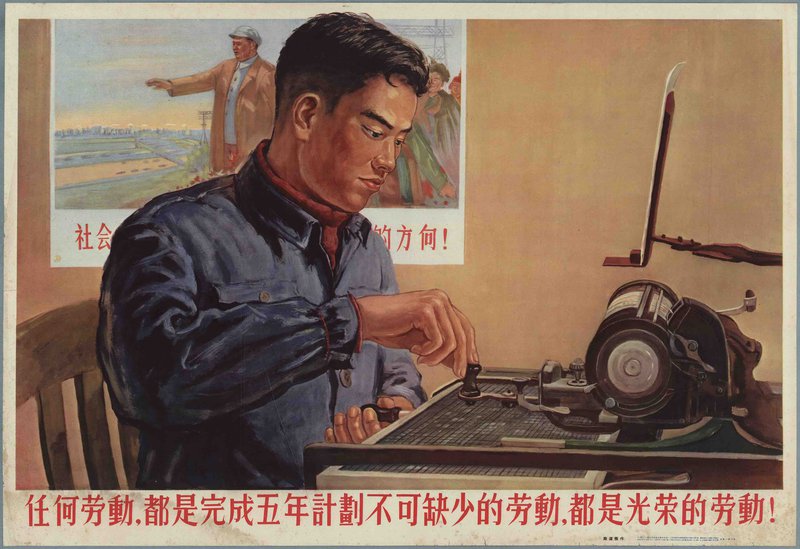
1956 propaganda poster featuring a Chinese typist and the caption “All labor contributes indispensably to the fulfillment of the [First] Five-Year Plan and is glorious work!” Original poster by Zhou Daowu. Photo via The Mao Era in Objects. 🅮 Public domain.
On March 12, 2026, China’s top legislature, the National People’s Congress (NPC), approved the 15th Five-Year Plan (FYP), a roadmap for the nation’s socioeconomic development through 2030. Alongside it, the NPC also adopted the Law on National Development Plans (Law) [国家发展规划法]—the first statute to formalize the procedures for drafting, approving, and implementing FYPs.
Developed over seven decades, the planning process now operates under a mix of written authorities and long-standing customs. In 2018, the Communist Party and the State Council issued a joint opinion imposing a range of procedural and substantive requirements for drafting and implementing FYPs. In 2021, the NPC Standing Committee (NPCSC) overhauled its Decision on Strengthening the Oversight of Economic Work (Oversight Decision) [关于加强经济工作监督的决定]—which governs, among other things, legislative oversight of the planning process. Meanwhile, other features of the process, such as the Party’s quinquennial recommendations for formulating the next FYP, continue as a matter of practice.
The Law codifies that existing regime and regulates the entire lifecycle of an FYP: from drafting (Ch. II) to legislative review and approval (Ch. III), to implementation (Ch. IV) and related oversight activities (Ch. V). Most notably, the Law spells out the Party’s role throughout the planning process. While, unsurprisingly, it contains the now-standard language that national development planning must uphold the Party’s leadership (arts. 3, 5), the Law is the first Chinese statute to assign detailed roles to Party documents and institutions.
UPDATE (Mar. 3, 2026): In a new essay for the Brookings Institution’s John L. Thornton China Center, we further elaborated and commented on the Law’s Party provisions.
Entrance to Ihlas Supermarket in Kashgar, Xinjiang on August 19, 2018. The top red banner says, in Chinese and Uyghur, “Communication starts with Putonghua.” The photographer pointed out that “the Chinese term ‘Putonghua’ [was] translated into Uyghur literally as ‘the common language.’” They also noted that the whiteboard seen above the handrail had a bilingual list of hospital-related terms titled “Learn the National Language: One Sentence a Day.” Check out the original photo for details. Photo by Kubilayaxun (Wikimedia Commons). CC BY-SA 4.0.
On December 27, 2025, China’s national legislature, the NPC Standing Committee (NPCSC), approved revisions to the 2000 Law on the Standard Spoken and Written Chinese Language (Standard Language Law or Law) [国家通用语言文字法]—a statute that defines China’s “national common language” and mandates its use across a variety of settings.
The Law’s first overhaul came after the Communist Party under Xi Jinping had elevated “forging a strong sense of community for the Chinese nation” [铸牢中华民族共同体意识] to “the main task for [its] ethnic work and all other initiatives in areas with large ethnic minority populations.” The task’s success hinges on cultivating a “deep” fivefold identification—with the motherland, the Chinese nation, the Chinese culture, the Party, and socialism with Chinese characteristics—among all ethnicities. And the key to such identification is a common language, Xi argues, calling for “comprehensive efforts to popularize the standard spoken and written Chinese language and the use of unified state-compiled textbooks, so as to facilitate shared psyche and future through communication.”
This post is the second and final part of our coverage of China’s revised Public Security Administration Punishments Law (PSAPL) [治安管理处罚法], approved by the Standing Committee of the National People’s Congress (NPCSC) on June 27 and set to go into effect on New Year’s Day. As introduced in Part 1 in more detail, the PSAPL authorizes the police to punish what are deemed minor offenses against the public order through administrative processes outside the criminal justice system. Part 1 focuses on several broader issues that arose during the revision process: the use of administrative detention, the availability of detention hearings, and the vagueness of certain offenses. This part will more comprehensively survey the changes in the revision, though it is still not intended to be exhaustive.
The PSAPL can be roughly divided into three parts: general rules on liability and punishment; offenses and penalties; and procedures for investigating and penalizing public security violations. This post will proceed in the same order. We will draw on Jeremy Daum’s overview of the revision’s first draft as well as a recent explainer by the NPCSC Legislative Affairs Commission (LAC).1 For additional information on the revised PSAPL, please see this English translation by China Law Translate or this Chinese-language comparison chart we have prepared. Inline page citations are to the LAC article, while inline statutory references are to the revised PSAPL unless context indicates otherwise.
Chinese traffic police officer stands on duty on the street in Beijing. Photo by Phuong (stock.adobe.com).
On June 27, 2025, China’s national legislature, the Standing Committee of the National People’s Congress (NPCSC), approved an overhaul of the 2005 Public Security Administration Punishments Law (PSAPL) [治安管理处罚法], bringing a 12-year legislative marathon to a close. The revised PSAPL will enter into force on January 1, 2026.
The PSAPL sits at the intersection of Chinese criminal law and administrative law. On the one hand, it is a penal statute that defines “violations of public security administration”: relatively minor public order offenses that generally correspond to more serious “crimes” in the Criminal Law [刑法]. These violations are punishable with warnings, fines, license revocations, and even detention of up to 15 days (or up to 20 days for multiple offenses). The PSAPL also lays down the procedures for investigating and punishing the violations, so it is like the Criminal Law and the Criminal Procedure Law [刑事诉讼法] rolled into one. On the other hand, the PSAPL skirts the normal criminal justice process, authorizing the police to penalize public security violations by themselves through nominally administrative proceedings. It incorporates most of the procedures under the Administrative Punishments Law [行政处罚法] and the Administrative Coercion Law [行政强制法]—which regulate, respectively, administrative punishments (e.g., fines and detention) and coercive administrative measures (e.g., investigative restraints on physical liberty and property seizures)—while adapting them to the public security context.
As the first meaningful update of the PSAPL in 20 years, the revision has introduced too many changes to recount individually. To summarize, it has tweaked the general rules of liability and punishments; added around 30 new offenses to the original 152 and modified about 20 others; increased fines across the board; and refined investigatory and decisionmaking procedures.
We will cover the revision in two parts. In this first part, we will delve into a few major changes (or sets of changes), drawing on a recent explainer by Zhang Yijian, a division head in the Office for Criminal Law within the NPCSC Legislative Affairs Commission (LAC).1 Though necessarily biased and self-congratulatory—the article portrays a legislature that tempered the more aggressive draft prepared by the Ministry of Public Security (MPS)—it explains in detail why certain changes were or weren’t made, offers glimpses of behind-the-scenes debates, and candidly acknowledges some flaws in the PSAPL regime. In the next part, we will take a more comprehensive look at the changes but without detailed analysis.
Editor’s Note: After a fast-tracked legislative process spanning just over a year, China’s national legislature, the Standing Committee of the National People’s Congress, approved the Private Economy Promotion Law [民营经济促进法] on April 30. During that time, it reviewed the bill at three consecutive sessions—in December 2024, February 2025, and April 2025—and published (only) the first draft for public comment. Following the Law’s second review, friend of the site and Senior Fellow at Yale Law School’s Paul Tsai China Center Jamie P. Horsley authored a commentary for the Brookings Institution, in which she argues:
The first draft . . . contains little new in terms of legal or policy initiatives, apart from its somewhat problematic definition of promoted private businesses. It restates existing policies and legal requirements that have failed to resolve the sector’s legal challenges, emphasizes political correctness, and seems unlikely to succeed on its own to substantially reassure private investors and spark entrepreneurial enthusiasm. [And] the draft notably excludes majority foreign-owned companies and maintains a segregation of the Chinese economy into state, [domestic] private, and foreign-owned sectors.
In this follow-up piece, Horsley highlights notable new clauses in the Law’s final version and identifies several measures that lawmakers could have incorporated to improve government compliance with the Law but ultimately did not.
By Jamie P. Horsley
Neon signs on Nanjing Road, Shanghai’s main shopping district. Photo by Luciano Mortula-LGM (stock.adobe.com).
China’s first “foundational” [基础性] law intended to support and regulate its crucial domestic private sector, the Private Economy Promotion Law (PEPL), was promulgated on April 30 and takes effect on May 20, 2025. In official commentary surrounding its drafting and adoption, authorities recognized that the private sector has faced “difficulties and challenges in terms of fair participation in market competition, equal use of production factors, obtaining investment and financing support and service guarantees, and protection of legitimate rights and interests,” due in large part, as the PEPL makes clear, to Chinese government failures to abide by legal requirements. Official commentary also asserted that the PEPL now provides a legal guarantee and institutional support for its “sustained, healthy, and high-quality development.” However, the final PEPL, like the earlier drafts discussed in my previous analysis, contains little new in terms of substantive legal requirements, protections, or policy. It rather serves to emphasize and fortify pre-existing laws—including the state Constitution—and policies that apply to, but have not been uniformly and fairly implemented with respect to, the private sector.
The following post was originally published on Verfassungsblog. Thanks to the editors of Verfassungsblog for careful editing and to Zhu Jiawei and Jeremy Daum for helpful conversations about earlier drafts of this post. The citations in this post have been reformatted in accordance with NPC Observer’s style. Additional information that may be helpful to the readers of this site, including the original Chinese of important terms, is included in brackets. Both the original post and this crosspost are published under the Creative Commons BY-SA 4.0 license. Please cite the original version.
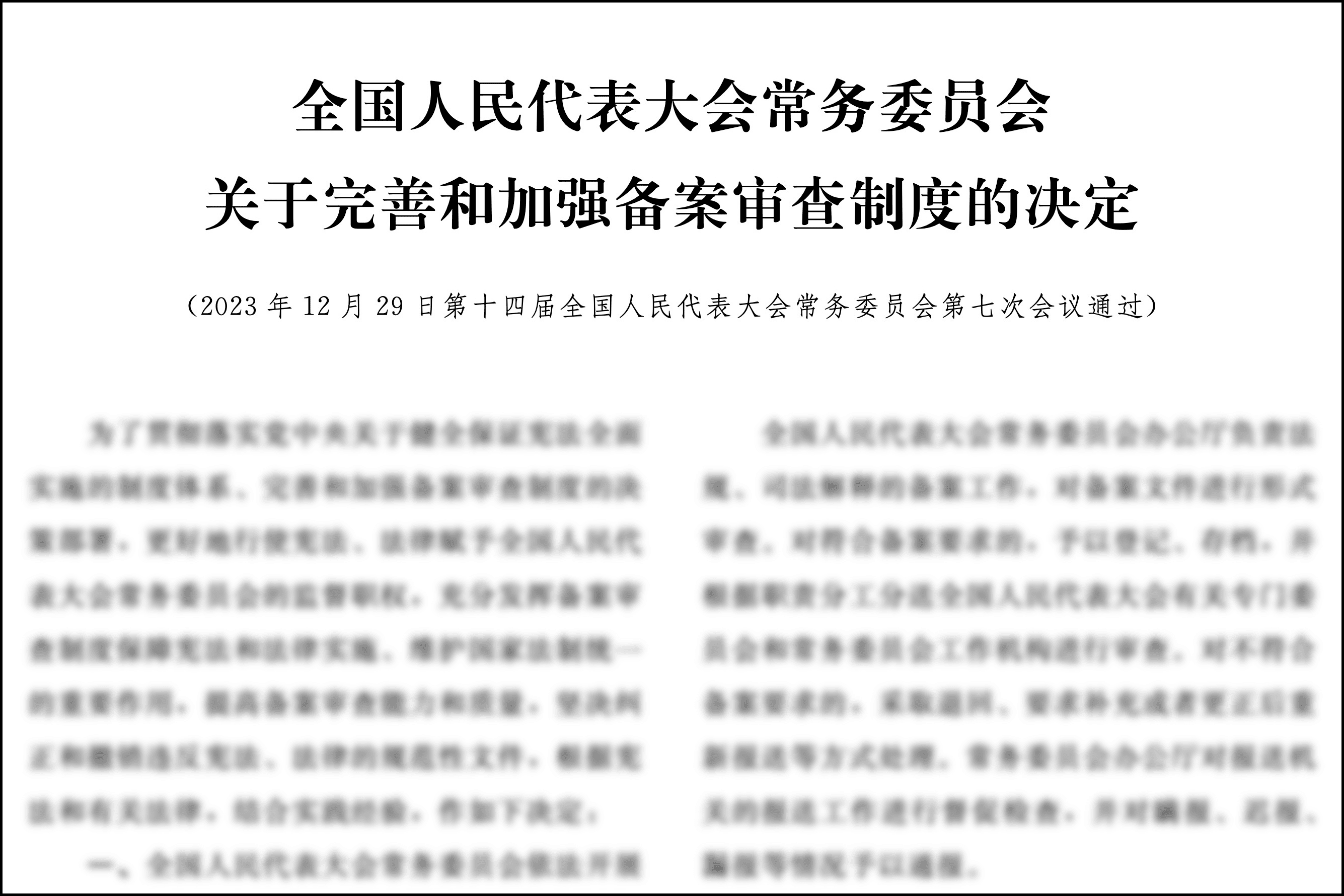
Caption and (blurred) initial paragraphs of the Decision as published in the NPCSC Gazette.
In December 2023, China’s national legislature, the Standing Committee of the National People’s Congress (NPCSC), adopted the Decision on Improving and Strengthening the System of Recording and Review (Decision) [关于完善和加强备案审查制度的决定], a major bill aimed at reforming “recording and review” (R&R) [备案审查]—China’s system of parallel processes for resolving legislative conflicts. Under R&R, an enacting body—that is, a governmental body authorized to issue documents of a legislative nature—must file its legislation with the designated reviewing body for subsequent review. The reviewing body is either a legislative or an administrative organ, as Chinese courts lack the power to review and invalidate legislation. Among all reviewing bodies, the NPCSC is the most powerful, because its jurisdiction extends to all major sub-statutory norms and it alone holds the power of constitutional review. Below, I will use “R&R” to refer just to the NPCSC’s process, as it will be the focus of this post.