
China’s top legislature, the 14th NPC Standing Committee (NPCSC), will convene for its seventeenth session from September 8 to 12, the Council of Chairpersons decided on Tuesday, August 26. According to the Council’s proposed agenda, the session will consider 16 legislative bills—the most so far during this five-year term—and hear 8 oversight reports, among other business. As usual, we preview the session’s legislative agenda in detail below.
Returning Bills
Twelve bills have been scheduled for further review.
First, the following bills return for their third—and most likely final—review:
- draft Atomic Energy Law [原子能法];
- draft Public Health Emergency Response Law [突发公共卫生事件应对法];
- draft National Parks Law [国家公园法];
- draft revision to the Arbitration Law [仲裁法]; and
- draft Law on Publicity and Education on the Rule of Law [法治宣传教育法].
Second, the draft amendment to the Food Safety Law [食品安全法] returns for a second review, and we expect it to pass as well, given it has only three articles.
Third, the draft Hazardous Chemicals Safety Law [危险化学品安全法] and the draft revision to the Prisons Law [监狱法] also return for their second review. It is likely that a third and final review awaits each.
Fourth, the draft Law on National Development Plans [国家发展规划法], too, is scheduled for a second review. At the close of its upcoming meeting, the NPCSC will likely decide to submit the bill to the 2026 NPC session for final review. Unlike recent legislation referred to the full NPC, however, this bill will have completed its first two reviews a few months ahead of schedule (the final NPCSC review for such bills typically occurs in December). So perhaps an additional round of deliberations is planned for year-end.
Finally, the NPCSC will review three divisions of the draft Ecological and Environmental Code [生态环境法典]: Part I (General Provisions), Part III (Ecological Conservation), and Part IV (Green and Low-Carbon Development). The Code also contains Part II (Pollution Prevention and Control) and Part V (Legal Liability and Supplementary Provisions). Legislative officials have long said that the Code will be presented to the full NPC for approval, so the only question is timing: Will it happen in 2026 or 2027?
Although we had initially leaned toward 2027, 2026 now appears likelier. In a since-deleted sentence in a May 27 article, Southern Weekend reported that the NPCSC would review Part IV twice and the others only once.1 We understand this to mean the number of times the Parts will be discussed separately, not as a complete bill. (The entire Code has already undergone one full review in April 2025 and is expected to be taken up again before it is submitted to the NPC.) On this timetable, the NPCSC could review Parts II and V—and Part IV again—in October, and then consider the full Code in December before sending it to the NPC. It seems unlikely that the legislature would stretch these remaining reviews over 16 months, making March 2026 the more probable end date.
New Bills
Four new bills have been submitted for review.
First, the Council of Chairpersons submitted a draft amendment to the Cybersecurity Law [网络安全法]. The Cyberspace Administration of China has sought public comment on two versions of the draft amendment in fall 2022 and spring 2025, respectively. The amendment would update only the Law’s penalty provisions. Among other changes, it would—
- impose aggravated punishments on network operators or critical information infrastructure (CII) operators that fail to perform specified cybersecurity protection duties, resulting in “grave” or “especially grave” consequences that endanger cybersecurity, such as large-scale data leaks or loss of CII functions;
- specify penalties for selling or providing critical network equipment or specialized cybersecurity products that have not undergone, or have failed, security certification or inspection;
- impose aggravated punishments on network operators that have violated their statutory obligations concerning unlawful information, “causing especially serious impacts or especially serious consequences”; and
- remove penalties for unlawful conduct now governed by the Personal Information Protection Law [个人信息保护法] or the Data Security Law [数据安全法].
We expect the amendment to pass after two reviews, potentially by the end of the year.
Second, the NPC Financial and Economic Affairs Committee submitted a draft revision to the Enterprise Bankruptcy Law [企业破产法]. You may recall that the Committee previously submitted such a revision three years ago, with the bill tentatively scheduled for the NPCSC session in December 2022 before it was taken off the agenda without explanation—a rare occurrence. To quote from our preview then:
[In 2021], the NPCSC inspected the Law’s enforcement and concluded that some of its provisions “no longer meet practical needs.” The inspection team’s report identified a number of issues in the Law’s implementation: for instance, businesses are generally reluctant to file for bankruptcy because they fear it would expose them to potential liability for mismanagement; courts frequently refuse to accept bankruptcy cases or fail to follow statutory deadlines so that such cases generally take too long to resolve; reorganization (of a debtor’s business or debts to allow for continued operation) has been underused as a form of relief; and certain special entities, like state-owned enterprises and financial institutions, face additional hurdles when filing for bankruptcy.
In addition, scholars, practitioners, and lawmakers have advocated for new rules on cross-border insolvency, substantive consolidation, prepackaged bankruptcy, and personal bankruptcy, among other matters. The revision is expected to address many of these issues. We expect it to pass after at least three reviews.
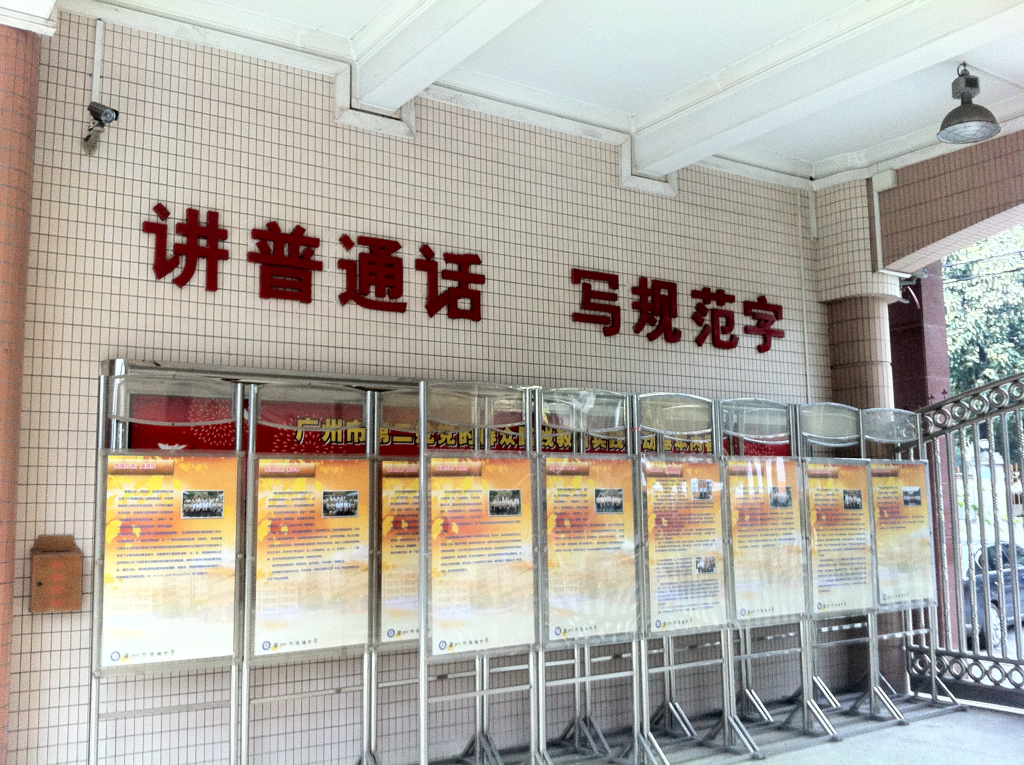
Third, the NPC Education, Science, Culture, and Public Health Committee submitted a draft revision to the Law on the Standard Spoken and Written Chinese Language [国家通用语言文字法]. This Law was enacted in 2000 to promote the use of China’s “standard spoken and written language”—Putonghua and simplified Chinese characters—in order to “facilitate economic and cultural exchanges among the various ethnicities and regions.” It enumerates the settings where the standard language must be used—including official government business, schools, radio, and television—while allowing some exceptions. Over recent decades, the Chinese government has embarked on an aggressive campaign to promote Mandarin nationwide, often at the expense of minority languages. A 2021 State Council policy document on this subject, for instance, vows to “deepen Mandarin-medium education” in ethnic areas, among other measures to popularize the common tongue. In support of this campaign, the NPCSC Legislative Affairs Commission has repudiated local regulations that permitted bilingual education in ethnic schools or gave preferences to applicants for official jobs who took exams in minority languages. The revision is expected to reflect this policy direction and pass after two or three reviews.
Finally, the State Council submitted a draft amendment to the Environmental Protection Tax Law [环境保护税法]. Enacted in 2016, this Law taxes the emission of certain air and water pollutants, solid waste, and noise. Listed taxable air pollutants include 18 specific volatile organic compounds (VOCs) (such as benzene and toluene), even though all VOCs contribute to the formation of ground-level ozone and smog. Shortly after the Law took effect in 2018, the Chinese government announced its intention to subject all VOC emissions to the levy. It most recently reiterated that goal in a joint opinion by the Communist Party and the State Council on building a “Beautiful China.” This is therefore likely to be the amendment’s focus, though other changes are likely as well. We expect the bill to pass after two or three reviews, depending on its scope.
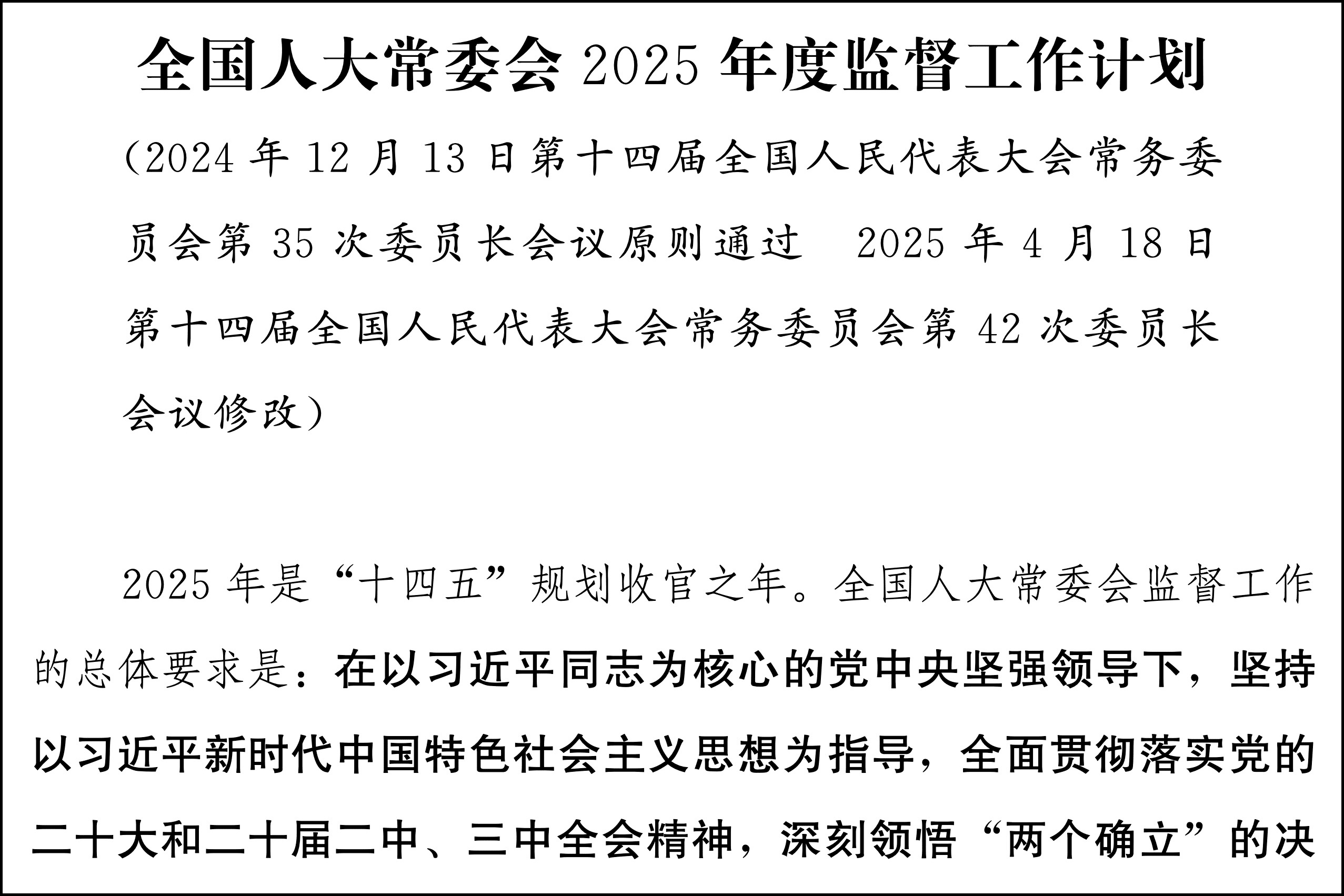
As mentioned earlier, the NPCSC will hear eight oversight reports next month, including the State Council’s three reports on the management of government debt in 2024; on efforts to respond to climate change and achieve carbon peaking and carbon neutrality; and on efforts to pilot water resource tax reforms. The NPCSC will also hear its General Office’s report on NPC components’ efforts to conduct preparatory research for the formulation of the 15th Five-Year Plan.
See our coverage of the NPCSC’s 2025 oversight plan for details:
- As far as we can tell, the original version of the article has not been archived anywhere, but we happen to have preserved that sentence in our internal chats, so you will have to trust us. The sentence read: “南方周末记者了解到,其余四编是全国人大常委会法工委牵头,这一编是全国人大环资委牵头,准备上全国人大常委会审议两次,比其他编多审议一次。” (Southern Weekend reporters have learned that NPCSC Legislative Affairs Commission is responsible for the other four Parts, while the NPC Environmental Protection and Resource Conservation Committee is responsible for this Part [i.e., Part IV], which is scheduled to be reviewed twice by the NPCSC, one more time than the other Parts.) ↩︎