

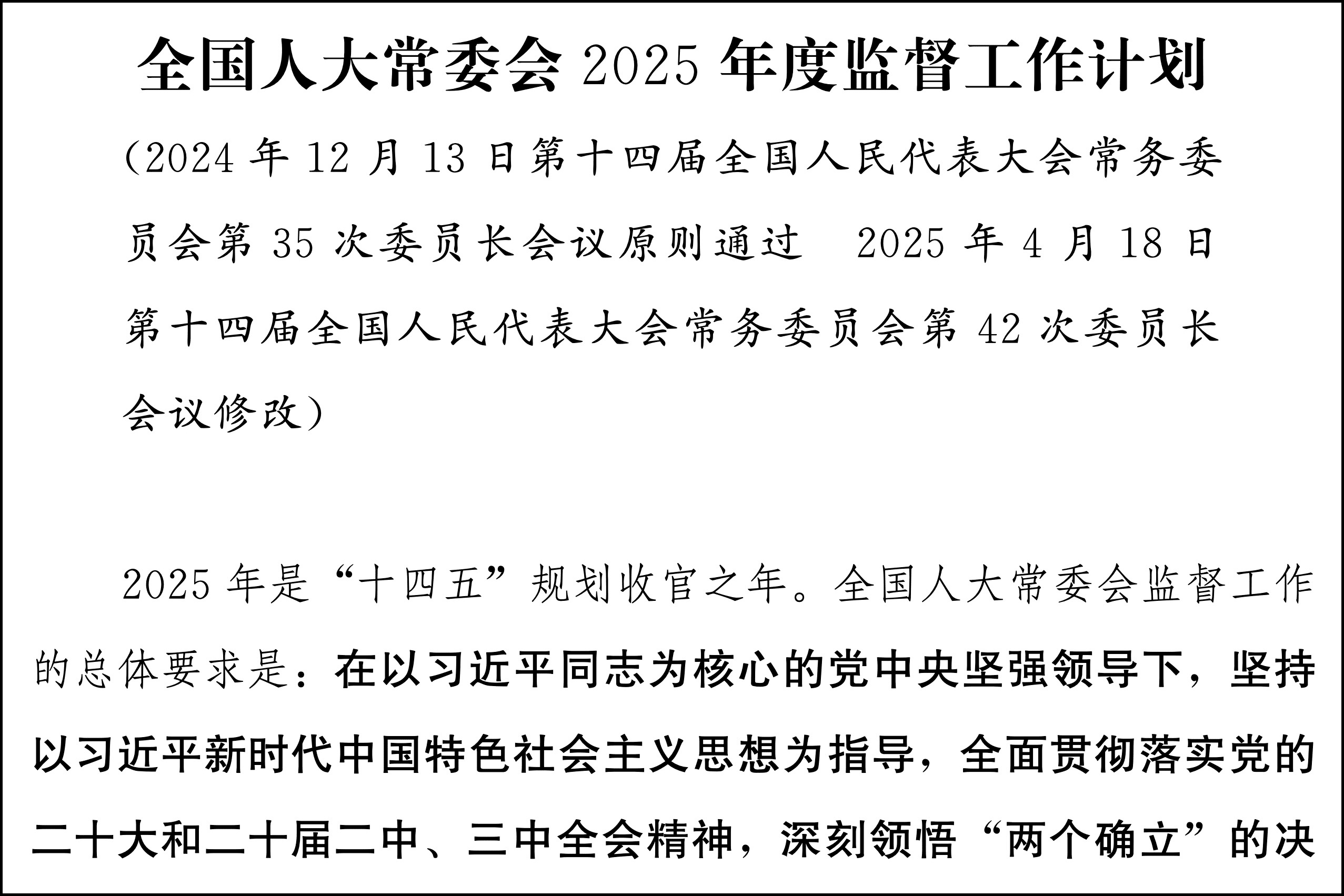
A few weeks ago, on May 14, 2025, China’s national legislature, the NPC Standing Committee (NPCSC), released its 2025 oversight plan. Today, after an eight-year hiatus, we are resuming coverage of this annual document on this site. We begin with some background before delving into the 2025 plan itself.
The full NPCSC conducts oversight primarily by reviewing reports, either submitted by the state organs subject to its oversight or produced by its subordinate bodies. Every year since 2010, it has also held two or three “special inquiries” [专题询问]—essentially Q&A sessions where lawmakers question officials on specific issues—to supplement its review of selected reports. These inquiries, as well as the follow-up oversight measures available to the NPCSC after it hears a report, are discussed here.
An annual oversight plan therefore lists the oversight projects scheduled for the year, specifying the focus of each project, the month the resulting report will be delivered, the NPC body responsible for overseeing or implementing the project, and any associated special inquiry.
According to the 2025 plan, the NPCSC will review 36 reports and discuss 25 of them.1 These reports fall into two broad categories:
- Periodic reports: All periodic reports and their contents are prescribed by law. Most are annual reports on fiscal and economic matters prepared by the State Council; a few are required every five years. All periodic reports are published.
- Non-recurring reports: Non-recurring reports, whose topics vary from year to year, can be further divided into three subcategories: (1) specialized work reports [专项工作报告] submitted by other state organs; (2) law enforcement inspection (LEI) reports [执法检查报告] issued by the NPCSC’s ad hoc LEI teams; and (3) topical research reports [专题调研报告] produced by designated NPC bodies. The first two types of non-recurring reports are publicly available. Topical research reports, however, generally serve as internal references for the legislature and other relevant state organs, and are published only when scheduled for discussion.
The reports typically follow a common structure. They start with an overview of the relevant issue (e.g., the government’s efforts in a particular area or the implementation of a particular law), then identify shortcomings and challenges, and conclude with proposed or recommended improvements. They are a rich and authoritative, if often overlooked, source of information, thus deserving our renewed attention.
But unlike our initial foray into oversight reports, we will keep our coverage simple going forward. For each oversight plan, we will provide a list of reports scheduled for discussion (thus excluding most topical research reports), while highlighting a few that we find interesting—or think our readers might—with edited machine translations of excerpts from the plan. We will otherwise keep commentary to a minimum.
Periodic Reports
In 2025, the NPCSC will hear the following twelve periodic reports, all annual unless otherwise noted.2
| Month | Report(s) |
|---|---|
| April | |
| June | |
| August |
|
| October |
|
| December |
|
* Every December since 2017, the NPCSC has heard a report by the State Council on the allocation and use of fiscal funds, though it focuses on a different area of spending each year.
More details on two of the reports due in August:
1. State Council’s annual report on the management of government debt: The report and NPCSC review will focus on “the implementation of the Party Central Committee’s decisions and plans on government debt; control over total government debt and efforts to improve its structure; the issuance of central and local government bonds and the performance of the bond market; the planning, adjustment, implementation of government debt-financed projects, as well as their use of funds and performance evaluation; the formulation and implementation of repayment plans; efforts to prevent and defuse risks from hidden local government debt, including the replacement of existing hidden debt; accountability for borrowing that violates laws or regulations; improvements to the government debt management system; the monitoring and regulation of all types of local government debt; debt monitoring and reform of local government financing platforms; the implementation of NPC and NPCSC resolutions [on budgetary matters] and the handling of the NPCSC’s deliberation opinions; and the challenges, difficulties, and proposed next steps.”
2. NPCSC General Office’s report on preparatory research for the 15th Five-Year Plan. Since late March, NPC bodies have been carrying out research on “the environment, goals, and key tasks of China’s economic and social development during the 15th Five-Year Plan period [2026–2030], along with the main challenges and difficulties, and proposed next steps.” Their collective efforts are expected to yield approximately two dozen topical research reports. While these reports won’t be released for some time, the NPCSC General Office’s August report (like its previous iteration five years ago) is expected to summarize the research reports and offer recommendations for formulating the 15th Five-Year Plan, which the NPC will approve in spring 2026.
Non-Recurring Reports
In 2025, the NPCSC will hear the following fifteen non-recurring reports, and we will highlight six of them below the chart. The NPCSC’s 2025 work priorities call for “placing greater emphasis on integrating oversight with legislation.” As a result multiple reports seem to have been scheduled to inform pending or planned legislation; any related legislative project is listed under the corresponding report.
| Month | Report(s) |
|---|---|
| April | |
| June |
|
| August |
|
| October |
|
| December |
|
1. State Council’s report on the development of new quality productive forces (June): The report and NPCSC review will focus on “the overall development of China’s new quality productive forces, the implementation of measures to promote their development, the challenges and difficulties encountered, and proposed next steps.”
2. State Council’s report on responding to climate change and achieving “dual carbon” goals (August): The report and NPCSC review will focus on “the international landscape of climate change response and China’s participation in global climate governance; progress toward binding 14th Five-Year Plan targets for reducing energy consumption and carbon emissions per unit of GDP; implementation of the 2030 nationally determined contribution (NDC) targets; development of the next round of NDC targets; progress in green and low-carbon industrial and technological development; the establishment of institutions, mechanisms, policies, and standards for responding to climate change and for achieving carbon peaking and carbon neutrality; as well as the challenges, difficulties, and proposed next steps.”
3. Supreme People’s Procuratorate’s report on procuratorial oversight of the enforcement of criminal penalties (October): The report and NPCSC review will focus on “the overall performance of the procuratorates in overseeing the enforcement of criminal penalties; their efforts to strengthen on-site supervision in prisons and detention centers; progress in promoting roving inspections of prisons and detention centers; the application of big data in the supervision of criminal enforcement; the substantive review of sentence reductions and parole; efforts to ensure the lawful use of parole and standardized implementation of [medical parole]; and strengthened oversight of sentence handover, enforcement of financial penalties in criminal judgments, and community corrections; the investigation and prosecution of crimes committed by judicial personnel in carrying out the foregoing duties; as well as the challenges, difficulties, and proposed next steps.” (This report will be heard together with the State Council’s report on the enforcement of criminal penalties.)
4. NPCSC LEI Team’s report on inspecting the enforcement of the Food Safety Law (October): The inspection will focus on “compliance with legal requirements in the area of food safety, especially in areas of widespread public concern such as online food delivery, children’s food, health supplements for the elderly, and pre-made foods; the fulfillment of regulatory responsibilities throughout the entire farm-to-table process to ensure food quality and safety across the whole supply chain; and the problems and challenges faced in enforcing the Law and related opinions and recommendations.”
5. State Council’s report on protecting the rights and interests of gig workers (December): The report and NPCSC review will focus on “the overall efforts to protect the rights and interests of workers in flexible and new forms of employment; efforts to guide and supervise enterprises in hiring in accordance with the law and to strengthen protections for relevant workers’ rights and interests; the development and improvement of mechanisms for protecting rights and interests in areas such as fair employment, wages, social insurance, health and rest, and vocational skills; as well as the challenges, difficulties, and proposed next steps.”
6. NPCSC LEI Team’s report on inspecting the enforcement of the Energy Conservation Law (December): The inspection will focus on “the implementation of green and low-carbon development principles throughout all stages and sectors of energy conservation efforts; enforcement of energy-saving management systems; operation of incentive and restraint mechanisms for energy efficiency; and the effectiveness of energy-saving schemes in key sectors and key energy-consuming entities, such as industry, construction, transportation, and public institutions; and the problems and challenges faced in enforcing the Law and related opinions and recommendations.”
- The plan also includes a section on “strengthening constitutional enforcement and supervision.” Consistent with the Communist Party’s 2024 Third Plenum Decision, it vows to establish a system for reporting on constitutional enforcement, though it does not appear the system will become operational in 2025. This section is otherwise not noteworthy. ↩︎
- We hope to publish a primer on the NPCSC’s oversight reports by the time it releases its 2026 oversight plan. The primer will introduce the annual reports in detail, so we won’t list them again when covering future oversight plans. ↩︎