The second session of China’s 14th National People’s Congress (NPC) concluded on Monday, March 11. Below we have compiled a list of all official documents from this session (except for two legislative documents the NPC has so far neglected to release). We have also linked to the submitted (i.e., draft) version of six main reports for your reference. Unless otherwise noted, the documents are available in Chinese only. The vote results for each bill and resolution are listed below in brackets, in the order of yea–nay–abstention.
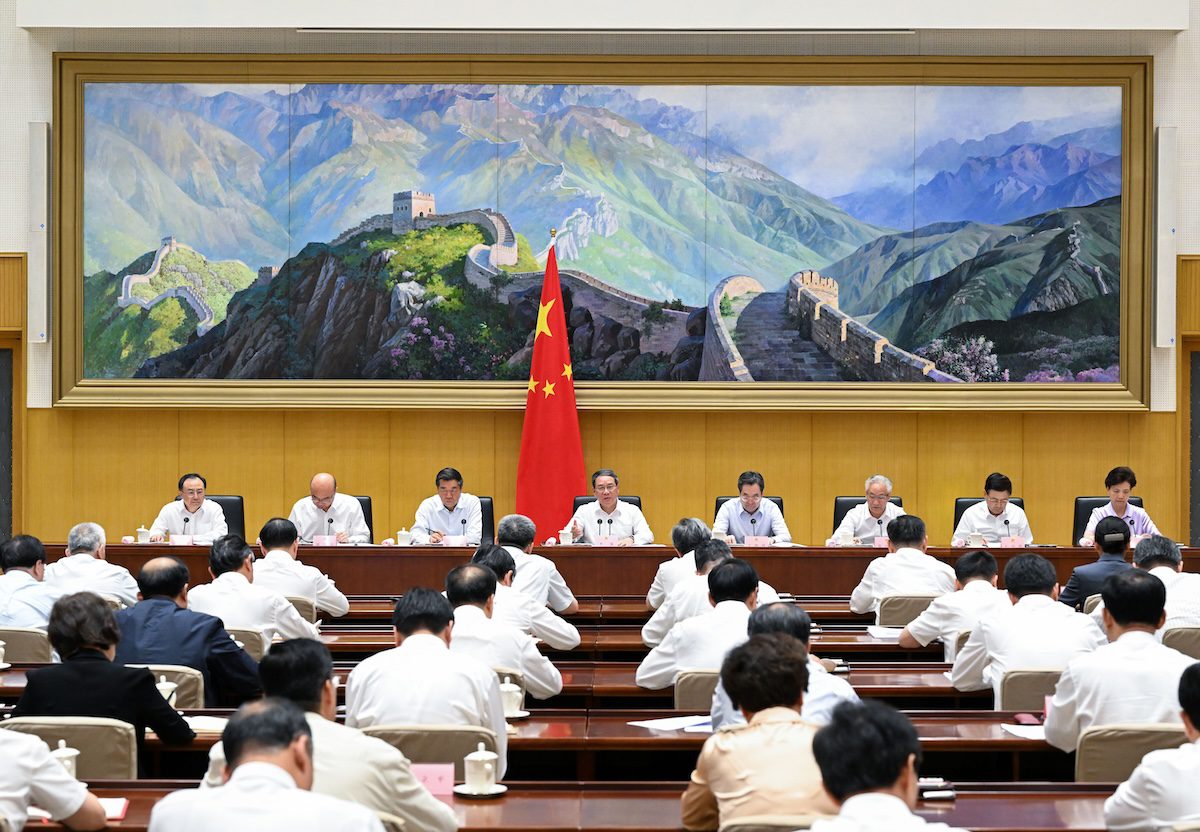
Li Qiang presides over the second plenary meeting of the State Council on August 16, 2023.
On March 11, 2024, China’s top legislature, the National People’s Congress, voted 2883 to 8, with 9 abstentions, to revise the State Council Organic Law [国务院组织法]—the first update of the statute since its enactment in December 1982. As part of a Communist Party-directed effort to “improve the organic laws of state institutions,” the revision seeks to modernize the governing statute of China’s central government. It memorializes some of the core principles and practices concerning State Council operation that have developed since 1982 and harmonizes the statute with later-enacted laws. For instance, the revision specifies the State Council’s constitutional status, guiding ideologies, and relationship with other state organs; clarifies the functions of different State Council meetings; and incorporates existing policy measures to develop a “law-based government” [法治政府]. The practical significance of these changes is thus minimal. But they nonetheless hold great symbolic value (e.g., by codifying the State Council’s duty to uphold the Party’s leadership) or can serve an important signaling purpose (e.g., by writing into law the principle of “adhering to transparency in government affairs”).
That does not change the fact, however, that the Law remains minimalist. With only 20 articles (increased from 11), it is not only the shortest state-organ organic law but also one of the shortest national laws overall. More detailed rules on the State Council’s operation are (still) found in lower-level authorities like the latest State Council Work Rules [国务院工作规则]. For this reason, instead of providing an even shorter summary, we are posting a full translation of the revised Law below, with comments on selected provisions. 🆕 marks newly added articles, whereas 🔄 marks those without substantive changes. The remaining articles were all amended to some extent, though we won’t comment on every one of them. For details, please refer to this comparison chart (in Chinese).
China’s National People’s Congress (NPC) has released its 2024 session’s agenda and daily schedule of meetings, as well as a preliminary schedule of press events during the session. This year’s session will open on the morning of March 5 and close on the afternoon of March 11, lasting seven full days, consistent with Covid-era norms. But in a break with long-standing tradition, and for the first time since 1993, the premier will not hold a press conference after this session, or during the reminder of this NPC’s term “absent special circumstances,” a spokesperson announced on March 4.
All times below are in China Standard Time (UTC +8:00). For a primer on the NPC and its annual sessions, check out this FAQ.
UPDATE (Feb. 27, 2024): The NPCSC on February 27 approved the revision to the Law on Guarding State Secrets, which will take effect on May 1, 2024. An English translation of the revised Law and a Chinese comparison chart are accessible from the bill page.
China’s top legislature, the 14th NPC Standing Committee (NPCSC), will convene for its eighth session from February 26 to 27, the Council of Chairpersons decided on Wednesday, February 7.
As expected, this two-day meeting will primarily make preparations for the NPC’s 2024 session, scheduled to open on March 5. In addition to discussing its annual work report to the NPC, the NPCSC will review a proposed itemized agenda for the 2024 NPC session, among other preparatory matters.
China’s top legislature, the 14th NPC Standing Committee (NPCSC), will convene for its seventh session from December 25 to 29, the Council of Chairpersons decided on Monday, December 18. The session’s tentative agenda includes twelve legislative bills, which we preview below.
In addition, the NPCSC adopted a decision authorizing the State Council to allow local governments to issue bonds within 60% of their annual new bond quotas before the NPC approves their annual debt ceilings for the next five years. It also approved an adjustment to the 2023 central government budget, authorizing the issuance of RMB 1 trillion of special treasury bonds for post-disaster reconstruction and related projects.
Finally, the NPCSC decided to remove Li Shangfu as defense minister, state councilor, and member of the Central Military Commission. It also removed Qin Gang from his state councilor position, after having removed him as foreign minister in July.
Before getting to the news, a note on our new link-archiving policy: After the NPC website’s recent URL change had created an acute link-rot problem for us, we announced a plan to deal with this particular incident and to prevent link rot going forward. One big change you will likely notice is that, with some exceptions, online sources subject to mainland China’s censorship regime (including all government websites) will be archived using perma.cc. Those visiting from mainland China should be aware, however, that perma.cc is blocked by the Great Fire Wall.
China’s top legislature, the 14th NPC Standing Committee (NPCSC), will convene for its sixth session from October 20 to 24, the Council of Chairpersons decided on Friday, October 13. The session will tentatively discuss ten legislative bills, in addition to a potential motion to replace China’s current defense minister. We preview these agenda items below.
UPDATE (Aug. 28, 2023): The NPCSC is expected to approve the draft revision to the Administrative Reconsideration Law, draft Foreign State Immunity Law, and draft amendment to the Civil Procedure Law on Friday, September 1. The draft revision to the Company Law will be subject to a fourth (and mostly likely final) review.
China’s top legislature, the 14th NPC Standing Committee (NPCSC), will convene for its fifth session from August 28 to September 1, the Council of Chairpersons decided on Monday, August 21. In addition to proposing an agenda that includes nine legislative bills, the Council also discussed a few other interesting matters at Monday’s meeting. We briefly discuss all those developments below.
UPDATE: On Tuesday, the NPCSC decided to remove Qin Gang as minister of foreign affairs and instead reappointed his predecessor and China’s current top-ranked diplomat, Wang Yi, to that post. Qin remains a state councilor. His removal [免职], unlike a dismissal [撤职], is not inherently considered a disciplinary action. In addition, the NPCSC has the statutory authority (under the 2021 amendments to the NPC Organic Law) to remove Qin as a state councilor, but did not exercise that power today. We won’t speculate as to why.
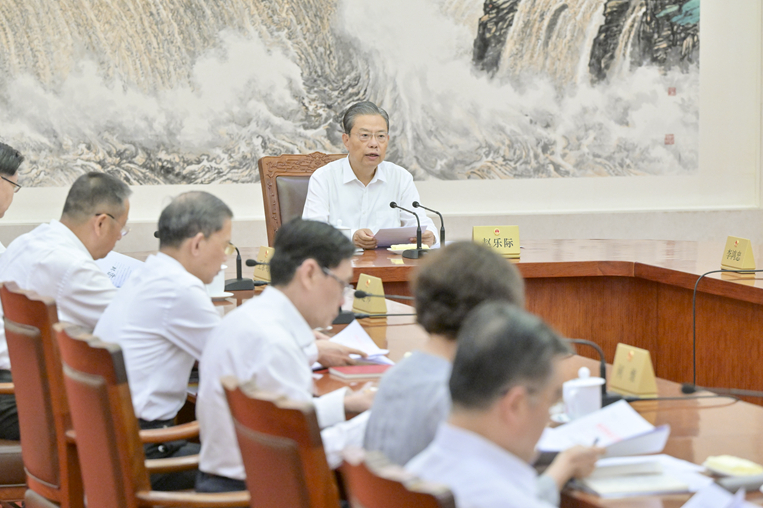
The Council of Chairpersons meeting on Monday to convene Tuesday’s NPCSC session. Photo by Xinhua.
Senior leaders of China’s national legislature, the Standing Committee of the National People’s Congress (NPCSC), decided on Monday, July 24 to convene the NPCSC for an emergency session just a day later, on Tuesday, July 25. According to the official readout of their meeting, the sole items on the session’s agenda are a draft Criminal Law Amendment (XII) [刑法修正案(十二)], which is not expected to pass on Tuesday, and unspecified personnel matters—or, in legal-speak, “bills of appointments and removals” [任免案]—which will pass and appear to be the source of the emergency.
UPDATE (June 26, 2023): The NPCSC is expected to approve the Barrier-Free Environments Development Law and the Foreign Relations Law on Wednesday, June 28.
The 14th NPC Standing Committee (NPCSC) will convene for its third session from June 26 to 28, the Council of Chairpersons decided on Friday, June 16. Eight bills, including six draft laws, are on the session’s tentative agenda, which we preview below.
The 14th NPC Standing Committee (NPCSC) will convene for its second session from April 24 to 26, the Council of Chairpersons decided on Friday. Before providing our customary rundown of the session’s legislative agenda, we’d like to first discuss our approach to covering the NPCSC’s sessions during its new five-year term—what will change and what won’t.
🔔 Read our latest newsletter for an important programming update. We also covered the 2025 report on recording and review and the delegate bills submitted during the 2026 NPC session.