

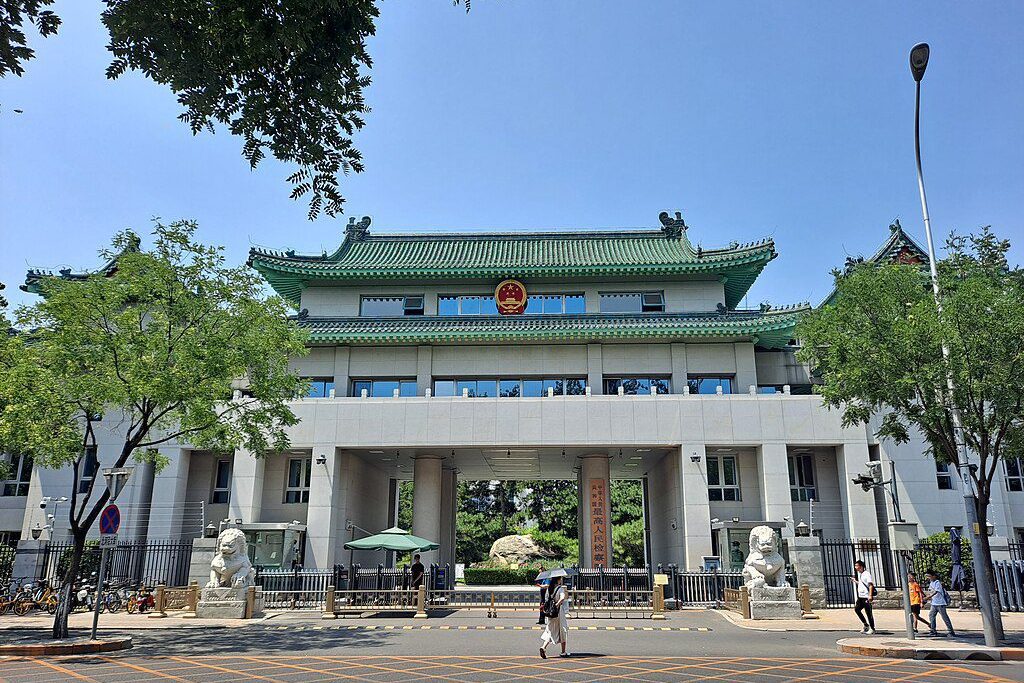
China’s top legislature, the 14th NPC Standing Committee (NPCSC), will convene for its eighteenth session from October 24 to 28, immediately after the Communist Party’s upcoming Fourth Plenum concludes on October 23, the Council of Chairpersons decided on Wednesday, October 15. According to the Council’s proposed agenda, the session will consider 9 legislative bills and hear 7 oversight reports, among other business. As usual, we preview the session’s legislative agenda in detail below.
Returning Bills
Seven bills have been scheduled for further review.
First, the draft revision to the Maritime Law [海商法] returns for its third—and most likely final—review.
Second, the following bills return for their second review and are also expected to pass:
- draft amendment to the Villagers’ Committees Organic Law [村民委员会组织法];
- draft revision to Urban Residents’ Committees Organic Law [城市居民委员会组织法];
- draft amendment to the Cybersecurity Law [网络安全法]; and
- draft amendment to the Environmental Protection Tax Law [环境保护税法].
Finally, the NPCSC will again review Part II (Pollution Prevention and Control) and Part V (Legal Liability and Supplementary Provisions) of the draft Ecological and Environmental Code [生态环境法典]. It first took these up as part of a complete draft Code in April 2025. Last month, it reviewed the other three Parts of the Code: Part I (General Provisions), Part III (Ecological Conservation), and Part IV (Green and Low-Carbon Development). By the end of this month, therefore, it will have completed a second review of the entire Code. This pace is consistent with Southern Weekend’s reporting from May, though, based on that report, we were expecting the NPCSC to discuss Part IV again this month. That said, and despite the lack of any official announcement so far, all signs still point to the Code’s final passage at the NPC session next spring.
New Bills
Two new bills have been submitted for review.
First, the NPC Supervisory and Judicial Affairs Committee submitted a draft Procuratorial Public Interest Litigation Law [检察公益诉讼法]. Public interest litigation (PIL) initiated by procuratorates—China’s organs of legal supervision—first began in July 2015, when the NPCSC authorized a pilot program for two years. (The Supreme People’s Procuratorate’s November 2016 interim report on the pilot was one of the very first developments we covered on this site.)
There are two varieties of procuratorial PIL: (1) civil PIL against private defendants who engage in unlawful conduct that harm the public interest; and (2) administrative PIL against administrative agencies whose unlawful actions or derelictions of duty harm the public interest. In June 2017, days before the two-year pilot was about to expire, the NPCSC codified the procuratorates’ new power in the Civil Procedure Law [民事诉讼法] and the Administrative Litigation Law [行政诉讼法]. The amendments originally limited the procuratorates’ jurisdiction to just a few areas, including environmental protection and food and drug safety, but subsequent legislation has expanded it to cover a dozen more areas, such as juvenile rights and cultural relics protection.
The 2017 statutory amendments require procuratorates to satisfy certain conditions before filing suit—that they must give qualified citizen groups an opportunity to sue first in civil cases and allow administrative agencies to rectify their failings in administrative cases. Beyond that, however, the amendments said nothing about the procedures that apply in PIL cases. Today, they are still primarily governed by two judicial interpretations, one issued by the Supreme People’s Procuratorate alone, and the other jointly with the Supreme People’s Court. The forthcoming Law is designed to be a comprehensive statute on procuratorial PIL, specifying issues including the scope of PIL, the jurisdiction of individual procuratorates and courts, pre-litigation procedures, evidentiary matters, trial and enforcement procedures, and remedies. We expect the Law to pass after three reviews.
Second, the State Council submitted a draft Cultivated Land Protection and Quality Improvement Law [耕地保护和质量提升法]. In September 2022, the Ministry of Natural Resources sought public comment on a draft Cultivated Land Protection Law, before the project was listed as a top-priority (i.e., Category I) project in the 14th NPCSC’s five-year legislative plan a year later. That draft, among other things, would afford special protection to “permanent basic cropland” [永久基本农田]—a subset of “cultivated land” [耕地] designated in perpetuity to meet the anticipated demand for grains and other essential agricultural products, as well as strictly control the use of cultivated land for other agricultural purposes and for construction. It also contained a chapter on improving the “quality of cultivated land,” an issue that has since become another core objective of the Law, as indicated by its current title. We expected the Law to pass after three reviews.
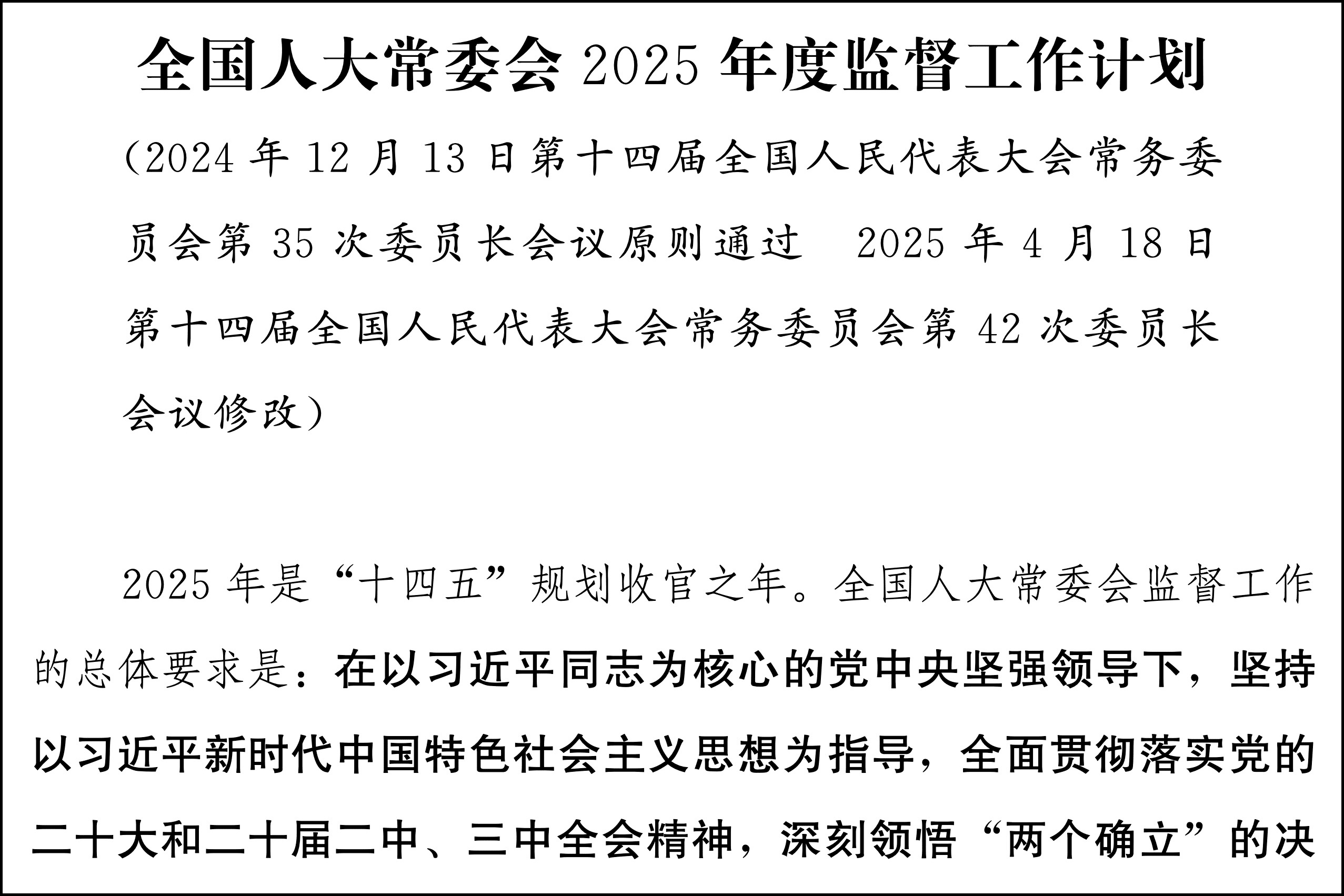
As mentioned earlier, the NPCSC will hear seven oversight reports next week, including the State Council’s annual report on financial work; the Supreme People’s Court’s report on maritime adjudication; and a report on the enforcement of the Food Safety Law [食品安全法]. Check out our coverage of the NPCSC’s 2025 oversight plan for details:
Finally, the NPCSC will ratify the Agreement under the United Nations Convention on the Law of the Sea on the Conservation and Sustainable Use of Marine Biological Diversity of Areas beyond National Jurisdiction (known as the BBNJ Agreement). It is “the first comprehensive, cross-sectoral ocean treaty in decades,” aimed at “ensuring the conservation and sustainable use of marine biological diversity of areas beyond national jurisdiction for the present and in the long term.” As of today, the Agreement has been ratified by 75 states and is scheduled to enter into force on January 17, 2026.
With contribution from Taige Hu