
As we bid farewell to 2025, we reflect on the work of the National People’s Congress (NPC) and of this publication over the past year.
The NPC in 2025

In 2025, the 14th NPC Standing Committee (NPCSC) held six sessions, lasting a total of 24 days. In March, the 14th NPC met for its third (week-long) session, during which it amended the law governing the delegates to people’s congresses. Their legislative output in 2025 was consistent with the previous year’s. Altogether, the NPC and its Standing Committee enacted 6 new laws, approved major changes to 13, adopted 3 quasi-statutory decisions, and issued 1 legislative interpretation. An additional 15 bills remain pending as of today. For details, please see the lists at the end of this section.
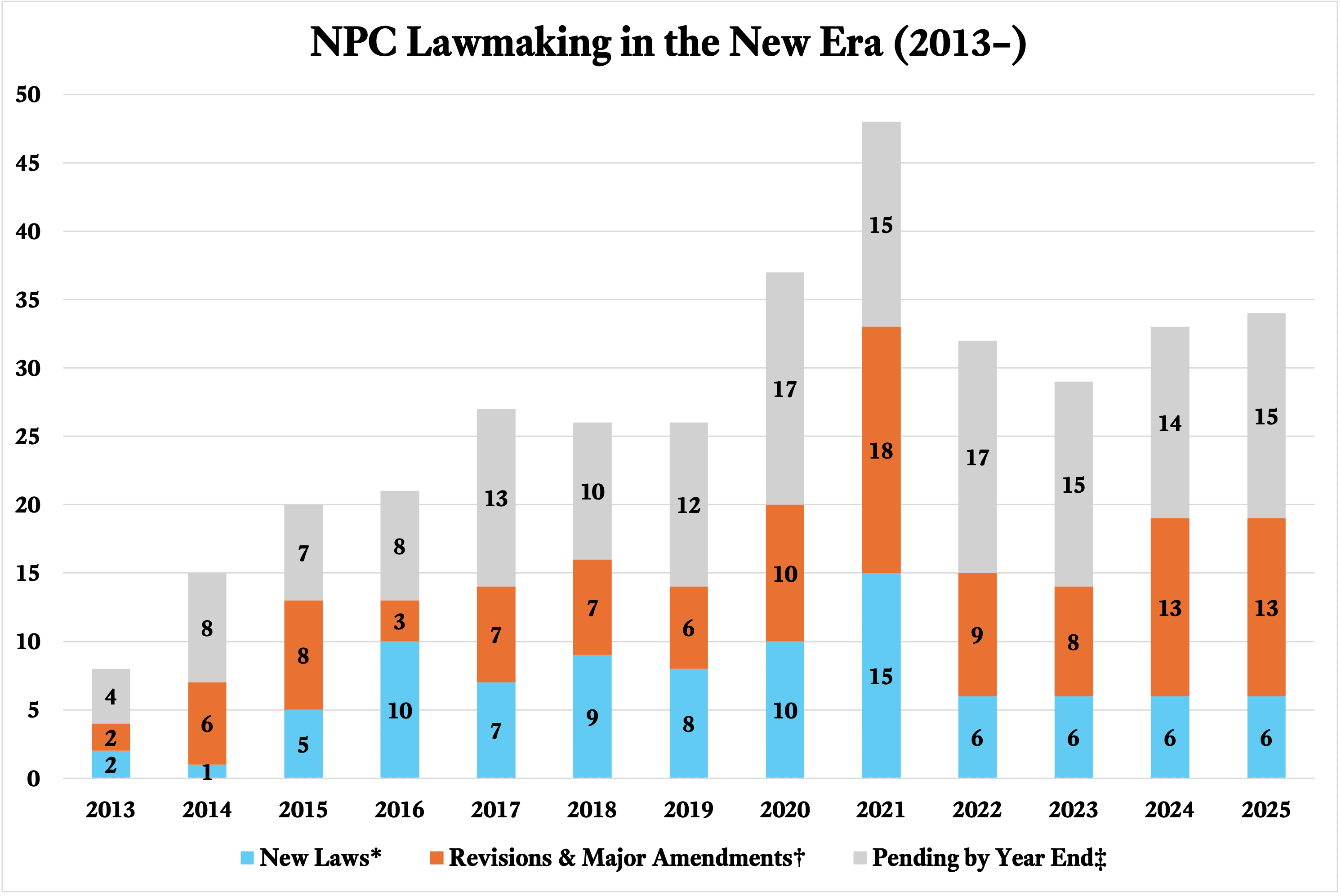
† Excluding minor amendments, including ones adopted after a single review.
‡Bills pending by the end of a given year were not all necessarily reviewed during that year.
Looking back, these were the most notable developments in the NPC’s work in 2025:
- Private Economy Promotion Law (PEPL): The NPCSC approved this law on April 30 after three reviews in rapid succession—without seeking public comment on its second draft, as would have been customary. The PEPL attracted significant global attention, though it “contains little new in terms of substantive legal requirements, protections, or policy,” as our friend Jamie P. Horsley observes in a guest commentary. Instead, the PEPL’s “impact lies in serving as a political statement of the [Communist Party]’s intent to better ensure China’s private firms continue to invest, hire, train, innovate, and otherwise contribute to the country’s socioeconomic development,” she argues.
- Ecological and Environmental Code: Since April, the NPCSC has been focusing on revising this bill, which will become China’s second formal statutory code once the NPC enacts it next spring. The Code will incorporate ten statutes in full and portions of approximately two dozen others. The NPCSC has followed roughly the same deliberative process used for the Civil Code [民法典]: it first considered the Code as a whole, then its individual parts, and finally the entire Code again, before referring it to the full NPC. This time, though, it has moved at a considerably faster pace. (The Civil Code took almost two years, counting from August 2018.)
- Controversy over record-sealing for petty offenses: On June 27, after a lengthy process, the NPCSC approved comprehensive revisions to the Public Security Administration Punishments Law (PSAPL) [治安管理处罚法], which we covered in depth here and here. Just over a month before the revised PSAPL is scheduled to take effect (on January 1), however, a hitherto obscure provision requiring record-sealing for all public security violations triggered an unexpected public backlash. We commented on the controversy in this piece for The Diplomat. Last week, the legislature finally responded to the online criticisms; we summarized and translated its statement here.
- Legislation clean-up: In 2025, the NPCSC Legislative Affairs Commission carried out a comprehensive “clean-up” of existing laws—that is, an effort to identify obsolete or internally inconsistent statutory provisions. It reported its findings and recommendations to the legislature last week. The full implications of this clean-up so far remain unclear, as the Commission’s report has not been made public. But the NPCSC took an initial step to implement the Commission’s recommendations on December 27, by confirming that 104 instruments enacted between 1955 and 2021 have lapsed and are no longer in force. At the same time, the NPCSC also disclosed that it would ask the NPC (presumably next March) to address the legal force of an additional 35 obsolete documents. We will cover this development in greater detail in early 2026.
- Legislation database upgraded: In August, the NPCSC rolled out major upgrades to the National Database of Laws and Regulations, which we reviewed here. In short, we concluded that the revamped Database would “prove to be much more valuable for the average citizen, if not for legal professionals as well.”
- 15th Five-Year Plan preparations: From March to July, various NPC components carried out preparatory research for the drafting of the 15th Five-Year Plan, due to be approved next March. This work culminated in 26 (non-public) research reports. In September, the NPCSC General Office delivered a public summary of those reports to the legislature. In the meantime, the NPCSC reviewed the draft Law on National Development Plans [国家发展规划法] three times before deciding last week to submit it to the full NPC. The Law will govern the procedures for drafting, approving, and implementing China’s five-year plans and will be adopted alongside the 15th Five-Year Plan.
- Recording and review (R&R) … for fiscal and budgetary matters: On December 22, the NPCSC Budgetary Affairs Commission reported to the legislature for the first time on its “R&R of fiscal and budgetary matters” [财政预算事项备案审查]. This report appears likely to become annual, paralleling the NPCSC Legislative Affairs Commission’s yearly reports on the more familiar form of R&R for legislation (see the next highlight). A separate R&R process for fiscal and budgetary matters is presumably necessary because the documents under review either do not qualify as legislation (e.g., local budgets) or do not fall within the NPCSC’s legislative R&R authority (e.g., ministerial documents). Requiring annual reports may push the Budgetary Affairs Commission to conduct more rigorous review, which in turn could pressure the relevant administrative bodies to stay within the boundaries of their delegated authority. We will have more to say about this report soon.
- Recording and review of local legislation: The NPCSC Legislative Affairs Commission also delivered its annual R&R report on December 22. Two of the disclosed decisions cited the Constitution, though neither relied on it exclusively. One rejected local rules requiring people with disabilities to hold a local hukou to register motorized wheelchairs; the other disapproved a local government policy barring those with criminal records from obtaining a local hukou. Once again, the report offered little reasoning for these decisions—an omission that becomes increasingly difficult to justify as the years go by. So perhaps the true highlight of the report is that, in 2025, Chinese citizens submitted a record 6,705 petitions for review, despite the legislature’s continued unwillingness to promptly provide full explanations. We will delve deeper into this report in the next issue of our newsletter.
New laws (and one legislative interpretation) passed in 2025
- Private Economy Promotion Law [民营经济促进法] (Apr. 30)
- Atomic Energy Law [原子能法] (Sept. 12)
- Public Health Emergency Response Law [突发公共卫生事件应对法] (Sept. 12)
- National Parks Law [国家公园法] (Sept. 12)
- Law on Publicity and Education on the Rule of Law [法治宣传教育法] (Sept. 12)
- Hazardous Chemicals Safety Law [危险化学品安全法] (Dec. 27)
- Interpretation of Article 292 of the PRC Criminal Procedure Law [关于《中华人民共和国刑事诉讼法》第二百九十二条的解释] (Dec. 27)
Revisions & major amendments passed in 2025
- Amendment to the Law on the Delegates to the National People’s Congress and Local People’s Congresses [全国人民代表大会和地方各级人民代表大会代表法] (Mar. 11)
- Revision to the Law on the Prevention and Control of Infectious Diseases [传染病防治法] (Apr. 30)
- Revision to the Public Security Administration Punishments Law [治安管理处罚法] (June 27)
- Revision to the Anti–Unfair Competition Law [反不正当竞争法] (June 27)
- Revision to the Arbitration Law [仲裁法] (Sept. 12)
- Amendment to the Food Safety Law [食品安全法] (Sept. 12)
- Revision to the Maritime Law [海商法] (Oct. 28)
- Amendment to the Villagers’ Committees Organic Law [村民委员会组织法] (Oct. 28)
- Revision to the Urban Residents’ Committees Organic Law [城市居民委员会组织法] (Oct. 28)
- Amendment to the Cybersecurity Law [网络安全法] (Oct. 28)
- Amendment to the Environmental Protection Tax Law [环境保护税法] (Oct. 28)
- Revision to the Fisheries Law [渔业法] (Dec. 27)
- Revision to the Civil Aviation Law [民用航空法] (Dec. 27)
- Revision to the Law on the Standard Spoken and Written Chinese Language [国家通用语言文字法] (Dec. 27)
- Revision to the Foreign Trade Law [对外贸易法] (Dec. 27)
Legislative bills pending by the end of 2025
- Draft Financial Stability Law [金融稳定法] (reviewed in Dec. 2022 & June 2024)
- Draft Ecological and Environmental Code [生态环境法典] (reviewed in Apr., Sept., Oct. & Dec. 2025)
- Draft Law on National Development Plans [国家发展规划法] (reviewed in Apr., Sept. & Dec. 2025)
- Draft revision to the Prison Law [监狱法] (reviewed in Apr. & Sept. 2025)
- Draft Social Assistance Law [社会救助法] (reviewed in June 2025)
- Draft Healthcare Security Law [医疗保障法] (reviewed in June 2025)
- Draft Law on Promoting Ethnic Unity and Progress [民族团结进步促进法] (reviewed in Sept. & Dec. 2025)
- Draft Enterprise Bankruptcy Law [企业破产法] (reviewed in Sept. 2025)
- Draft Cultivated Land Protection and Quality Improvement Law [耕地保护和质量提升法] (reviewed in Oct. 2025)
- Draft Procuratorial Public Interest Litigation Law [检察公益诉讼法] (reviewed in Oct. 2025)
- Draft State-Owned Assets Law [国有资产法] (reviewed in Dec. 2025)
- Draft Childcare Service Law [托育服务法] (reviewed in Dec. 2025)
- Draft Antarctic Activities and Environmental Protection Law [南极活动与环境保护法] (reviewed in Dec. 2025)
- Draft Banking Supervision and Administration Law [银行业监督管理法] (reviewed in Dec. 2025)
- Draft revision to the Trademark Law [商标法] (reviewed in Dec. 2025)
Quasi-statutory decisions passed in 2025
- Decision on Authorizing the State Council to Temporarily Adjust the Application of Relevant Provisions of the PRC Seed Law in the China (Xinjiang) Pilot Free Trade Zone [关于授权国务院在中国(新疆)自由贸易试验区暂时调整适用《中华人民共和国种子法》有关规定的决定] (Apr. 30)
- Decision on Establishing the Commemoration Day of Taiwan’s Restoration [关于设立台湾光复纪念日的决定] (Oct. 24)
- Decision on Approving the NPCSC Legislative Affairs Commission’s Report on Efforts to Clean Up Legislation and Disposition Opinions [关于批准《全国人民代表大会常务委员会法制工作委员会关于法律清理工作情况和处理意见的报告》的决定] (Dec. 27)
NPC Observer in 2025
In 2025, here on our main site, we published 35 posts and received almost 128,000 pageviews—a roughly 10% drop from 2024, though still our second-best year to date—by just over 67,000 visitors from 177 jurisdictions worldwide. Readers from the United States (based on recorded IP addresses) again contributed the most traffic, followed by those from Hong Kong, Mainland China, Singapore, the United Kingdom, Germany, and India.
Not counting email opens, our most popular post published in 2025 was the report on the agenda and daily schedule of the 2025 NPC session, followed by Jamie P. Horsley’s guest commentary on the Private Economy Promotion Law. Two older posts—on the allocation of seats in the NPC and China’s leadership transition process, respectively—continued to attract significant traffic.
Unsurprisingly, The Primate Economy Promotion Law [民营经济促进法] page was the most viewed bill page™️ in 2025, followed by those for the Anti–Foreign Sanctions Law [反外国制裁法], Civil Code [民法典], Ecological and Environmental Code [生态环境法典], Public Security Administration Punishments Law [治安管理处罚法], Law on Promoting Ethnic Unity and Progress [民族团结进步促进法], and Cybersecurity Law [网络安全法].
On our Substack newsletter, NPC Observer Monthly, we published nine recaps (including a triple issue) and six special issues in 2025. In the recaps, we supplemented the coverage here with discussions of additional topics, including NPC special committees’ reports on 2024 delegate bills; China’s new laws on infectious diseases, national parks, and neighborhood committees; and the recent decline in delegate bills. The special issues featured our commentary in the Made in China Journal on the 2024 retirement-age legislation; a discussion of proposed changes to the State Council’s regulation-making procedures; and translations of the State Council’s reports to the NPCSC on “new quality productive forces” and China’s climate actions, respectively. If those sound interesting to you, consider subscribing to the newsletter today.
In 2025, we began covering the NPCSC’s oversight work more seriously, beyond R&R. We published a report on its 2025 oversight plan (the first such post since 2017) and translated two oversight reports it heard last year for our newsletter (as mentioned above). With large language models making it much easier to produce quality translations of lengthy, jargon-heavy policy reports, we intend to continue such coverage in 2026.
Finally, we gave this website a major facelift last year. With new fonts (both Chinese and English), refined colors, and a new hyperlink style, in addition to interactive enhancements, we aim to continue making the site easier to use and more enjoyable to read. This also serves as a reminder to email subscribers that you should consider reading new posts directly on our site for the full experience.
That concludes our programming in 2025. Best wishes to everyone in 2026.
Happy New Year!