


After a decade of development, the National People’s Congress (NPC), China’s national legislature, launched the National Database of Laws and Regulations (Database) [国家法律法规数据库] on February 24, 2021. Initially approved for development in 2011, the Database was deployed for testing in November 2018. By January 202, all data had been uploaded, and the following month it was opened for trial use by select institutions. While recognizing its scale, ambition, and laudable goal, we nonetheless thought the Database’s initial version—which we will call “Phase I”—missed the mark. Due to glaring gaps in coverage and a broken search function, it was “good for reading the documents you are able to locate, but not much more,” we wrote.
Four and a half years later, the NPC quietly rolled out major upgrades to the Database on August 20, 2025. While this new version—or “Phase II”—has the same coverage (with a caveat, as we will note below), there have been significant improvements on all other fronts: it has a more modern look, upgraded core functionalities, and useful new features. In short, we believe Phase II will prove to be much more valuable for the average citizen, if not for legal professionals as well.
In this guide and review, we introduce the Database’s current collection, redesigned homepage, browsing and search experience, and individual document pages. Its WeChat Mini App has received similar upgrades, but we decided not to review it this time.
Current Collection
Like Phase I, Phase II still hosts only (1) the enactments of the NPC and its Standing Committee (NPCSC) and (2) legal instruments that other state organs file with the NPCSC for recording. The Database now groups these documents into six Level 1 categories, most with one or two levels of subcategories, as shown in the table below.
| # | Level 1 | Level 2 | Level 3 |
|---|---|---|---|
| 1 | Constitution [including Amendments] 宪法 | / | / |
| 2 | 法律 Laws | 法律 Laws | 7 official areas of law |
| 法律解释 Legislative Interpretations | / | ||
| 有关法律问题和重大问题的决定(部分)* Decisions on legal issues and major issues (partial) | / | ||
| 修正案** Amendments | / | ||
| 修改、废止的决定 Amending or repealing decisions | / | ||
| 3 | 行政法规 Administrative regulations | 行政法规 Administrative regulations | / |
| 修改、废止的决定 Amending or repealing decisions | / | ||
| 4 | 监察法规*** Supervision regulations | / | / |
| 5 | 地方法规 Local legislation | 地方法规**** [Ordinary and special] local regulations | 地方性法规 Local regulations |
| 自治条例 Autonomous regulations | |||
| 单行条例 Separate regulations | |||
| 经济特区法规 Special economic zone regulations | |||
| 浦东新区法规 Pudong New Area regulations | |||
| 海南自由贸易港法规 Hainan Free Trade Port regulations | |||
| 法规性决定 Regulation-like decisions | / | ||
| 修改、废止的决定 Amending or repealing decisions | / | ||
| 6 | 司法解释 Judicial interpretations | 高法司法解释 Supreme People’s Court judicial interpretations | / |
| 高检司法解释 Supreme People’s Procuratorate judicial interpretations | / | ||
| 联合发布的司法解释 Joint judicial interpretations | / | ||
| 修改、废止的决定 Amending or repealing decisions | / |
* “Decision on legal issues” [有关法律问题的决定] is a long-standing category of legislation; see this post for details. Since 2017, this category has been expanded to also cover “decisions on major issues” [有关重大问题的决定], without distinguishing between the two types of decisions.
** On the difference between “amendments” [修正案] and “amending decisions,” see this post. To date, “amendments” have been used only to amend the Criminal Law [刑法].
*** “Supervision regulations” [监察法规] does not have the subcategory “amending or repealing decisions” because the State Supervision Commission has so far issued only one such regulation (in 2021) and subsequently updated it through “revision” [修订]—that is, by substituting a new text (in 2025).
**** Autonomous, separate, special economic zone, Pudong New Area, and Hainan Free Trade Port regulations are what we term “special local legislation.” What makes them “special” is that, unlike “ordinary” local legislation—the local regulations enacted by municipal or provincial legislatures—they may contradict, or “vary” [变通], national law in some circumstances.
There is a marked delay in updates. For example, the recent judicial interpretation on labor disputes that the Supreme People’s Court promulgated on July 31—widely discussed in China and abroad—was still unavailable as of September 21, even though it should have been filed with the NPCSC by the end of August.
And, like Phase I, Phase II does not include the remaining—and second-largest—category of Chinese legislation: “rules” [规章], which consist of the “departmental rules” [部门规章] issued by central agencies and “local government rules” [地方政府规章] issued by provincial and municipal governments. Nor does Phase II carry the generally binding, albeit non-legislative, normative documents issued by governmental authorities nationwide.
To partially make up for this gap in coverage, since August 2022, the Database has linked to two other databases on its homepage (see next section): the National Database of Rules [国家规章库] managed by the Ministry of Justice, and the Database of Treaties [条约数据库] run by the Ministry of Foreign Affairs.
Homepage
Phase II offers a redesigned, simplified homepage, with the following six main sections.
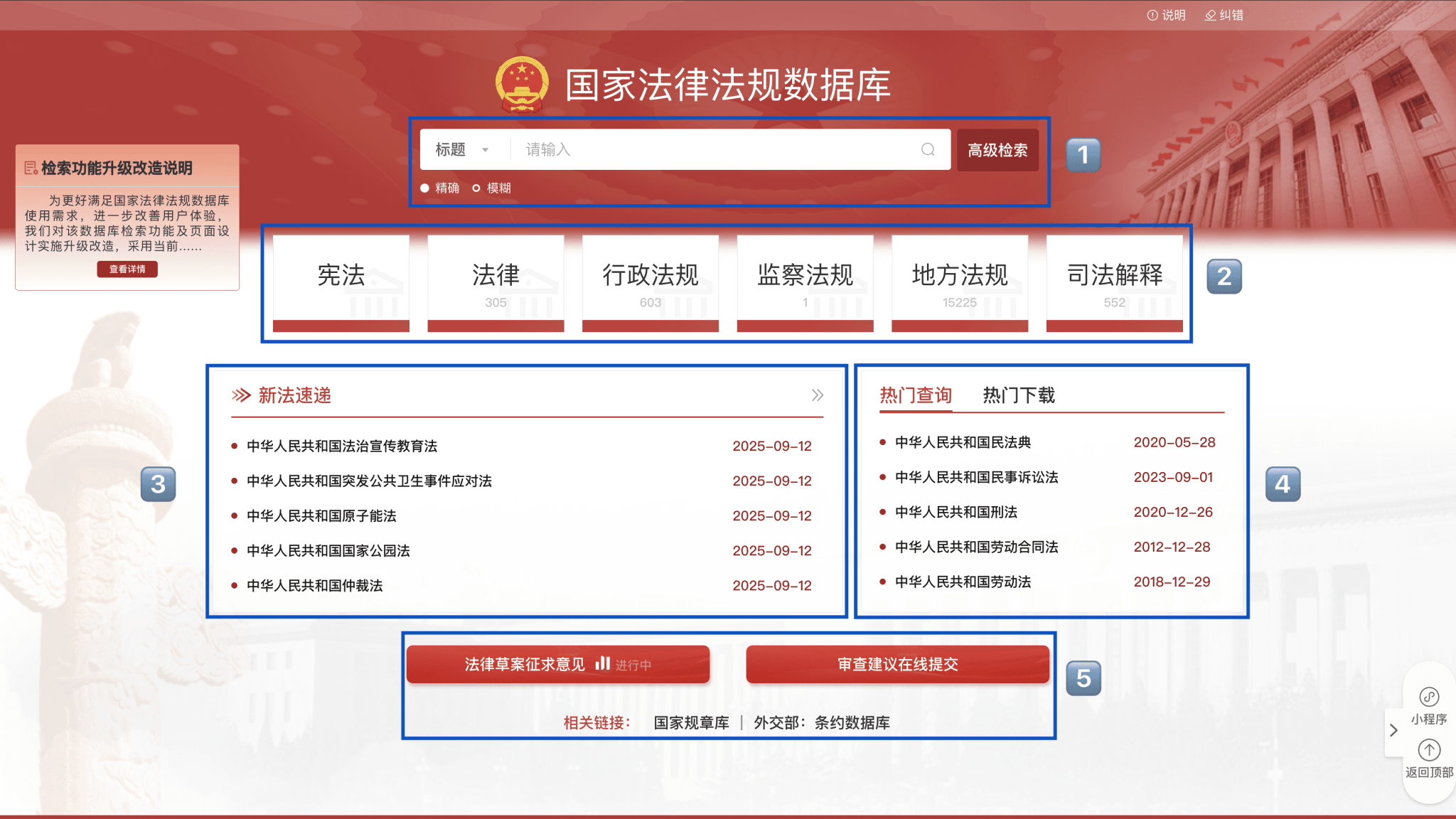
Across the top and below the site title is a search bar (Fig. 1, box 1). You can search by “title only” [标题] or “full text” [正文] (title and body text) and choose either “exact” [精确] or “fuzzy” [模糊] match (the latter is the default). To the right of the search bar is a button for “Advanced Search” [高级检索]. We will delve into the search function in the next section.
Below the search bar are six panels, one for each of the Level 1 categories introduced earlier (Fig. 1, box 2). Each panel (save the one for the Constitution) simply displays the category name and the number of current authorities within the category (or an unspecified subset thereof). The panel for “Laws,” for example, shows “305” as of September 21, reflecting only the (outdated) number of effective statutes as of June 27 (it is now 309)—excluding other documents (e.g., legislative interpretations) within that category. Phase II no longer displays the latest legislation in each category on the homepage.
Below those six panels are two sections side by side. The one on the left—“新法速递”—shows the latest legislation added to the database (Fig. 1, box 3). On the right, you can switch between two other lists: “热门查询” (Most Viewed) and “热门下载” (Most Downloaded) (Fig. 1, box 4). The Civil Code [民法典] tops both lists at the moment.
Toward the bottom of the homepage are two sets of links (Fig. 1, box 5). The first (added in October 2021) links to two other NPC platforms: the site for commenting on draft laws (an animated icon shows there is an ongoing public consultation), and the site where citizens may request the NPCSC to review regulations (i.e., Categories #3–6 combined) and judicial interpretations. The second set (added in August 2022) links to the database of rules and treaties mentioned earlier.
Browsing and Searching
Phase II has combined browsing and searching into a unified interface: search criteria now function like preset filters that narrow down the documents shown.
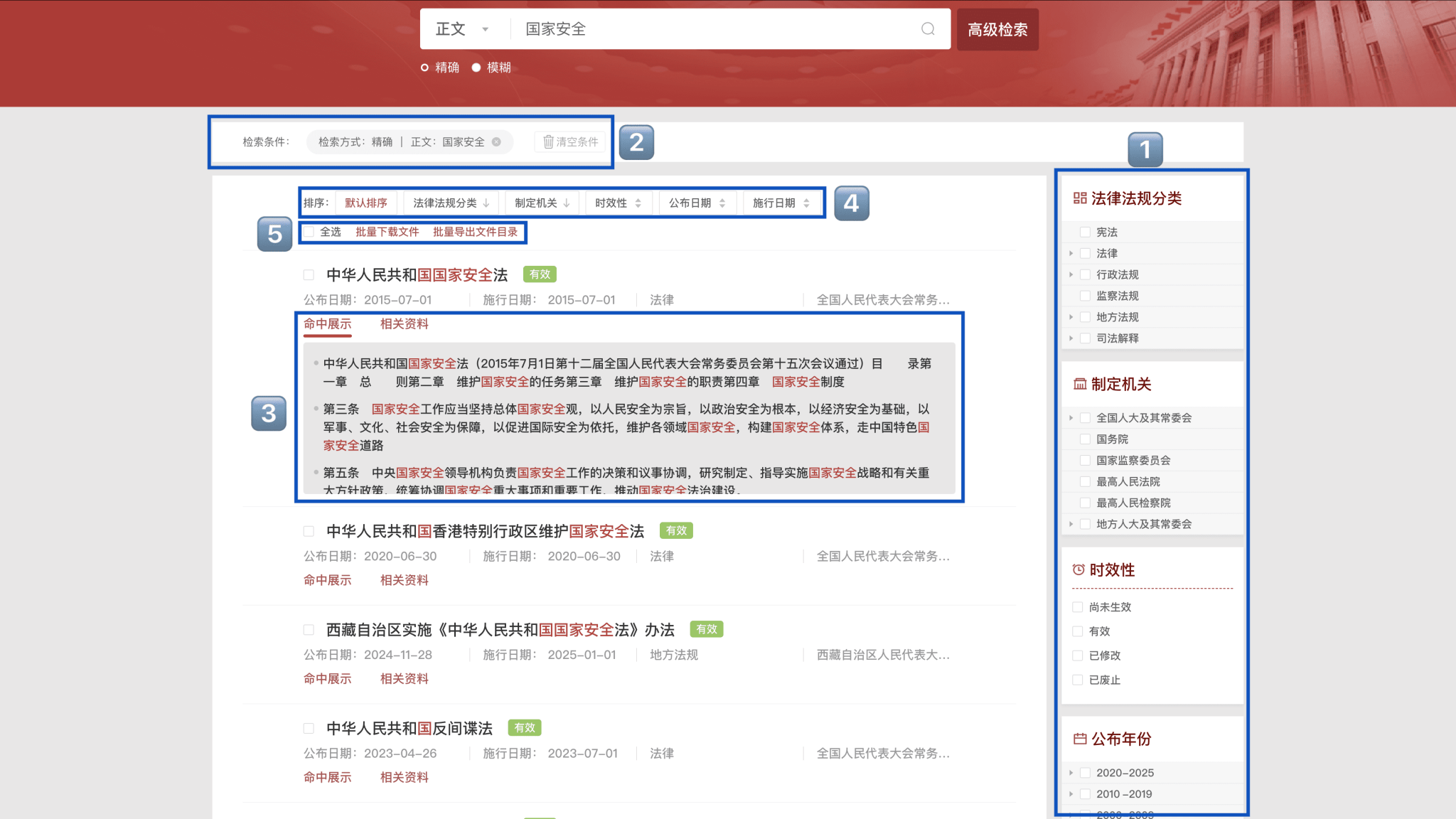
(1) Criteria. As shown on the right of the interface, Phase II offers the following preset filters (Fig. 2, box 1):
- 法律法规分类 (Categories of Law and Regulations), which include all three levels of categories shown in the table above;
- 制定机关 (Enacting Organs): NPC, NPCSC, State Council, State Supervision Commission, Supreme People’s Court, Supreme People’s Procuratorate, and local people’s congresses (down to the provincial level only).
- 时效性 (Effectiveness): not yet effective, effective, amended, and repealed; and
- 公布年份 (Year Promulgated): decade or year, from 1949 onward.
Selected filters appear in the “检索条件” (Active Criteria) bar on top of the results (Fig. 2, box 2). (If no filter is selected, the Database shows the newest legislation by default.) Basic search adds an additional criterion that includes the keywords entered, the type of match (exact or fuzzy), and the field searched (title or full text).
(2) Basic search. The Database’s search function has received significant improvements. Not only is it now working properly (it did not during Phase I, for quite some time), but there are new features as well. As a demonstration, we searched for legislation that contains “国家安全” (national security).
As soon as we typed in the keyword, the search bar offered several search suggestions—commonly used or legally significant phrases that contain our input (Fig. 3). Though not shown in the screenshot, Phase II now also supports search history, which appears once you click on the search bar.

On the results page, Phase II has added a useful new feature—“命中展示” (Display of Hits)—that shows a few snippets from a responsive document with the keyword appearing in red (Fig. 2, box 3).
On this page, you can also view a list of the “Relevant Materials” [相关资料] associated with each document (Fig. 2, box 3; not selected in the screenshot), available only for documents issued since around four or five years ago, depending on the category. For the enactments of people’s congresses, these include the drafter’s explanation, accompanying legislative reports, and the promulgating instrument (e.g., presidential order for a national law). For other types of legislation, however, only the promulgating instrument is available (e.g., order of the State Council for an administrative regulation).
Finally, you can sort the results by category of legislation, enacting organ, effectiveness, date of promulgation, or date of effectiveness (Fig. 2, box 4). Phase II now also lets you download all documents shown on the current page—up to 100 at a time—as Word documents compressed into a Zip file, by “selecting all” [全选] and clicking on “批量下载文件” (Fig. 2, box 5). You can also download (by clicking on “批量导出文件目录”) a spreadsheet of the results (Fig. 2, box 5), which includes the titles, dates of promulgation and effectiveness, and legislative categories (though, as of September 21, you must manually change the file extension from .xlsx to .xls for it to open properly).
(3) Advanced search. Advanced search allows for finding the relevant documents with greater precision. In addition to the preset filters listed earlier, you can also search for (Fig. 4, box 1)—
- the titles of “Relevant Materials”;
- the full text of “Relevant Materials”;
- the date of promulgation (exact start and end dates required); and
- the date of effectiveness (same).
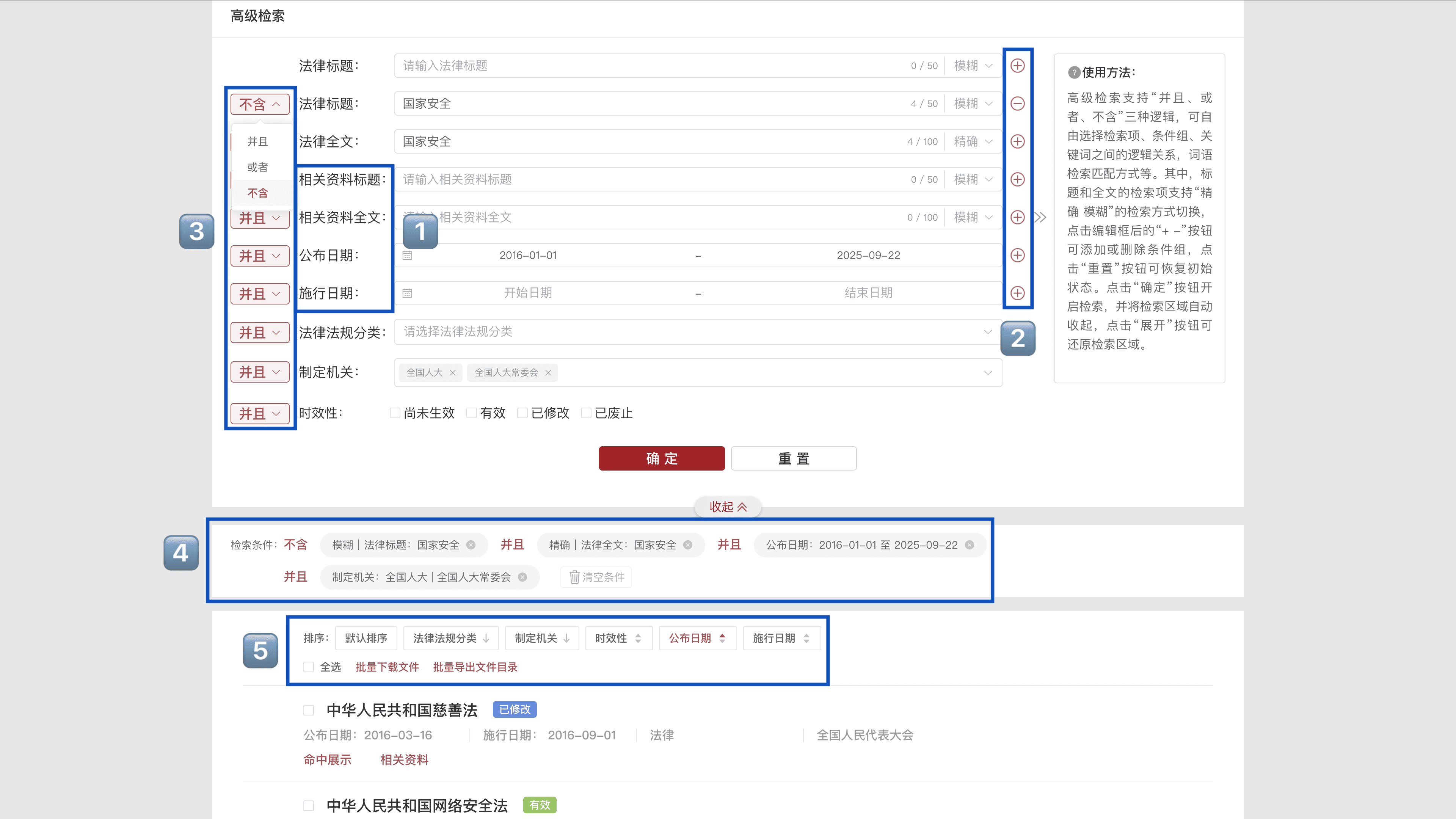
In addition, you can add multiple instances of a criterion (Fig. 4, box 2) and connect them with Boolean operators (“and,” “or,” and “not”) (Fig. 4, box 3)—for example, to search for national laws promulgated since 2016 that contain “国家安全” in the body text but not in the title (Fig. 4, box 4).
The results page for advanced search shares the same features as basic search (Fig. 4, box 5). At present, however, the “export file list” button on this page downloads a Zip file of the documents, not a spreadsheet.
Individual Document Page
Phase II has retained the basic layout of individual documents pages. Each page begins with the document’s basic information: title, effectiveness, category, enacting organs, and dates of promulgation and effectiveness (Fig. 5, box 1). Above the document viewer, which continues to occupy most of the page, are buttons to “download” [下载] the document or to switch between its “WPS version” [WPS版本] and, where available, “original gazette version” [公报原版] (Fig. 5, box 2).

(1) Document viewer. Phase II has added two new functions to the viewer. First, a new button—“目录” (Table of Contents)—displays a structured list of the document’s subdivisions, including individual article numbers (Fig. 5, box 3). Clicking on any entry takes you directly to that section of the document. It could prove especially useful in navigating lengthier statutes, such as the 1,260-article Civil Code. At the moment, this function is available only for the Constitution and national laws and works properly only for the WPS version.
Second, when you select text in the document viewer, an action menu now pops up (Fig. 5, box 4), allowing you to copy, highlight, underline, or strike out the selected text, although the last three functions are not available for every document. And because the Database currently does not allow user accounts, any annotated text disappears once you refresh the page.
(2) Sidebar. On the right is a new sidebar featuring related information. First, you can find a list of “Relevant Materials” (if available), as introduced earlier (Fig. 5, box 5). Clicking on each record opens a similar page that also allows download and annotation.
Second, a list of up to five “Linked Recommendations” [关联推荐] is available for most documents (Fig. 5, box 6). For the Law on the Prevention and Control of Infectious Diseases [传染病防治法], for example, the Database recommends (among others) the State Council’s implementing measures for the Law as well as its regulations on HIV prevention and treatment, schistosomiasis prevention and control, and medical waste management. While these recommendations seem fairly on-point, the algorithm is not always so smart. For the Civil Code, for instance, the Database recommends only five pieces of local legislation—four are county-level separate regulations that lowered the marriage ages for local ethnic minority populations—while omitting the Supreme People’s Court’s arguably more relevant interpretations of the Civil Code.
(3) Revision history. Phase II now allows users to view the different versions of a document and the associated repealing or amending instruments—subject to important limitations. For a document that has been amended or revised, a “Revision Timeline” [历史沿革] now appears above the document viewer (Fig. 5, box 7). Such Timelines are often incomplete, however. Presumably because the Database was initially deployed for testing in 2018, it includes only a document’s latest version as of summer 2018 (sometime between June and August)—excluding any older version. For the Law on the Prevention and Control of Infectious Diseases, therefore, the Timeline shows only its 2013 and 2025 versions, but not the 2004 or 1989 version.
In addition, the Timeline works only for documents with identical titles. So, if an update changed the title of a document (e.g., Licensed Physicians Law → Physicians Law), or if a statute replaced a prior administrative regulation (e.g., Interim Value-Added Tax Regulations → Value-Added Tax Law), the two instruments are not shown in a Timeline.
For documents amended or repealed by “decisions,” the Database now crosslinks to the amending or repealing decision as a “Related Document” [相关文件] in the sidebar of the amended or repealed text. And on the decision’s page, the text(s) amended or repealed are listed in a new section above the document viewer called “View [Amended or Repealed] Laws and Regulations” [查看法律法规] (Fig. 7). In the screenshots below, for example, the 2020 Minors Protection Law [未成年人保护法] links to the NPCSC’s April 2024 decision amending it and two other laws (Fig. 6). The 2024 decision in turn links to the three laws amended.
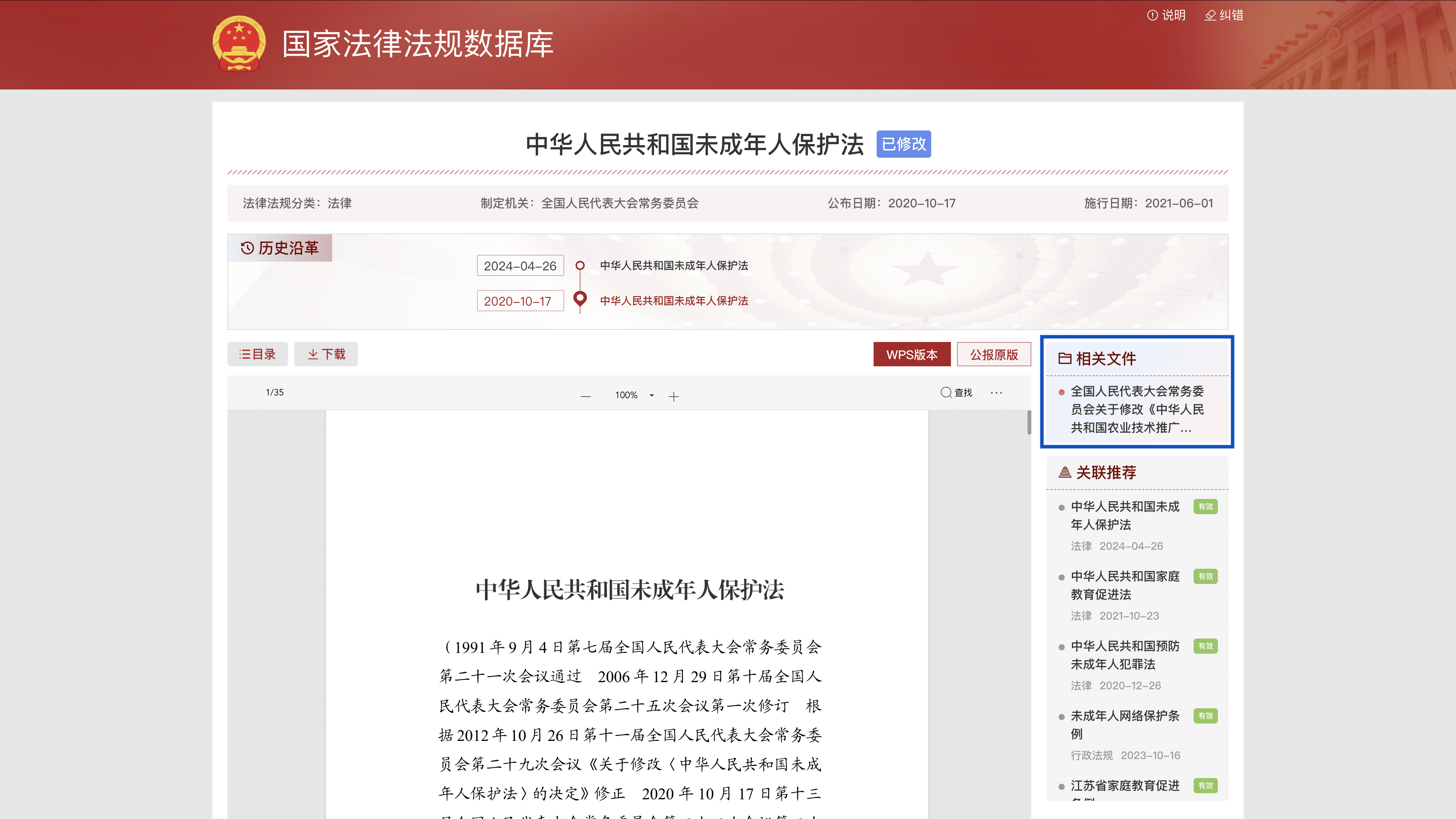
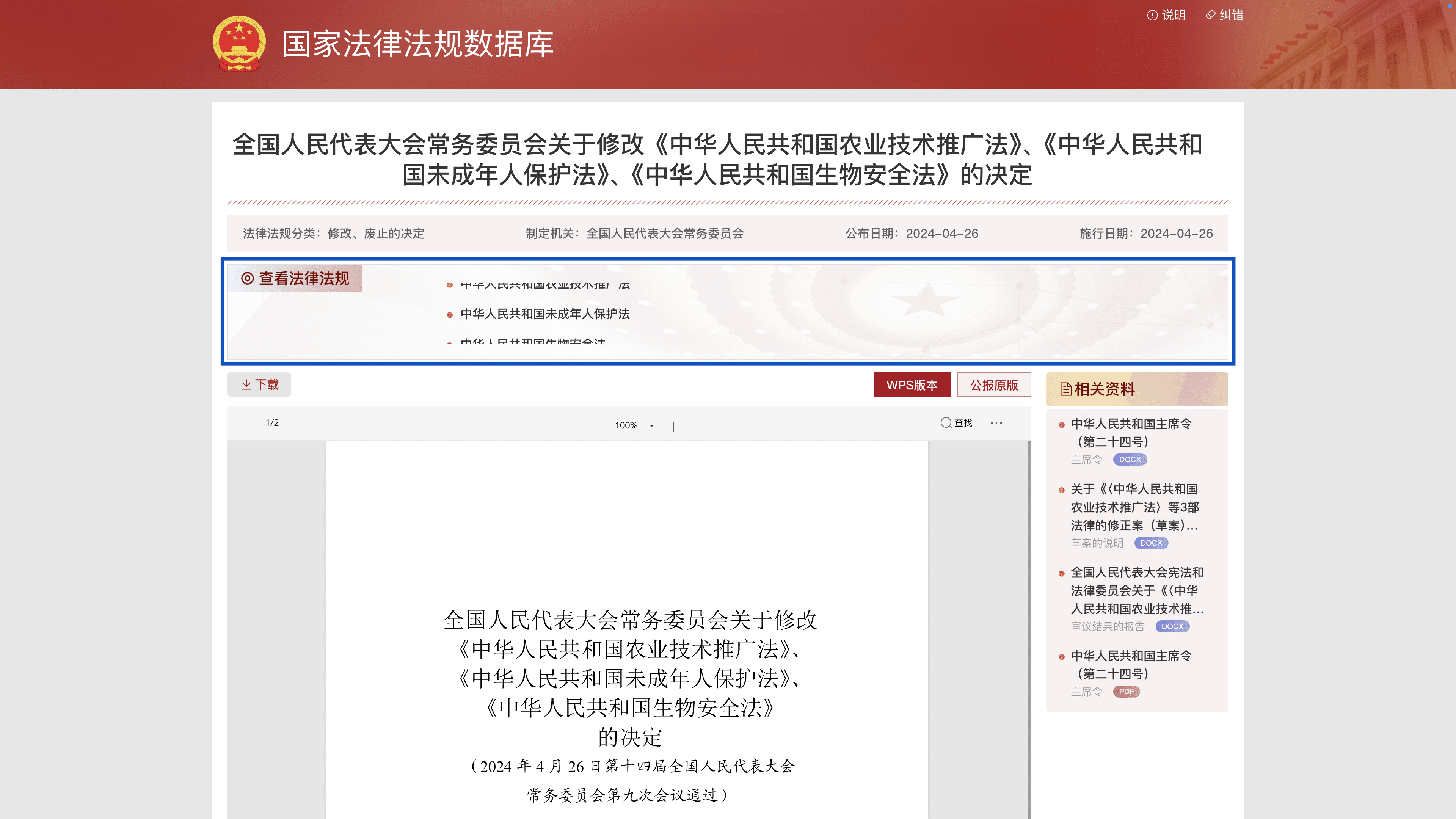
These two sections are not available for documents updated or repealed in other ways—for example, updated through a full revision (which substitutes a new text) or repealed and replaced by a newer document. In these cases, the newer text is instead listed as a “Linked Recommendation” for the amended or repealed document.
Looking Ahead
Unlike when we were writing in early 2021 after the Database’s initial launch, when it should reach its next milestone and what that would look like are much clearer today. The Communist Party’s 2024 Third Plenum called for creating “a unified national information platform for laws, regulations, and other normative documents” [全国统一的法律法规和规范性文件信息平台], with a self-imposed deadline of the PRC’s 80th anniversary in October 2029.
Work toward that goal began well before Phase II. By mid-March 2024, each province had launched its own database of regulations, rules, and normative documents—essentially all generally binding documents issued by public authorities in the province, whether or not they constitute formal legislation.
Now, several NPC components, in cooperation with key enacting organs and technical experts (including the company behind the leading commercial database pkulaw.com), are drafting a trio of standards to support the unified platform. Recent drafts indicate the platform may eventually host not only “rules” and other central normative documents, but also military regulations and rules and the local laws of Hong Kong and Macao. The standards would set formatting and technical requirements for uploaded documents and appear to enable the unified platform to act as a hub, capable of querying and synchronizing content from provincial and category-specific databases. The drafters aim to submit the standards for approval by January 2026.
In the meantime, there are several ways the NPC could further improve Phase II of the Database. First, it is imperative that the current collection be kept reasonably up to date. Under current law, regulations and judicial interpretations must be filed with the NPCSC within 30 days of promulgation. Once filed, they should be added to the Database with minimal delay. Otherwise, the Database’s utility would be seriously diminished.
Second, the authorities should prioritize creating a centralized platform for central non-legislative normative documents, in particular regulatory documents issued by State Council agencies. For better or worse, these documents often have the most direct impact on regulated entities, yet are currently scattered across individual agency websites.
Third, the NPC should expand the Database by adding historical materials—both repealed documents and older versions of existing texts, together with their legislative records—so that Revision Timelines show a document’s full history and “Relevant Materials” become consistently available.
Lastly, we renew two suggestions we offered back in 2021. The Database should link to the official translations of national laws published on the NPC’s English website. And it should be merged with the platform where citizens may request NPCSC review of regulations and judicial interpretations. That platform hosts the same documents as the Database (except for the national legislature’s own enactments), including the relevant legislative records, and offers rudimentary filtering and search. Allowing citizens to directly submit requests on the Database would significantly enhance its utility, increase public awareness of this procedure, and conserve the legislature’s resources.
Now we wait for the Database’s next major release.
With contribution from Chentuo Zhu