
China’s national legislature, the 14th NPC Standing Committee (NPCSC) is holding its seventeenth session from today to Friday, September 12. As we have previewed, it is considering a whopping 16 draft laws, in addition to other agenda items. Today’s official readout of the session’s opening meeting reveals that the NPCSC is reviewing two other bills as well: a draft Law on Promoting Ethnic Unity and Progress [民族团结进步促进法] and a draft revision to the Foreign Trade Law [对外贸易法]. We will take a quick look at these bills below, based on latest state-media reporting. The caveat is that such reports are essentially condensed versions of the bill’s official explanation, which in turn presents a selective summary of the draft itself. Those interested should consult the original texts (of the drafts and their accompanying explanations) when they are released on Friday. Below, we will also provide an update on the other bills under review.
Law on Promoting Ethnic Unity and Progress
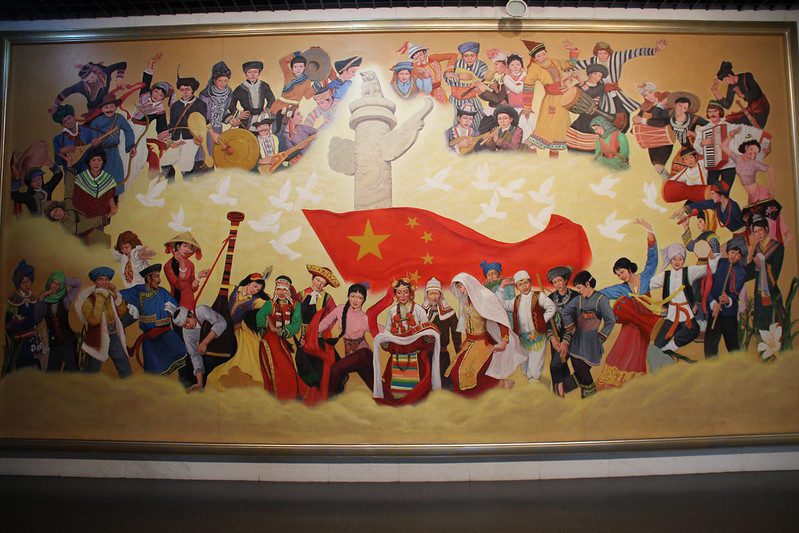
The NPC Ethnic Affairs Committee submitted a draft Law on Promoting Ethnic Unity and Progress [民族团结进步促进法]. Originally a Category II (i.e., lower priority) project in the 14th NPCSC’s five-year legislative plan, it has since been prioritized. Throughout 2024, legislative leaders led high-profile inspection tours across China on the promotion of ethnic unity and progress. In the interim, the 2024 Third Plenum Decision explicitly requires the formulation of this Law to “improve the institutions and mechanisms for forging a strong sense of community for the Chinese nation and further strengthen national cohesion.”
On August 29, the Communist Party took the rare step of disclosing that the Politburo discussed a draft of the Law that day. It was the first such disclosure during Xi Jinping’s tenure and may well be the first in decades: As far as we can tell, the last disclosed case was on January 10, 1988, when the Politburo approved a draft of China’s 1988 state-owned enterprises law. Under more recent practice, the Party typically signs off on important legislation by reviewing the NPCSC Party Group’s reports and requests for instructions at Politburo Standing Committee meetings. The full Politburo’s involvement underscores the importance of this legislation.
(The timing of the Politburo meeting also means that the Law was submitted after the ongoing NPCSC session had been scheduled on August 27, which explains why it was not on the initial agenda.)
Xinhua has published a brief outline of the draft Law. The draft begins with a preamble, followed by seven chapters (with 62 articles). Main substantive chapters are titled “Building a Shared Spiritual Home” [构筑共有精神家园], “Promoting Interaction, Exchange, and Integration” [促进交往交流交融], and “Promoting Common Prosperity and Development” [推动共同繁荣发展]. The report notes that the draft contains both hortatory provisions and binding rules and includes a chapter on liabilities for violations.
We expect the Law to pass after two or three reviews.
Foreign Trade Law Revision
The State Council submitted a draft revision to the Foreign Trade Law [对外贸易法]. This Law was originally enacted in 1994 and last overhauled in 2004. About a year ago, the Ministry of Commerce (MOFCOM) released a draft of the revision for public comment. Among other changes, that draft would codify the “negative list” system for cross-border trade in services that MOFCOM had debuted in March 2024 and authorize a “trade adjustment assistance” program to help businesses adversely affected by sudden changes in international trade.
Based on reporting from the Legal Daily and Xinhua, the latest draft presented to the NPCSC appears to retain the substance of MOFCOM’s original proposals, while introducing a raft of trade countermeasures. For example, the draft would authorize Chinese authorities to prohibit or restrict trade with foreign entities that endanger China’s sovereignty, security, or development interests, and to implement trade restrictions or prohibitions “in other emergency situations in international relations.”
We expect the draft revision to pass after two or three reviews.
According to the readout of the NPCSC’s meeting today, the following bills will pass on Friday as expected:
- draft Atomic Energy Law [原子能法];
- draft Public Health Emergency Response Law [突发公共卫生事件应对法];
- draft National Parks Law [国家公园法];
- draft revision to the Arbitration Law [仲裁法];
- draft Law on Publicity and Education on the Rule of Law [法治宣传教育法]; and
- draft amendment to the Food Safety Law [食品安全法].
It looks like the NPCSC will approve the draft amendment to the Environmental Protection Tax Law [环境保护税法] as well. According to Xinhua, the sole provision in the amendment would simply authorize the State Council to carry out, for five years, pilot projects to levy the tax on additional volatile organic compounds (beyond the 18 currently specified in the Law). It is unlikely the NPCSC would seek public comment and conduct another review.