Constitutional Social Rights vs. Collateral Consequences of Criminal Convictions

On Wednesday, December 25, China’s top legislature, the NPC Standing Committee (NPCSC), heard the annual report by its Legislative Affairs Commission (LAC) on “recording and review” [备案审查]: a process for resolving legislative conflicts that undermine China’s hierarchy of legal norms, including the supremacy of the Constitution. According to the report, private entities submitted a total of 5,682 requests for review in 2024, rebounding from what was hopefully an isolated dip in 2023 (when only 2,827 petitions were filed). This year’s report disclosed ten instances of legislation failing review, several of which merit in-depth coverage. (The rest we will discuss in a future issue of our newsletter.) Here, we will introduce two cases where the LAC—relying in part on constitutional protections for certain social rights—repudiated two types of collateral consequences imposed on individuals with criminal records: ineligibility for public-welfare benefits and employment restrictions.

Continue reading “Constitutional Social Rights vs. Collateral Consequences of Criminal Convictions”
Toward a More Rigorous Mechanism for Resolving Legislative Conflicts: Unpacking China’s Transitional “Mini Law” on the “Recording and Review” Process

The following post was originally published on Verfassungsblog. Thanks to the editors of Verfassungsblog for careful editing and to Zhu Jiawei and Jeremy Daum for helpful conversations about earlier drafts of this post. The citations in this post have been reformatted in accordance with NPC Observer’s style. Additional information that may be helpful to the readers of this site, including the original Chinese of important terms, is included in brackets. Both the original post and this crosspost are published under the Creative Commons BY-SA 4.0 license. Please cite the original version.

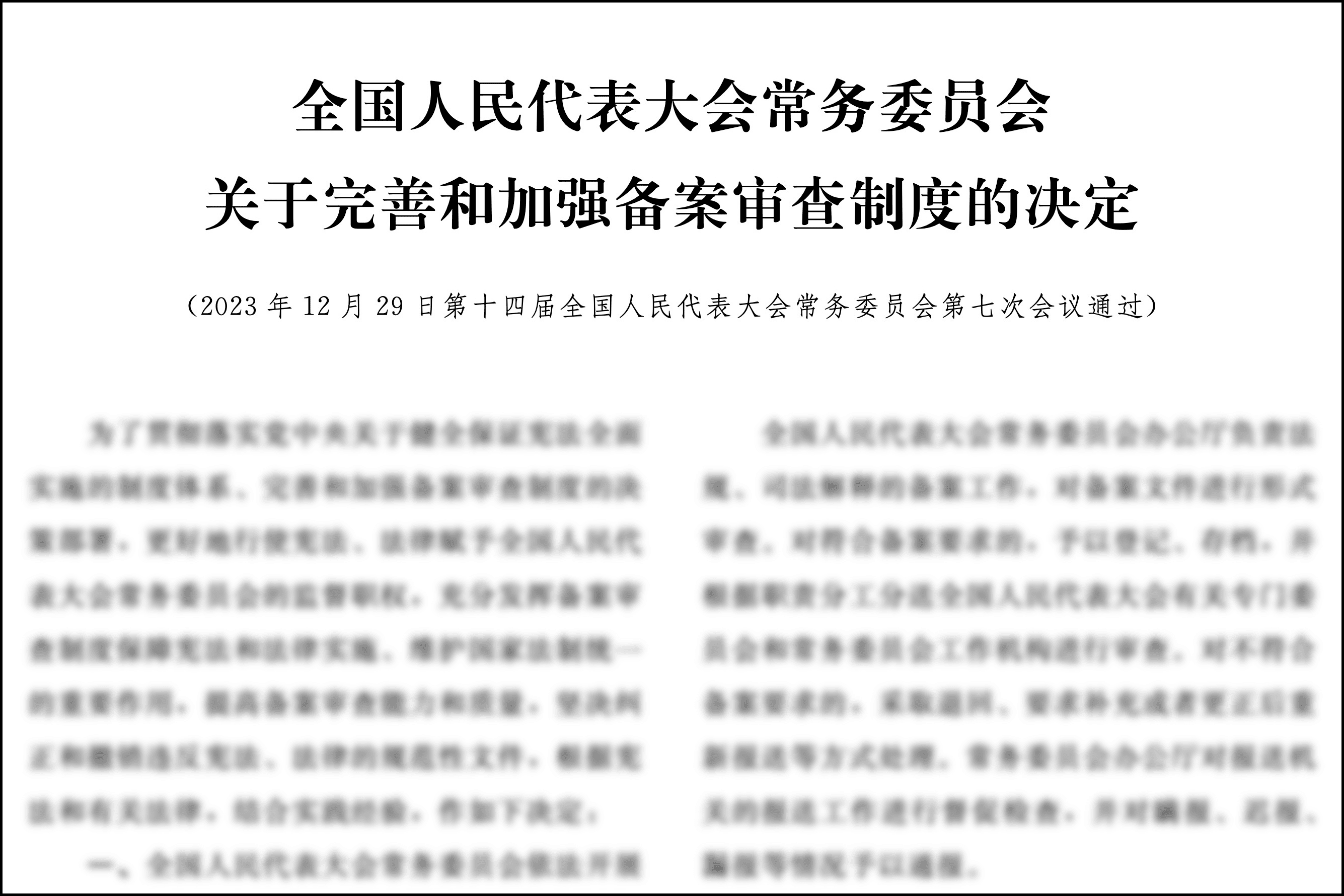
Caption and (blurred) initial paragraphs of the Decision as published in the NPCSC Gazette.

In December 2023, China’s national legislature, the Standing Committee of the National People’s Congress (NPCSC), adopted the Decision on Improving and Strengthening the System of Recording and Review (Decision) [关于完善和加强备案审查制度的决定], a major bill aimed at reforming “recording and review” (R&R) [备案审查]—China’s system of parallel processes for resolving legislative conflicts. Under R&R, an enacting body—that is, a governmental body authorized to issue documents of a legislative nature—must file its legislation with the designated reviewing body for subsequent review. The reviewing body is either a legislative or an administrative organ, as Chinese courts lack the power to review and invalidate legislation. Among all reviewing bodies, the NPCSC is the most powerful, because its jurisdiction extends to all major sub-statutory norms and it alone holds the power of constitutional review. Below, I will use “R&R” to refer just to the NPCSC’s process, as it will be the focus of this post.

Continue reading “Toward a More Rigorous Mechanism for Resolving Legislative Conflicts: Unpacking China’s Transitional “Mini Law” on the “Recording and Review” Process”

China’s Top Legislation-Review Body Halts Local Governments’ Collective Punishment of Telecom Fraudsters’ Families

Telecom fraud is a serious problem in China. During the first ten months of 2023, Chinese authorities indicted over 34,000 individuals for telecom fraud and more than 200,000 for related crimes, including aiding telecom fraud and concealing criminal proceeds, according to the Supreme People’s Procuratorate. In 2022, China’s top legislature, the Standing Committee of the National People’s Congress (NPCSC), passed the Law Against Telecom Network Fraud [反电信网络诈骗法] to bolster efforts to combat telecom fraud. The law, among other things, authorizes severe restrictions on scammers’ access to telecom and financial accounts and tools that are often implicated in fraud activities.

Continue reading “China’s Top Legislation-Review Body Halts Local Governments’ Collective Punishment of Telecom Fraudsters’ Families”

Introducing NPC Observer Monthly

Earlier today, we formally launched our new Substack newsletter, NPC Observer Monthly, a monthly recap of goings-on at the National People’s Congress (NPC) and its Standing Committee (NPCSC)—and sometimes more.

This newsletter drops at the start of each month, starting today. Each issue will, at a minimum, recap all major NPC-related events in the previous month, including any new law that took effect, any new documents released by the legislature, and, of course, any legislative meetings as well as their agendas and outcomes. In the course of recounting the events, we will link to and excerpt from any relevant coverage we have published here. And we will briefly discuss any development that we haven’t yet had the time to analyze in-depth here.

If, during the previous month, we have also published contents not tied to any current event, the newsletter will include a round-up of such publications. Finally, depending on the month and our schedule, we may also end an issue with musings on an NPC-related topic that is in some way connected to the previous month—as we did today (see excerpt below).

Continue reading “Introducing NPC Observer Monthly

Recording & Review: Ensuring Single Women’s Equal Access to Maternity Insurance (Updated)

UPDATE (Nov. 8, 2022): We have posted a full English translation of Prof. Liang’s request for review.

Image by xiongwu from freepick

Maternity insurance [生育保险] is one of the five programs that make up China’s social insurance system. Funded by employer contributions, maternity insurance reimburses women for pregnancy- and childbirth-related medical expenses and offers them a source of income during maternity leave. In all provinces except Guangdong, however, single women have been ineligible for maternity insurance benefits. Local legislation requires claimants to provide their marriage license or some other government-issued document available only to married couples, in effect barring single women from obtaining the benefits. In a legal battle that spanned four years, Zou Xiaoqi, a single mother from Shanghai, repeatedly challenged the city’s discriminatory policy in court but ultimately to no avail. (In late 2020, Shanghai suddenly dropped the marriage requirement, but reversed course just a few months later.)

Continue reading “Recording & Review: Ensuring Single Women’s Equal Access to Maternity Insurance (Updated)”

Recording & Review: Invalidating Compulsory Parentage Testing as a Tool to Enforce Birth Quotas

From 1980 to 2021, China imposed some form of enforceable birth quota on most of its population. A one-child policy had been implemented until late 2013, when it was partially relaxed so that couples may have two children if one parent was an only child. Then in 2016, the modified one-child policy was replaced by a two-child policy, which was in turn superseded by a three-child policy in May 2021. Although a formal birth quota remains after the latest policy change, a statutory amendment in August eliminated all the penalties that once attached to violations of the quota, such as hefty fines and terminations of employment. In effect, couples who exceed the three-child limit will not be penalized, though they will be ineligible for benefits such as extended maternity leave.

Continue reading “Recording & Review: Invalidating Compulsory Parentage Testing as a Tool to Enforce Birth Quotas”

Recording & Review: Removing the Vestiges of the One-Child Policy

China’s former one-child policy was “one of the most draconian examples of government social engineering ever seen.”1 The policy was formally launched nationwide in 1980. In just a few years, however, central authorities decided to “open small holes” by allowing more couples to have a second child, after encountering difficulties in enforcing a uniform birth-control policy nationwide and a backlash against abusive enforcement measures, such as forced sterilizations.2

The provinces were tasked with implementing that partial relaxation of the one-child policy. All provincial legislatures (except those of Xinjiang and Tibet) had adopted provincial birth-control legislation by the early 1990s.3 (Xinjiang eventually did so in 2002; Tibet still has not acted.) Such legislation translates the policy into concrete terms, specifying, among other things, exceptions to the one-child-per-couple rule4 and the penalties for above-quota births. Couples who exceed birth limits would face not only hefty fines called “social upbringing fees” [社会抚养费], but also discipline at work—including mandatory termination in a number of provinces.

Continue reading “Recording & Review: Removing the Vestiges of the One-Child Policy”

Recording & Review Pt. 8: “Same Life, Different Values”

Editor’s Note: In April 2022, the Supreme People’s Court amended the 2003 Interpretation to treat all victims in personal injury cases as urban residents, thereby eliminating the residency-based compensation standards discussed in this post.

Written by Dongyu Sun. Edited by Susan Finder and Changhao Wei.
This post also appears on the Supreme People’s Court Monitor.

Photo by ImagineChina, via Bloomberg News.

On December 15, 2005, a loaded truck rolled over on a mountain road in Chongqing, crushing a trishaw carrying He Yuan and her two friends to school. All three perished in the accident. What thrust this tragedy into the national spotlight, however, was the drastically different amounts of compensation their families received. The trucker’s employer settled with the families of Yuan’s friends for over 200,000 RMB each, but was willing to pay hers only 80,000 RMB—because she, unlike her classmates, had a rural hukou (or household registration).1 The company cited a 2003 Supreme People’s Court (SPC) interpretation on the application of law in personal injury cases (2003 Interpretation), which created two separate standards for compensating the deaths of urban and rural residents.

As a result of this effectively hukou-based rule, countless victims’ families have found themselves in the same position as Yuan’s. The Chinese public has dubbed this phenomenon “same life, different values” [同命不同价] and has persistently criticized the 2003 Interpretation. Some citizens have requested that the NPC Standing Committee (NPCSC) conduct a constitutional review of the Interpretation.

It was not until 2020 that the NPCSC’s Legislative Affairs Commission publicly addressed these requests in its annual report on “recording and review” (R&R) [备案审查]. This report’s timing and content are significant. Below, we will first take a closer look at the 2003 Interpretation and the controversy surrounding hukou-based compensation standards, before returning to the Commission’s report.

Continue reading “Recording & Review Pt. 8: “Same Life, Different Values””

Recording & Review Pt. 7: Constitutionally Mandated Mandarin-Medium Education

Photo by Xu Qin (Zuma Press), via WSJ

On Wednesday, January 20, the NPC Standing Committee (NPCSC) heard its Legislative Affairs Commission’s annual report on its efforts in 2020 to record and review the validity of various types of sub-statutory documents, including local regulations and judicial interpretations. In sum, a document will fail review if the Commission deems it (1) unconstitutional; (2) contrary to the Communist Party’s major policies; (3) unlawful; or (4) otherwise “clearly inappropriate.” The Commission will then ask the document’s enacting body to amend or repeal it. This year’s report is particularly notable in that it devotes a full section to discussing how the Commission “proactively and prudently” dealt with constitutional issues in the recording-and-review process. This section mentions three cases, and below, we will focus on one of them, which concerns the language of instruction used by China’s ethnic schools.

Continue reading “Recording & Review Pt. 7: Constitutionally Mandated Mandarin-Medium Education”

Recording & Review: A Reintroduction

Editor’s Note (Jan. 1, 2024): On December 29, 2023, the NPCSC adopted the Decision on Improving and Strengthening the System of Recording and Review, which we analyzed here. We have yet to update this post in accordance with this new authority.

Editor’s Note (Sept. 30, 2021): We updated this post in accordance with our translation of the Working Measures for the Recording and Review of Regulations and Judicial Interpretations.

In early 2018, we first gave a detailed introduction to “recording and review” (R&R) [备案审查], an increasingly notable aspect of the oversight by the NPC Standing Committee (NPCSC). For our purposes here, and generally speaking, R&R is a process whereby various governmental bodies with lawmaking authority record their enactments with the NPCSC, which may then review the recorded legislation on certain grounds and order corrections if the legislation does not pass muster.[1] R&R has led to some positive developments in Chinese law since our initial introduction. A few months ago, for instance, it led to the NPCSC’s abolition of “custody and education” [收容教育]—a decades-old extrajudicial detention system targeting prostitution.

The biggest update to the R&R scheme since its inception came last December. That month, the Council of Chairpersons approved the Working Measures for the Recording and Review of Regulations and Judicial Interpretations (Measures) [法规、司法解释备案审查工作办法], which were then quietly released in the NPCSC Gazette’s March issue. This is a noteworthy piece of authority: not only does it supplement the two main governing statutes—the Legislation Law [立法法] and the Law on Oversight by the Standing Committees of the People’s Congresses at All Levels (Oversight Law) [各级人民代表大会常务委员会监督法]—by filling in the procedural gaps, but more importantly, it elaborates on the existing grounds for review and also introduces brand-new ones. We thus would like to take this opportunity to reintroduce the NPCSC’s R&R practice, as now undertaken under these new rules. All citations below are to the Measures unless otherwise indicated.

Continue reading “Recording & Review: A Reintroduction”