

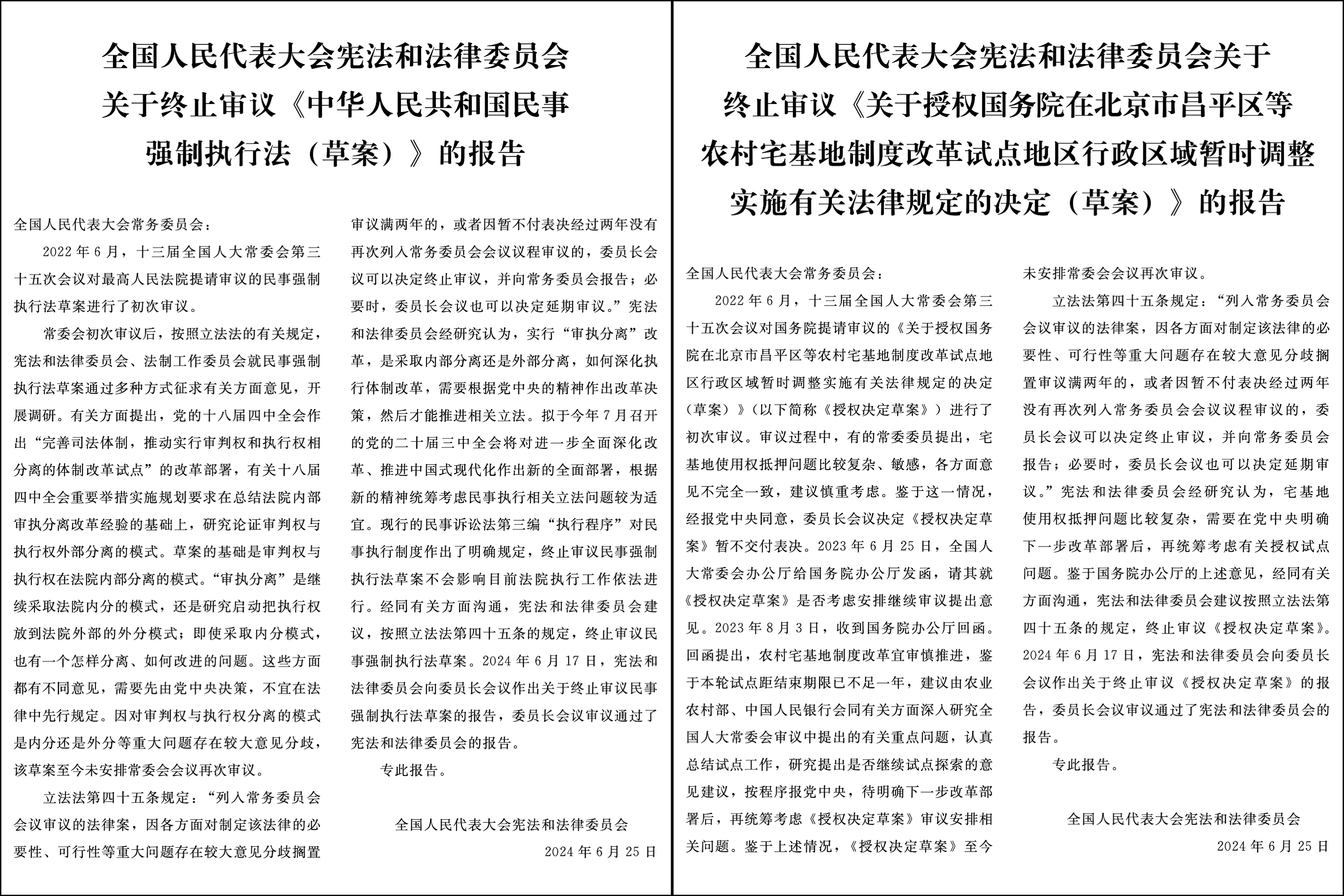
It is rare for a bill to “die” in the Chinese legislature. It is rarer for two bills introduced at the same time to later meet that fate together. Recently, the NPC Standing Committee (NPCSC) disclosed in its official publication, the NPCSC Gazette, that it decided to “terminate deliberations” [终止审议] on two bills that it reviewed in June 2022: a draft Compulsory Civil Enforcement Law [民事强制执行法] and a draft decision authorizing to the State Council to pilot certain reforms of rural residential land. In other words, the two bills in their current form have been shelved indefinitely. This post recounts the history of the deliberation-termination procedure and discusses the two bills at issue.
Bill-Shelving Procedure: History and Practice
Bills that remain pending at the end of an NPC’s term do not automatically expire. What happens, then, to a bill that languishes on the legislative docket for years without further review? For decades, Chinese law failed to provide a clear answer to that question. But as legislative activity picked up after the Cultural Revolution, occasionally a poorly crafted bill would come before the legislature for review, and only then would it become apparent that the legislation was unnecessary or unripe. Or a bill would include provisions that provoked major disagreement among stakeholders, thereby stalling the legislative process. Such was the case with the NPCSC’s initial attempt to legislate on state honors in 1993, where the propriety of posthumous state honors sharply divided lawmakers. That bill never went through a second review, in part because the legislature was not sure whether it could after years of inaction.1
In 2000, the Legislation Law [立法法] finally provided a process for dealing with bills stuck in legislative limbo. The relevant provision (which has been amended, as noted below) stated:
Where the deliberation of a legislative bill that has been placed on the agenda of a Standing Committee session has been deferred for two years because the various parties have large differences of opinion on major issues such as the necessity or feasibility of formulating this law, or where such a bill has not been placed on the agenda of a Standing Committee session for deliberation for two years because a vote on it was temporarily postponed, the Council of Chairpersons is to report to the Standing Committee that the deliberation of the legislative bill is to end.
列入常务委员会会议审议的法律案,因各方面对制定该法律的必要性、可行性等重大问题存在较大意见分歧搁置审议满两年的,或者因暂不付表决经过两年没有再次列入常务委员会会议议程审议的,由委员长会议向常务委员会报告,该法律案终止审议。
This process was understood to be mandatory. That is, a bill “dies” if it hits the two-year mark of inaction, unless the legislature conducts another review to reset the clock. By our count, four2 bills have expired under this process (excluding the two disclosed last week):
- Draft Law on High-Tech Industrial Development Zones [高新技术产业开发区法]: It was reviewed twice in December 1997 and June 1999, and declared dead in August 2002 due to “major disagreement” among the relevant parties.
- Draft Decision on Improving the People’s Assessor System [关于完善人民陪审员制度的决定]: It was reviewed in October 2000 and declared dead in December 2002 also due to disagreement among stakeholders. A new version of the bill was introduced in April 2004 and passed in August of that year.
- Draft amendment to the Land Management Law [土地管理法]: It was reviewed in December 2012 and expired two years later, reportedly as a result of disagreement over the bill’s provisions on rural-land expropriation. A new version of the bill was submitted in December 2018 and passed in August 2019.
- Draft amendment to the Special Equipment Safety Law [特种设备安全法]: First reviewed in April 2015, it was shelved in April 2017. The bill would abolish the occupational license required for inspecting or testing “special equipment” (e.g., elevators), a proposal that faced strong objections in the NPCSC.
In 2023, the NPC amended the Legislation Law to relax the mandatory expiration rule. The Council of Chairpersons can now choose to keep a bill “alive” after two years of inaction “when necessary.” As we have surmised:
The tortuous process several years ago to overhaul the Securities Law [证券法] might have prompted this change. That bill was first reviewed in April 2015 and would introduce a registration-based system for initial public offerings (IPOs). Just two months later, China’s stock market crashed, putting the revision process on hold. In December 2015, the NPCSC separately authorized a pilot of the IPO registration system. By April 2017, the pilot was still underway and the conditions for resuming the legislative process were still absent, but the two-year rule forced the NPCSC to take up the bill again, despite major disagreements among lawmakers. Under the [amended Legislation Law], the NPCSC will not have to conduct such a review just to reset the clock and can thereby conserve legislative resources.
The two bills disclosed last week are the first two to expire under the more flexible termination rule.
Draft Compulsory Civil Enforcement Law
The Compulsory Civil Enforcement Law originates from the Communist Party’s 2014 Fourth Plenum. That meeting decided to “effectively resolve difficulties in enforcing [court judgments], enact a law on compulsory enforcement, and standardize judicial procedures for sealing, seizing, freezing, and disposing of property involved in cases”—with an eye to “ensuring that successful litigants can promptly realize their rights and interests.” The Supreme People’s Court (SPC) began drafting the law in 2018 and completed the process four years later.
After the bill’s initial review in June 2022, some stakeholders pointed out that it implicated another reform initiative in the 2014 Fourth Plenum Decision: experimenting with “separating adjudicatory and enforcement powers” [审判权和执行权相分离]. This may be achieved by either (1) separating the two powers within a court, or (2) separating the enforcement power from the courts and vesting it in some other body. Even under the first model, there are questions about how to separate the powers within a court, according to those stakeholders. In their view, the Party leadership must decide all those issues, so it was premature for the SPC to premise its draft on the first model of separation.
Given this criticism, the NPC Constitution and Law Committee in June recommended shelving the bill. The Committee also hinted that the Party would provide further guidance on the relevant issues at the Third Plenum in July. And indeed it did: the Plenum vowed to “deepen the reforms to separate adjudicatory and enforcement powers” within the next five years. Presumably, the Party has opted for the second model, for otherwise it would have been unnecessary to scrap the whole bill.
In any event, it seems to us that legislation on enforcing court judgments will eventually return to the NPC, although that is likely many years away.
Draft Rural Land Reform Authorization
The other shelved bill also concerned an issue that has long appeared on the Party’s reform agenda: improving the system of “rural house sites” [农村宅基地]—which, in brief, are plots of collectively owned land that are allocated to eligible rural households to build their homes. To allow rural residents to fully tap into the value of their houses, the Party’s 2013 Third Plenum ordered pilot projects to permit “mortgaging . . . the property rights in rural residential housing [农民住房财产权],” which include the right to use house sites [宅基地使用权]. This practice is otherwise prohibited by national law.
In December 2015, the NPCSC approved the State Council’s request to suspend the relevant statutory provisions and allow rural residents in selected localities across China to obtain loans secured by “property rights in rural residential housing.” The pilots ran for three years, ending on January 1, 2019. Days before the pilots would end, however, the State Council reported major difficulties in carrying them out, so it proposed letting the pilots expire without changing the law. It disclosed that the reform to allow mortgages on rural residential housing would be included in a broader program to improve the house-site system, the details of which had not been finalized at that point.
Eventually, in June 2020, the central leadership approved a reform package for rural house sites (the document’s full text has not been made public). A new round of pilot projects soon began in 107 localities. A few months later, the State Council came back before the NPCSC in June 2022, requesting the same authorization that was granted in 2015: to allow mortgages on rural residential housing in those localities.
This time, however, the pilot project was doomed from the start. When considering the requested authorization, some lawmakers recommended proceeding with caution on the grounds that the mortgage issue was “relatively complex and sensitive” and had not garnered a consensus. For this reason, and with the Party’s approval, the NPCSC did not vote on the request. In August 2023, when asked whether the NPCSC should take up the bill again, the State Council responded that, given the new round of house-site reform pilots was set to conclude in April 2024, consideration of the bill should be deferred until after the relevant ministries have had time to reflect on the pilots, formulate a recommendation on whether to renew them, and report it to the central leadership for a decision.
By June 2024, that decisionmaking process was likely still ongoing. The NPC Constitution and Law Committee therefore recommended shelving the State Council’s request, citing the complexity of the proposed reform and the need for further instructions from the Party.
While general house-site reforms are still on the Party’s agenda, the 2024 Third Plenum did not specifically address the issue of mortgaging rural residential housing, leading to doubts about the future of this reform. What happens next we shall wait and see.
- See 全国人大常委会法制工作委员国家法室 [Off. for State L., Legis. Affs. Comm’n, NPC Standing Comm.], 中华人民共和国立法法释义 [Annotations of the PRC Legislation Law] 148 (2015). ↩︎
- In August 2023, the NPCSC also decided to terminate its review of an amendment to the Administrative Litigation Law [行政诉讼法] that was submitted in December 2022, not because two years had elapsed, however, but because the Supreme People’s Court decided to withdraw the bill. ↩︎
Comments & Pingbacks
Comments are closed.