
NPC 2023: Amendments to China’s “Statutory Constitution” of Lawmaking

Editor’s Note (Mar. 16, 2023): We have updated this post in accordance with the final text of the amendments adopted on March 13. The original version of this post is archived here.

For the ninth year in a row, China’s National People’s Congress (NPC) considered and adopted legislation at its annual session earlier this month. This year’s bill was amendments to the Legislation Law [立法法] (Bill), previously reviewed in October and December 2022. The Legislation Law is an important statute with semi-constitutional status. It serves three principal purposes: it demarcates the legislative authority of various state institutions; regulates (to varying extents) their legislative procedures; and prescribes a hierarchy of legal norms, along with the attendant mechanism to enforce that hierarchy, called “recording and review” [备案审查].

The Bill has made an array of amendments to provisions in all three areas. In this post, we will offer a relatively thorough discussion of the Bill, proceeding in the order of legislative authority, procedure, and hierarchy. In each section below, we will discuss more important amendments in the order they appear in the Bill, and briefly summarize minor ones at the end of the section. We will not mention amendments that simply repeat the provisions of other laws. All in-line citations are to the Legislation Law as amended by the Bill.

Continue reading “NPC 2023: Amendments to China’s “Statutory Constitution” of Lawmaking”
NPC Calendar: March 2023

This post was updated on April 18, 2023. The original version is archived here.

The revised Animal Husbandry Law [畜牧法] (adopted on Oct. 30, 2022) and the Reservists Law [预备役人员法] (adopted on Dec. 30, 2022) took effect on March 1.

The 14th National People’s Congress (NPC) held its inaugural session from March 5 to 13. It approved the State Council Institutional Reform Plan [国务院机构改革方案] on March 10, and the following documents on March 13:

  • an amendment to the Legislation Law [立法法];
  • annual work reports of the State Council, the NPC Standing Committee (NPCSC), the Supreme People’s Court (SPC), and the Supreme People’s Procuratorate (SPP);
  • the 2023 National Economic and Social Development Plan and accompanying Ministry of Finance report; and
  • the 2023 Central Budget and accompanying National Reform and Development Commission report.

In addition, the NPC adopted a decision to establish the 14th NPC’s special committees on March 5, and voted to fill the following state positions throughout the session:

  • March 5: chairpersons, vice-chairpersons, and members of the 14th NPC Constitution and Law Committee and the 14th NPC Financial and Economic Affairs Committee.
  • March 10: PRC president and vice-president; chairperson of the Central Military Commission (CMC); and chairperson, vice-chairpersons, and secretary-general of the 14th NPCSC.
  • March 11: premier of the State Council; vice-chairpersons and members of the CMC; chairperson of the State Supervision Commission; president of the SPC; procurator-general of the SPP; and rank-and-file members of the 14th NPCSC.
  • March 12: vice-premiers, state councilors, departmental heads, and secretary-general of the State Council; and chairpersons, vice-chairpersons, and members of the other NPC special committees.

For the full texts of aforementioned documents (including any English translation), outcomes of the votes (if available), and our related coverage, please see this page.

On March 14, the 14th NPCSC held its first session, at which it appointed five deputy secretaries-general.

The amendment to the Legislation Law (adopted on Mar. 13) took effect on March 15.

(Still) Mostly Han Men: Demographics of the 14th NPC

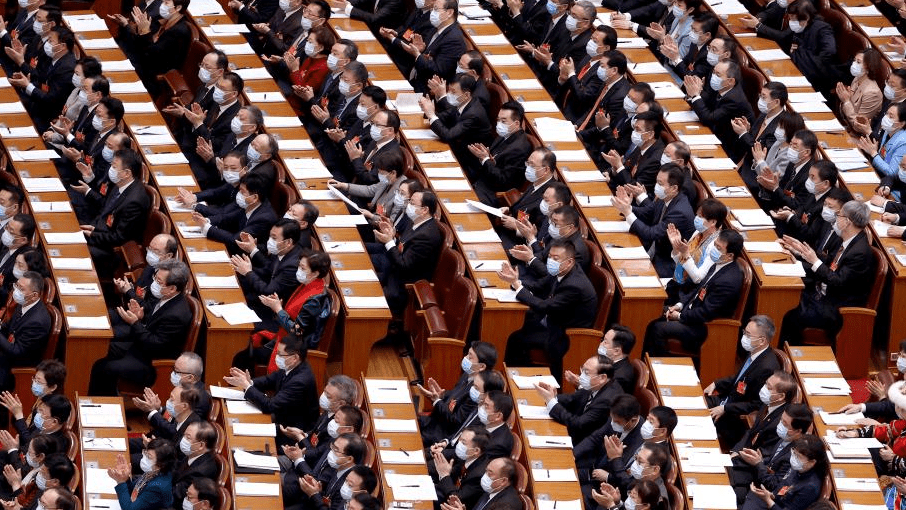
Delegates clapping at the 2022 NPC session. Photo by CGTN.

On Friday, February 24, the 13th NPC Standing Committee (NPCSC) concluded its final session, thus effectively bringing the 13th NPC’s five-year term to a close. As one of its last official acts, the outgoing NPCSC certified the elections of 2,977 delegates to the 14th NPC, which will first convene on March 5. In a rare move, the NPCSC Delegate Credentials Committee disqualified three delegates-elect (from Hebei, Guangdong, and Chongqing, respectively)[*] because they “lack the basic statutory requirements” for being a delegate, without further elaborating.

Continue reading “(Still) Mostly Han Men: Demographics of the 14th NPC”

2022 Legal Inquiry Response: Localities Lack Legislative Authority over Personal Bankruptcy—Except Shenzhen?

On January 28, 2023, the Legislative Affairs Commission (LAC) of the NPC Standing Committee (NPCSC) released one of the “legal inquiry responses” [法律询问答复] it had issued during the past year. As discussed in depth here, such responses clarify the applicable law in real-world scenarios at the request of central governmental bodies or provincial legislatures. They are not universally binding, but are considered highly persuasive—hence a form of “soft law”—because of the LAC’s pivotal role in lawmaking.

The sole response released on Saturday concerns the division of legislative powers between central and local authorities. In May 2022, an unnamed provincial legislature1 wrote to the LAC that the minors protection legislation it was reviewing would touch on (1) guardianship of minors, and that it was also mulling legislation on (2) intellectual property protections for porcelain and (3) personal bankruptcy. May it legislate on those matters, it asked, or are they within the national legislature’s exclusive purview?

Continue reading “2022 Legal Inquiry Response: Localities Lack Legislative Authority over Personal Bankruptcy—Except Shenzhen?”